
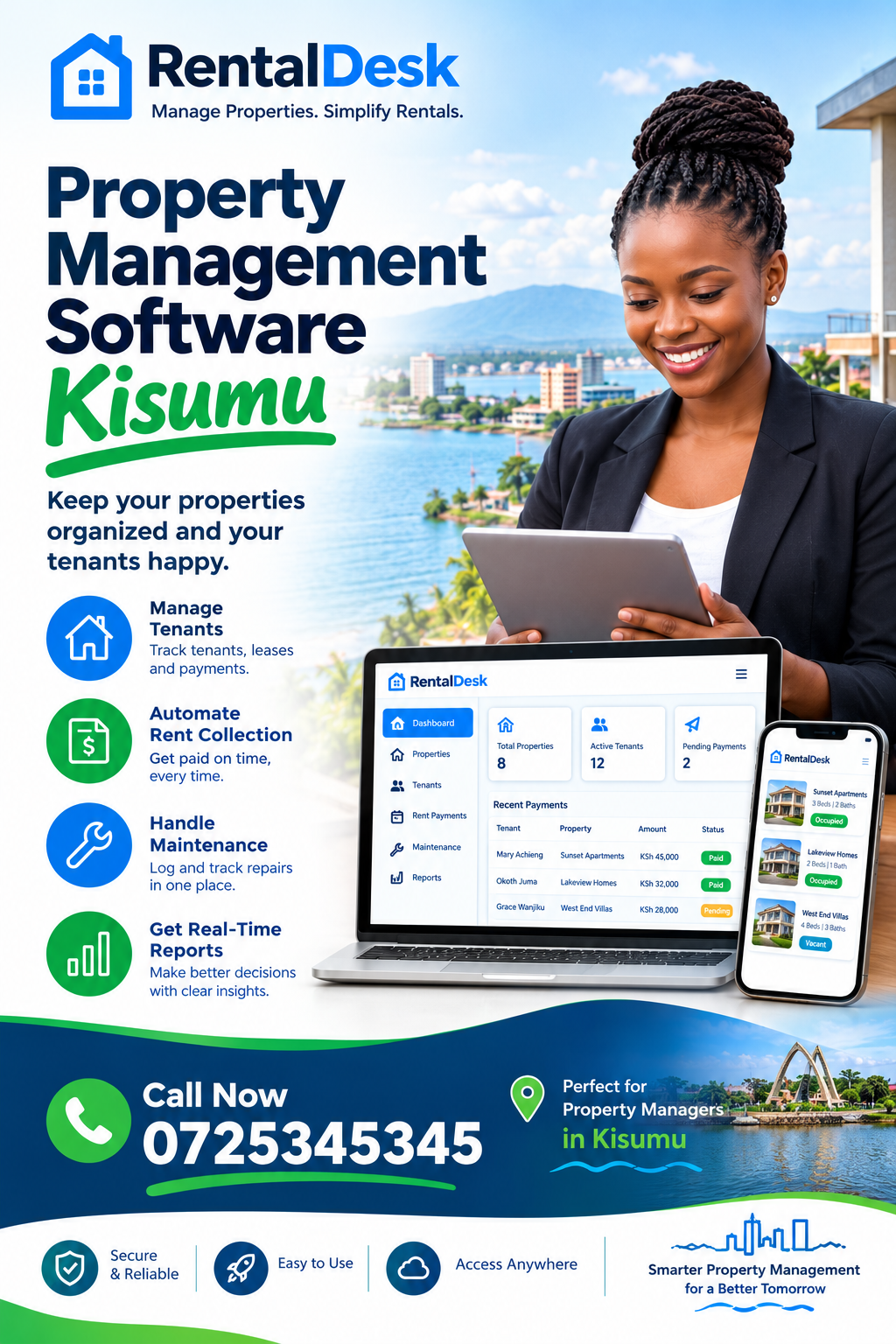
SEO TITLE:
Property Management Software Kisumu: A Complete Guide for Landlords and Property Managers
META DESCRIPTION:
Property Management Software Kisumu helps landlords manage tenants, rent, arrears, vacancies and property records efficiently. Learn how to choose the right system.
URL SLUG:
property-management-software-kisumu
PRIMARY KEYWORD:
Property Management Software Kisumu
WORD COUNT:
Approximately 4,300 words
KEYWORD COUNT:
60 exact-match occurrences in the article body
Table of Contents
ToggleARTICLE
Property Management Software Kisumu: A Complete Guide for Landlords and Property Managers
Managing rental property requires much more than collecting rent. A landlord or property manager has to keep track of tenants, units, leases, rent charges, payments, arrears, maintenance requests, vacancies and expenses. For landlords operating apartments, rental houses, commercial buildings or mixed-use properties in Kisumu, Property Management Software Kisumu can provide a structured way to organize these responsibilities. This guide explains how rental management software works, the features to consider, how it can support rent collection and tenant management, and what landlords should evaluate before choosing a system.
What Is Property Management Software?
Property Management Software Kisumu is software designed to help landlords and property managers organize the information and daily activities associated with rental properties.
Instead of keeping tenant details in one spreadsheet, payment information in another file, maintenance requests in WhatsApp messages and receipts in physical folders, a property management platform can bring important information into one centralized system.
Depending on the provider, the software may help users manage:
- Properties
- Individual rental units
- Tenants
- Lease information
- Rent charges
- Invoices
- Payments
- Arrears
- Maintenance requests
- Vacancies
- Property expenses
- Reports
- User accounts
The purpose is not simply to digitize paperwork. The bigger objective is to make rental operations easier to monitor and control.
For a landlord with a few units, manual records may appear manageable. As the portfolio grows, however, the amount of information increases quickly. A manager handling 50, 100 or several hundred units has many more transactions and tenant interactions to monitor.
That is where Property Management Software Kisumu can become useful.
Why Rental Property Management in Kisumu Requires Organization
Kisumu has a broad rental market covering apartments, family homes, bedsitters, student accommodation, commercial premises and larger residential developments.
Property owners may operate in areas such as Milimani, Mamboleo, Manyatta, Kondele, Nyalenda, Riat Hills and other neighborhoods across the city and surrounding areas.
Each property can have different characteristics.
One building might have 20 apartments with identical monthly rents. Another may contain several unit types with different prices. A property manager may also manage commercial spaces where leases, billing and payment arrangements differ from residential units.
Property Management Software Kisumu helps address this complexity by giving the manager a structured digital record of the portfolio.
A well-organized system can make it easier to answer questions such as:
- How many units are occupied?
- Which units are vacant?
- How much rent was expected this month?
- How much has actually been collected?
- Which tenants have outstanding balances?
- Which properties have maintenance issues?
- How much income has each property generated?
- Which tenants have active leases?
- Which payments have already been recorded?
When this information is available from one system, daily management becomes more predictable.
The Problems Caused by Manual Rental Records
Many landlords begin with notebooks, spreadsheets and mobile-phone messages. These tools can be useful, particularly for a small portfolio.
The problem appears when the number of records increases.
A spreadsheet may contain tenant names and rent amounts, while payment confirmations remain in a mobile-money account. Maintenance requests may be communicated through calls or WhatsApp, and invoices may be stored separately.
Property Management Software Kisumu can reduce the fragmentation created by these separate records by organizing property information in one place.
Tenant information becomes difficult to maintain
A landlord may have dozens of tenant records containing names, telephone numbers, unit numbers and payment histories.
If information is updated in one location but not another, inconsistencies can develop.
Rent reconciliation becomes time-consuming
A property manager must determine whether each tenant has paid the correct amount.
This becomes difficult when tenants make partial payments or pay at different times.
Arrears may not be visible
Without a dedicated arrears report, landlords may depend on memory or manual calculations to determine which tenants still owe money.
Reports take longer to prepare
Owners often want monthly summaries showing income, outstanding rent and occupancy.
Preparing such reports manually can take considerable time.
How Property and Unit Management Works
One of the foundations of Property Management Software Kisumu is property and unit management.
A property management system should allow the user to create a property and then organize the individual units within that property.
For example, a landlord might create:
Property: Mamboleo Apartments
Units:
- A01
- A02
- A03
- A04
- B01
- B02
- B03
- B04
Each unit can then be associated with information such as its rent amount, occupancy status and current tenant.
This structure is much more useful than maintaining a simple list of names.
A property manager can understand where a tenant is located and which property generates a particular payment.
Property Management Software Kisumu can therefore provide the foundation for managing multiple buildings without mixing their records.
Tenant Management
Tenants are at the center of rental operations.
A tenant management feature should make it possible to store and retrieve important information quickly.
A typical tenant profile may include:
- Full name
- Phone number
- Email address
- Identification information
- Property
- Unit
- Rent amount
- Lease dates
- Payment history
- Outstanding balance
With Property Management Software Kisumu, the manager can have a structured approach to tenant records rather than relying on several disconnected documents.
This is especially useful when tenants contact the property manager with questions about their account.
For example, a tenant might ask why their balance shows an outstanding amount.
The manager can look at the account, review the charges and payments and explain the balance based on the available records.
This creates a clearer communication process.
Rent Collection and Payment Tracking
Rent collection is one of the most important functions of rental management.
A landlord needs to know not only whether money has been received, but also which tenant made the payment, which unit the payment belongs to and whether the tenant still has an outstanding balance.
Property Management Software Kisumu can help organize these records where the platform provides appropriate billing and payment features.
For example, suppose a property has 40 tenants and every tenant owes monthly rent.
The manager needs to know:
- The total amount expected.
- The amount already collected.
- The tenants who have paid.
- The tenants who have paid partially.
- The tenants who have not paid.
- The outstanding amount.
A structured payment system can make these questions easier to answer.
M-Pesa and Rental Payments in Kenya
Mobile money is an important part of Kenya’s payment environment, including rental transactions.
Safaricom provides M-PESA services for businesses and has also published rental-focused payment solutions involving invoicing, collections, reminders and e-receipting.
For landlords, the important consideration is how payments are connected to tenant records.
Property Management Software Kisumu can be useful when rental payment information is organized against the correct tenant and unit.
A good payment workflow should reduce confusion around:
- Payment references
- Tenant identification
- Partial payments
- Multiple payments
- Outstanding balances
- Payment dates
- Receipts
The landlord should also be able to verify transactions using the relevant financial records.
Software should improve organization, but landlords should still maintain appropriate financial controls and reconciliation procedures.
Rent Arrears Management
Rent arrears can affect cash flow and create administrative pressure for landlords.
A tenant who misses one payment may become significantly behind if the account is not monitored.
Property Management Software Kisumu can help make outstanding balances more visible when arrears functionality is available.
A useful arrears report might contain:
| Item | Purpose |
|---|---|
| Tenant | Identifies the account |
| Property | Shows where the tenant is located |
| Unit | Identifies the rental space |
| Expected rent | Shows the amount due |
| Amount paid | Shows actual collections |
| Balance | Shows outstanding rent |
| Payment date | Helps with reconciliation |
This information can help the manager prioritize follow-up.
Partial payments
Partial payments are particularly important.
For example, if rent due is KES 20,000 and a tenant pays KES 12,000, the tenant should not simply be marked as fully paid.
The account should reflect the remaining KES 8,000.
Accurate balances are important for both the landlord and tenant.
Invoicing and Tenant Statements
A clear invoice gives the tenant useful information about what they are expected to pay.
Property Management Software Kisumu may support rental billing and invoicing depending on the platform and subscription selected.
A rental invoice can include:
- Tenant name
- Property
- Unit
- Billing period
- Rent
- Additional charges
- Previous balance
- Amount due
- Payment status
Tenant statements are also valuable.
A statement can provide a history of charges and payments over a particular period.
If a tenant disputes a balance, the manager can refer to the account records rather than relying on memory.
This is one reason accurate digital records matter.
Maintenance Management
Rental property management extends beyond financial transactions.
Buildings require regular maintenance.
Tenants may report:
- Plumbing problems
- Electrical faults
- Broken locks
- Damaged doors
- Leaking roofs
- Water problems
- Blocked drainage
- Broken fixtures
- Common-area issues
Property Management Software Kisumu can help managers organize maintenance requests if maintenance functionality is available.
A basic maintenance workflow could look like this:
- Tenant reports an issue.
- Manager records the request.
- The issue is categorized.
- A technician is assigned.
- Work is completed.
- The cost is recorded.
- The request is closed.
This provides a history of repairs.
Over time, the landlord may identify properties or units that require unusually frequent maintenance.
That information can support longer-term property decisions.
Vacancy and Occupancy Tracking
Vacant units represent potential lost rental income.
A landlord therefore needs to know the current status of each unit.
Property Management Software Kisumu can help track occupancy where the platform provides unit-status management.
Units can potentially be classified as:
- Occupied
- Vacant
- Reserved
- Under maintenance
- Listed
- Inactive
A centralized view makes it easier for managers to identify available units.
This is particularly important for property managers handling multiple buildings.
Without clear occupancy information, a manager may accidentally advertise a unit that is already occupied or fail to market a vacant unit.
Managing Multiple Properties
Property portfolios can become difficult to manage when information is spread across separate files.
Property Management Software Kisumu can help consolidate property information where multi-property functionality is supported.
Consider a property manager responsible for:
- An apartment building in Milimani
- Rental units in Mamboleo
- Residential houses in Manyatta
- Commercial premises in central Kisumu
Each property has its own tenants, units, income and expenses.
The manager needs both property-level and portfolio-level visibility.
A centralized system can make it easier to switch between properties without maintaining completely separate administrative processes.
Property Expenses and Financial Monitoring
Rent collection is only one part of financial management.
Property owners may also have expenses for:
- Repairs
- Security
- Cleaning
- Utilities
- Landscaping
- Plumbing
- Electrical work
- Contractor services
- Property improvements
Property Management Software Kisumu can help organize property records and expenses when financial management features are included.
A landlord collecting KES 500,000 in rent cannot automatically assume that the property generated KES 500,000 in profit.
Operating expenses must also be considered.
A useful management system should therefore help the owner understand income alongside relevant costs.
Reporting for Property Owners
Property owners often need regular reports.
Property Management Software Kisumu can support reporting when the software provides the appropriate reporting functions.
Useful reports may include:
Rent collection report
Shows expected and collected rent.
Arrears report
Shows tenants with outstanding balances.
Occupancy report
Shows occupied and vacant units.
Tenant statement
Shows transactions for a particular tenant.
Property report
Provides information about a particular building.
Payment history
Shows historical payments for reconciliation.
Reports are useful because they transform individual transactions into information that can support management decisions.
Why Cloud-Based Rental Management Can Be Useful
Many property management platforms are cloud-based.
This means information can potentially be accessed through an internet-connected device rather than being tied to a single office computer.
Property Management Software Kisumu can make property information more accessible when the platform supports cloud-based access.
A property manager may need to check a tenant account while:
- Visiting a building
- Meeting a landlord
- Inspecting a vacant unit
- Speaking with a tenant
- Working outside the office
However, accessibility should always be combined with proper account security.
Users should protect login credentials and ensure that access is only given to authorized individuals.
Data Security and Tenant Information
Landlords and property managers handle personal information.
Tenant records may contain names, telephone numbers, identification information, addresses and payment-related information.
Kenya’s Data Protection Act, 2019 provides the legal framework for personal data protection, while the Office of the Data Protection Commissioner provides guidance concerning data protection obligations and data-subject rights.
Property Management Software Kisumu should therefore be evaluated not only on features but also on how tenant information is handled.
Questions to ask include:
- Who can access tenant records?
- Are user accounts protected?
- Can permissions be assigned by role?
- How are records backed up?
- What happens when an employee leaves?
- How is data exported?
- How is personal information protected?
Data security should be treated as part of responsible property management.
User Roles and Permissions
A property management company may have several employees.
For example:
- Property manager
- Accountant
- Administrator
- Maintenance officer
- Property owner
- Collections officer
Property Management Software Kisumu can be more useful for a team when it supports appropriate user roles and permissions.
Not every employee needs access to every record.
For example, a maintenance employee may only need access to maintenance requests, while an accountant may need access to payment information.
Role-based access can help limit unnecessary exposure of sensitive information.
Choosing the Right Property Management System
Choosing software should begin with the actual needs of the property business.
Property Management Software Kisumu should be evaluated according to the number of units, number of properties, payment methods, reporting requirements and size of the management team.
Consider your portfolio size
How many units do you currently manage?
How many might you manage in two or three years?
Consider your payment process
How do tenants pay?
Do you need M-Pesa-related workflows?
Do you need payment reconciliation?
Consider tenant communication
Do you need automated reminders?
Do tenants need statements?
Consider reporting
Which reports does the owner need every month?
Consider maintenance
Do you need a structured way to track repair requests?
These questions help prevent landlords from buying features they do not need while overlooking functions they actually require.
Questions to Ask a Software Provider
Before subscribing to Property Management Software Kisumu, ask the provider specific questions.
- How many properties can I manage?
- How many units are included?
- Can I import existing tenant information?
- Can I track rent payments?
- Can I monitor arrears?
- Can I generate tenant statements?
- Does it support M-Pesa workflows?
- Can I track vacancies?
- Can I manage maintenance requests?
- Can multiple users access the platform?
- Can user permissions be controlled?
- How is data backed up?
- What customer support is available?
- Can I export my data?
- What happens if I cancel the subscription?
A demonstration is also useful.
Seeing the software in action can reveal whether it actually matches the manager’s workflow.
Spreadsheet vs Dedicated Property Management Software
Spreadsheets remain useful for many business processes.
However, the difference becomes noticeable as a rental portfolio grows.
Property Management Software Kisumu can provide dedicated features that would otherwise have to be manually created and maintained in a spreadsheet.
| Function | Spreadsheet | Dedicated Software |
|---|---|---|
| Tenant records | Possible | Structured |
| Unit management | Manual | Dedicated |
| Rent tracking | Manual | Built around rental workflows |
| Arrears | Manual calculations | Dedicated tracking |
| Occupancy | Manual | Centralized |
| Reporting | Often manual | Built-in reports |
| Multi-property management | Can become complex | Usually structured |
| User permissions | Depends on setup | Often available |
| Maintenance | Separate process | May be integrated |
| Payment records | Manual | Can be integrated or structured |
The right choice depends on the landlord’s circumstances.
A small landlord with a few units may have simple needs.
A property manager with several buildings may benefit from a dedicated platform.
Property Management Software for Growing Portfolios
Growth changes administrative requirements.
A landlord may start with ten units and eventually acquire another building.
Suddenly, the landlord has:
- More tenants
- More payments
- More invoices
- More maintenance requests
- More vacancies
- More records
- More reporting requirements
Property Management Software Kisumu can help create a scalable structure when the software supports portfolio expansion.
The important question is whether the platform can grow alongside the business.
Before subscribing, check the limits for properties, units, users and transactions.
How RentalDesk Can Support Rental Management
RentalDesk is positioned as a rental property management platform for landlords and property managers.
Its published features include property and unit management, tenant management, rent collection, billing and reporting.
Property Management Software Kisumu can be useful when a platform reflects the practical requirements of Kenyan landlords rather than forcing them into an unsuitable workflow.
RentalDesk’s published property-management information describes a workflow in which users add properties, add units, add tenants and manage rental information from the platform.
For landlords in Kisumu, the important consideration is whether the available features fit the size and complexity of their portfolio.
Software should make daily management easier, not create another complicated administrative task.
A Practical Example for a Kisumu Apartment Building
Consider a landlord with 30 units in an apartment building.
The landlord needs to track:
- 30 units
- 30 tenants
- Monthly rent
- Payments
- Arrears
- Vacancies
- Maintenance
- Property expenses
Without centralized software, the landlord might keep a spreadsheet for tenants, payment messages on a phone and maintenance requests in WhatsApp.
Property Management Software Kisumu can bring these workflows into a more organized environment when the relevant features are available.
The landlord can create the property and its 30 units.
Each tenant can be assigned to a unit.
Rent information can be recorded.
Payments can be tracked.
Outstanding balances can be reviewed.
Vacancies can be monitored.
Maintenance requests can be recorded.
Reports can then provide an overview of the building.
The value comes from having a consistent system rather than from simply having another digital document.
Building a Monthly Rental Management Routine
A property manager can establish a repeatable monthly process.
At the beginning of the month, review expected rent.
During the month, monitor incoming payments.
After the due date, review unpaid accounts.
Follow up with tenants who have outstanding balances.
At the end of the month, reconcile payments and review reports.
Property Management Software Kisumu can support this workflow when its available features match the landlord’s requirements.
A repeatable process reduces the likelihood that important tasks will be forgotten.
Week One: Review Billing
The manager should confirm that:
- Tenants are correctly assigned to units.
- Rent amounts are accurate.
- New tenants have been added.
- Vacated tenants have been removed or updated.
- Any relevant additional charges are correct.
Week Two: Monitor Collections
The manager reviews payments and identifies accounts that remain unpaid.
Week Three: Follow Up
Tenants with outstanding balances can be contacted according to the landlord’s established policies.
Week Four: Reconcile and Report
The manager reviews:
- Total expected rent
- Total collected
- Outstanding balances
- Vacancies
- Maintenance
- Expenses
This produces a useful monthly management picture.
Common Mistakes When Choosing Rental Software
Not every platform will suit every landlord.
One common mistake is choosing software solely because it is inexpensive.
Property Management Software Kisumu should be evaluated based on functionality, reliability, usability and the needs of the property portfolio.
Mistake 1: Ignoring unit limits
A system may appear affordable until the landlord discovers that additional units require a different plan.
Mistake 2: Ignoring payment workflows
Rent collection is central to rental management, so payment recording should be examined carefully.
Mistake 3: Not testing reports
A system may store information but still fail to provide the reports the owner needs.
Mistake 4: Overlooking user permissions
If several people will use the system, access controls matter.
Mistake 5: Failing to plan for growth
Choose a platform that can reasonably accommodate future expansion.
How Much Does Property Management Software Cost?
Pricing varies by provider.
Some platforms charge monthly subscriptions. Others use annual plans, unit-based pricing or different feature tiers.
Property Management Software Kisumu should therefore be compared based on total value rather than only the advertised starting price.
Check whether the price includes:
- Number of properties
- Number of units
- Number of users
- Tenant management
- Billing
- Payment tracking
- Reports
- SMS or reminders
- Customer support
- Data migration
- Additional integrations
RentalDesk publishes pricing options for different portfolio sizes, including a free option for a small property portfolio. The provider’s current pricing page should be checked for the latest plan details before subscribing.
Is Software Useful for Small Landlords?
A landlord with five units may not need every advanced feature.
However, even a small landlord can benefit from organized tenant and payment records.
Property Management Software Kisumu can be useful for small portfolios when the platform offers an appropriately sized plan.
The landlord should avoid paying for unnecessary functionality.
At the same time, it can be helpful to establish good records early.
If the portfolio expands later, the landlord already has a structured process.
Benefits for Professional Property Managers
Professional property managers often handle properties for several owners.
This creates an additional requirement: separating records by property and owner.
Property Management Software Kisumu can support professional management when it allows different properties and units to be organized clearly.
A property management company might handle:
- Property A for Owner A
- Property B for Owner B
- Property C for Owner C
The manager needs to know which tenant belongs to which property and which income belongs to which owner.
Centralized records can help reduce confusion.
Improving Tenant Communication
Communication is an important part of rental management.
Tenants may need information about:
- Rent due
- Outstanding balances
- Payment confirmation
- Maintenance requests
- Notices
- Lease information
Property Management Software Kisumu can support communication workflows where reminders or notifications are available.
The purpose of automation should be convenience and consistency.
For example, a payment reminder can be more useful when it clearly states the relevant amount and billing period.
Landlords should also avoid excessive messaging.
Communication should remain relevant and professional.
Using Rental Reports to Understand Performance
Reports can help landlords identify trends.
Suppose one building has consistently higher arrears than another.
The landlord can investigate possible reasons.
Potential factors could include:
- Rental pricing
- Tenant selection
- Payment convenience
- Property condition
- Management procedures
- Local demand
Similarly, if a particular property repeatedly incurs high maintenance costs, the owner may investigate whether larger preventive repairs could reduce recurring expenses.
Property Management Software Kisumu does not make these decisions automatically. Instead, organized records can give the owner better information for making them.
What Should Appear on a Property Dashboard?
A useful property dashboard should provide an overview of important activity.
Property Management Software Kisumu should ideally make frequently requested information easy to access.
Useful dashboard information may include:
- Total properties
- Total units
- Occupied units
- Vacant units
- Rent billed
- Rent collected
- Outstanding rent
- Recent payments
- Tenant activity
- Maintenance requests
The exact dashboard depends on the platform.
The main principle is that the manager should not need to search through several unrelated files to understand the current position of the portfolio.
How to Move From Manual Records to Software
Switching systems requires preparation.
Start by creating a list of all properties.
Next, list every unit.
Then review tenant records.
Confirm rent amounts.
Review outstanding balances.
Identify current vacancies.
Organize historical payment information where necessary.
Property Management Software Kisumu will be easier to implement when the information being entered is already accurate.
Step 1: Clean the data
Remove duplicate tenants and outdated records.
Step 2: Verify balances
Do not transfer unverified arrears.
Step 3: Create properties
Add each building separately.
Step 4: Add units
Create the units under the correct property.
Step 5: Add tenants
Assign each tenant to the appropriate unit.
Step 6: Establish payment procedures
Decide how new payments will be recorded and reconciled.
Step 7: Train users
Make sure staff understand the basic workflows.
What Landlords in Kisumu Should Prioritize
Different landlords have different priorities.
However, the following features are generally worth examining:
- Property management
- Unit management
- Tenant management
- Rent tracking
- Payment recording
- Arrears monitoring
- Vacancy tracking
- Billing
- Reporting
- Maintenance management
- User permissions
- Data security
Property Management Software Kisumu should ultimately be judged according to whether it makes these core activities easier and more reliable.
A system with hundreds of features is not automatically useful.
The best fit is one that solves the landlord’s actual problems.
Frequently Asked Questions
What is Property Management Software Kisumu used for?
Property Management Software Kisumu is used to organize rental property information such as properties, units, tenants, rent charges, payments, arrears, vacancies and reports. The exact features vary between providers.
Can rental software track M-Pesa payments?
Some rental platforms support M-Pesa-related workflows, payment recording or reconciliation. The exact integration depends on the provider, so landlords should confirm the functionality before subscribing.
Can software track rent arrears?
Yes. Property Management Software Kisumu can help identify outstanding balances when the selected platform provides rent and arrears tracking.
Can I manage several rental properties using one system?
Many property management systems support multiple properties. However, landlords should check the property and unit limits of the specific plan.
Can property management software manage tenants?
Yes. Tenant management is one of the main functions offered by many rental management platforms. Records can include contact information, unit details, rent and payment history.
Is property management software suitable for small landlords?
Yes. Property Management Software Kisumu can be useful even for smaller portfolios if the landlord selects a plan that matches the number of units and required features.
Can software help monitor vacant units?
Yes. Where vacancy tracking is available, managers can see which units are occupied, vacant or under another status.
Does rental software replace accounting software?
Not necessarily. Property Management Software Kisumu may provide rental financial records and reports, but it may not replace a full accounting system for every business.
What should I check before buying rental management software?
Review unit limits, property limits, payment features, tenant management, reports, user permissions, data security, customer support and pricing.
Is tenant information protected when using cloud software?
Protection depends on the platform’s security measures and how the landlord manages access. Landlords should evaluate user permissions, authentication, backups and data-handling practices before choosing a provider.
Final Conclusion
Rental property management becomes increasingly complex as the number of properties and tenants grows. A landlord who manages a few units may be able to rely on a spreadsheet, notebook and mobile-phone records, but larger portfolios require a more organized approach.
Property Management Software Kisumu can provide that structure by bringing property, unit, tenant, billing and payment information into one management environment.
For landlords and property managers in Kisumu, the most important consideration is not simply whether software is available. The real question is whether the system solves the practical problems that affect the rental business.
Those problems may include rent collection, arrears, tenant records, vacancies, maintenance, payment reconciliation and reporting.
A suitable platform can make it easier to identify outstanding balances, understand occupancy, review tenant histories and prepare reports.
Property Management Software Kisumu can also help create a consistent workflow as a portfolio expands from a few units to several buildings.
The implementation process matters as much as the software itself.
Landlords should begin with accurate information. Tenant names, unit assignments, rent amounts and outstanding balances should be verified before they are entered into a new system.
Payment procedures should also be clearly defined.
If several staff members use the platform, access permissions should be configured according to their responsibilities.
Data protection should remain an important consideration because rental records can contain personal information.
Property Management Software Kisumu should therefore be assessed from both an operational and information-management perspective.
A landlord should also avoid selecting a system simply because it has the longest feature list.
Instead, identify the most important daily problems.
If rent collection is the biggest challenge, prioritize payment and reconciliation functionality.
If tenant records are difficult to maintain, focus on tenant management.
If several buildings are being managed, prioritize property and portfolio organization.
If owners require regular reports, examine reporting capabilities.
If maintenance requests are frequently lost in messages, look for maintenance-management functionality.
Property Management Software Kisumu should be evaluated against those real-world requirements.
For Kenyan landlords, payment convenience is another important factor.
M-Pesa and other digital payment methods have changed how many businesses receive money. A rental management system should make it easier to identify and reconcile payments rather than adding another manual step.
Property managers should also consider future growth.
A system that works for ten units may not be sufficient for 100 units.
Before choosing a provider, review the limits on properties, units, users and transactions.
Property Management Software Kisumu can be particularly useful when landlords want a centralized approach to managing rental properties and tenants.
RentalDesk’s published platform information covers property and unit management, tenant management, rent collection, billing and reporting. Landlords should review the provider’s current features and pricing to determine whether they match their particular portfolio.
The right software will not eliminate every challenge associated with property management.
Landlords will still need to communicate with tenants, maintain buildings, make financial decisions and deal with unexpected problems.
What software can provide is better organization.
When property information is structured, payment records are easier to review, tenant balances are clearer and reports are easier to produce.
Property Management Software Kisumu therefore becomes most valuable when it is treated as part of a broader property-management process rather than as a replacement for good management practices.
A landlord should establish clear procedures for rent collection, maintenance, tenant communication, data management and financial reconciliation.
Software can then support those procedures.
For a growing rental portfolio in Kisumu, this can create a more consistent operating model.
Property Management Software Kisumu can help bring together the information that landlords need to understand their properties and make day-to-day management more manageable.
Ultimately, the purpose of adopting rental management software is straightforward: give landlords and property managers better visibility over their properties, tenants, payments and outstanding responsibilities.
For anyone comparing rental software in Kisumu, start by identifying the problems that currently consume the most time.
Then compare platforms based on those requirements.
Property Management Software Kisumu should be considered in terms of its ability to support the complete rental workflow, from property setup and tenant onboarding through billing, collections, arrears monitoring, reporting and ongoing management.
Additional Practical Considerations for Kisumu Landlords
The rental market can vary significantly from one neighborhood to another.
A property close to educational institutions may have different tenant requirements from a commercial property in the city center.
A residential development in Mamboleo may have different operating expenses from an apartment building in Milimani.
Property Management Software Kisumu can help maintain separate records for these properties so that their performance can be examined independently.
This distinction matters when landlords manage a diverse portfolio.
A single overall income figure may not explain why one property performs differently from another.
Property-level records provide more useful information.
For example, one building may have high occupancy but high maintenance expenses.
Another may have lower occupancy but stronger rental margins.
A manager needs enough information to understand these differences.
Improving Efficiency Without Losing Control
Automation should reduce repetitive work, but landlords should still maintain oversight.
Property Management Software Kisumu can help automate or organize repetitive processes where the relevant features are available.
However, important financial records should still be reviewed.
For example:
- Check payment allocations.
- Review unusual balances.
- Confirm large adjustments.
- Reconcile collections.
- Review arrears regularly.
- Verify property expenses.
Automation is most useful when combined with good controls.
The goal is to reduce unnecessary manual work while maintaining accuracy.
Preparing for Future Growth
Property businesses often evolve.
A landlord who begins with one building may eventually purchase another property.
A property manager may gain additional clients.
As the portfolio grows, the number of transactions increases.
Property Management Software Kisumu can help create a structured foundation for this growth when the platform supports the required number of properties, units and users.
Before choosing software, think beyond today’s portfolio.
Ask:
- How many units could I manage next year?
- Will I need additional staff?
- Will I manage properties for other owners?
- Will I need more detailed reports?
- Will I need more payment channels?
- Will I need additional integrations?
These questions can help prevent the need to migrate to another platform too soon.
Final Checklist Before Choosing a Platform
Before subscribing to Property Management Software Kisumu, use this checklist:
Property management
- Can I create multiple properties?
- Can I organize units?
- Can I track occupancy?
Tenant management
- Can I maintain tenant profiles?
- Can I view payment history?
- Can I manage tenant balances?
Financial management
- Can I record rent?
- Can I track arrears?
- Can I reconcile payments?
- Can I generate reports?
Operations
- Can I record maintenance?
- Can I monitor vacancies?
- Can I manage multiple users?
Security
- Are user permissions available?
- How is data protected?
- Are backups maintained?
Commercial terms
- What does the subscription include?
- Are there limits?
- Is customer support available?
- Can I export my data?
A platform that answers these questions clearly is easier to evaluate.
Closing Perspective
The quality of property management depends heavily on the quality of the information available to the manager.
When records are scattered, simple questions can require significant effort.
When records are organized, the manager can spend more time acting on information instead of searching for it.
Property Management Software Kisumu can provide a central structure for rental operations, helping landlords organize properties, units, tenants, payments and reports.
For Kisumu landlords, the best approach is to identify the specific operational challenges affecting their properties and then select software based on those needs.
A landlord does not necessarily need the most complicated platform.
The landlord needs a system that is reliable, understandable, scalable and suitable for the rental business.
Property Management Software Kisumu should ultimately make property management more organized without making the manager’s work more complicated.
With accurate records, clear payment processes, responsible data handling and regular reporting, landlords can build a stronger foundation for managing rental properties as their portfolios grow.