
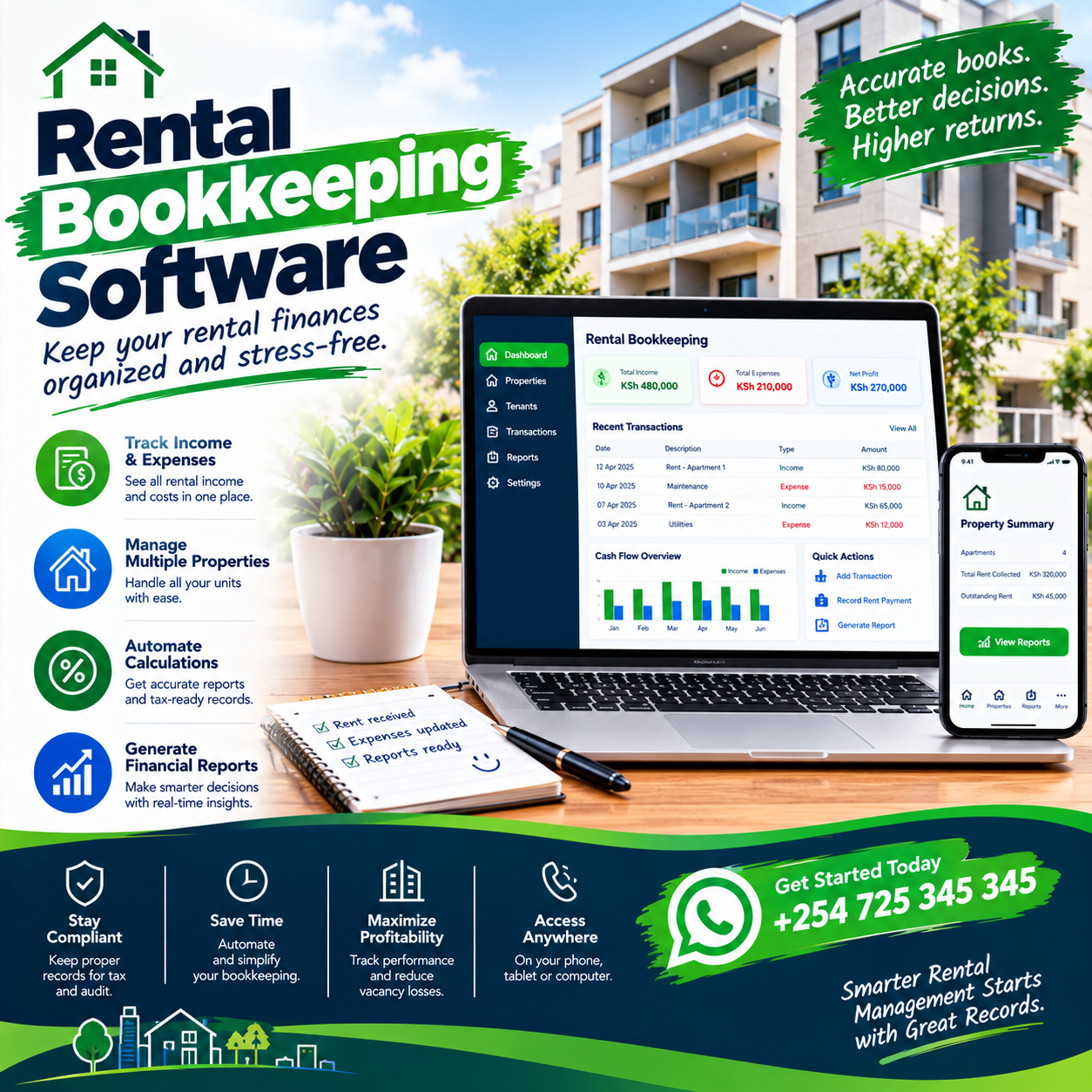
Rental bookkeeping software is the financial backbone that separates landlords who own property from landlords who run a real business.
Rent comes in, expenses go out, repairs happen, and taxes arrive — and the owner who cannot see all of it in one place is flying on feelings. The encouraging truth of 2026 is that professional-grade books are now within reach of every Kenyan landlord, at a price that feels almost accidental.
For years, property finances lived in shoeboxes, bank statements, and the memories of whoever collected the rent. At tax time, at loan time, and at dispute time, that disorder turned expensive in ways owners never saw coming.
Rental bookkeeping software replaces the shoebox with a system that records, categorizes, reconciles, and reports automatically. This guide walks you through everything the category offers and how to put it to work.
We cover what proper rental bookkeeping actually involves, the features worth demanding, what it costs, and how it connects to the tax obligations covered in our earlier guides. By the end, you will be able to choose and run rental bookkeeping software like a seasoned financial operator.
Whether you own two bedsitters in Rongai or two hundred apartments across Nairobi, the principle never changes. Income you cannot account for is income you cannot defend, optimize, or grow. And nothing makes rental income more accountable than purpose-built rental bookkeeping software running quietly behind your portfolio.
What Is Rental Bookkeeping Software?
Rental bookkeeping software is a digital system that records every financial event in your rental business — income, expenses, transfers, and balances — and turns them into organized, reportable books.
It is the accounting layer of property management, distinct from the payment tracking and tenant records covered in our earlier guides.
Think of it as the difference between knowing rent arrived and knowing where your business actually stands. At its core, the software maintains a double view of your finances.
The income side records every rent payment, deposit, and fee, matched to the right tenant, unit, and period. The expense side records every repair, rate, and running cost, categorized so that each shilling spent has a name and a reason.
Where the two sides meet, rental bookkeeping software produces the number every landlord ultimately cares about: profit. The category draws on principles any accountant would recognize. Transactions are categorized, reconciled against bank and mobile money records, and summarized into reports that explain the business at a glance.
What makes rental bookkeeping software special is that all of this arrives pre-built for property — units, tenants, leases, and rent cycles already understood. That property-native design is the dividing line between real rental bookkeeping and a generic spreadsheet wearing a accounting costume.
A generic tool makes you translate property life into its language; a purpose-built one already speaks it. That translation work is exactly what rental bookkeeping software removes from your life.
Why Landlord Books Fail Without a System
Most rental finances do not fail loudly; they decay quietly, one unrecorded detail at a time. Understanding the failure modes explains precisely what rental bookkeeping software prevents.
Each one is common, costly, and completely avoidable.
The first failure mode is the vanishing expense.
A plumber is paid in cash, the receipt goes into a drawer, and by tax season the deduction has evaporated from every record. Over a year, unrecorded expenses quietly inflate the tax bill of anyone running without rental bookkeeping software.
The second failure mode is the blurred boundary between personal and property money.
When rent lands in the same account as salary and school fees, reconstructing the business’s true position becomes archaeology. Separation — or at minimum disciplined categorization — is the foundational discipline that rental bookkeeping software enforces by design.
The third failure mode is the missing paper trail.
Payments made and received without receipts, dates, or references create books that cannot survive a query, a loan application, or a dispute. Auditable records are the armor plate that rental bookkeeping software builds automatically.
The fourth failure mode is the year-end scramble.
Owners who compile twelve months of activity in one panicked week always miss things, and missed things always cost money. Continuous bookkeeping through rental bookkeeping software turns tax season into a filter exercise instead of an excavation.
Why 2026 Is the Breakout Year
Three forces are converging to make 2026 the year digital bookkeeping becomes standard across Kenyan property.
Each one removes an old excuse.
Together, they move rental bookkeeping software from nice-to-have to operating necessity.
First, the data is already digital.
M-Pesa statements, bank feeds, and platform payment records mean the raw material for perfect books exists the moment money moves.
Software simply organizes what rental bookkeeping software users no longer have to capture by hand.
Second, formalization is accelerating.
Tax authorities increasingly expect documented income and expenses, and lenders increasingly require them before advancing against property.
Clean books have shifted from virtue to requirement, which is the structural demand behind rental bookkeeping software adoption.
Third, the tools have become radically accessible.
Capabilities that once required a bookkeeper on retainer now run from a phone for less than the cost of a family dinner out. The price barrier that kept rental bookkeeping software institutional has effectively collapsed.
The Income Side: Recording Every Shilling In
Proper bookkeeping begins with income that is complete, categorized, and matched. The system should record every rent payment against the right tenant, unit, and period automatically. That automatic matching is the foundation of trustworthy rental bookkeeping software books.
Beyond base rent, the income side captures the full picture. Deposits held, service charges, water reimbursements, late fees, and parking income all belong on the books, each categorized correctly.
Complete income capture is what makes the reports inside rental bookkeeping software actually meaningful. The distinction between received and accrued matters here too.
Rent charged and rent received are different numbers, and professional books show both. That dual view is a quiet hallmark of mature rental bookkeeping software. Income records also connect backward to your collection systems.
When payments flow through tracked platforms, bookkeeping entries generate themselves from reconciled transactions. That integration is what turns rental bookkeeping software from manual entry into automatic accounting.
The Expense Side: Where Deductions Are Won
Expenses are where most landlords leave money on the table, and where proper bookkeeping pays most directly. Every repair, every rate payment, every insurance premium belongs on the record — categorized, dated, and evidenced.
The expense discipline inside rental bookkeeping software is what converts spending into documented deductions. Categorization is the heart of the discipline.
Repairs differ from improvements, management fees differ from utilities, and each category carries different weight when accounts are reviewed or filed. Sensible, consistent categories are the intelligence built into rental bookkeeping software. Evidence travels with the entry.
A photo of the receipt, the paybill confirmation, or the bank record attaches to each expense, so every deduction traces to proof in seconds. That evidence-first design is what makes rental bookkeeping software records genuinely defensible. Per-unit and per-property expense views complete the picture.
Knowing what each building costs to run — and which units drain maintenance budgets — transforms how owners price, budget, and buy. That granularity is the analytical gift of rental bookkeeping software on the expense side.
Reports: The Numbers That Actually Matter
Raw entries become value only when they summarize into reports, and this is where bookkeeping earns its keep.
The reports below should exist in any system you adopt, updated automatically as transactions land. This section is your feature checklist for the reporting layer of rental bookkeeping software. The profit and loss statement is the headline report.
It shows income minus expenses over any period, per property and per portfolio, revealing the truth about how the business performs. Everything else in rental bookkeeping software exists to make that one statement accurate. The cash flow view matters just as much.
Knowing when money moves — not just how much — lets owners plan commitments around reality instead of optimism. Timing visibility is the practical gift of rental bookkeeping software cash reporting. Per-property and per-unit reports power real decisions.
Which building underperforms, which unit drains repairs, which months historically dip — these answers were once the privilege of large portfolios with accountants on staff. Today they generate automatically inside rental bookkeeping software.
Year-end and accountant-ready exports complete the set. When your accountant receives clean categorized files instead of a bag of receipts, fees drop and accuracy rises. That handoff is the quiet financial dividend of disciplined rental bookkeeping software use.
Reconciliation: Proving the Books Are True
Bookkeeping without reconciliation is just organized guessing. Reconciliation is the discipline of matching your recorded transactions against independent records — M-Pesa statements, bank statements — until every figure agrees.
Automatic reconciliation is the defining technical feature of serious rental bookkeeping software. Here is how it works in practice. Payments recorded in the system are matched against the actual transactions on your M-Pesa or bank statement, and any gap surfaces immediately.
A missing entry, a duplicate, or a wrong amount becomes visible in days rather than at year-end. That early-error detection is the protective core of rental bookkeeping software reconciliation. The discipline compounds across the year. Twelve small monthly reconciliations produce books that are permanently trustworthy.
One annual reconciliation produces books that are permanently doubtful — the difference between the two approaches is the entire value proposition of rental bookkeeping software.
Real Benefits for Landlords
The first benefit is financial clarity, plain and simple.
Owners finally see profit per property, cost per unit, and trend per month — the numbers that should drive every decision.
That clarity is the headline return of rental bookkeeping software.
The second benefit is tax readiness.
Deductions documented all year become deductions claimed without stress, and filings become a filter exercise rather than a crisis.
Our earlier rental income tax guide described the record-keeping ideal; rental bookkeeping software is the tool that delivers it.
The third benefit is borrowing power.
Lenders evaluating property-backed loans look for documented income, and clean books presented over twelve months speak louder than any verbal estimate.
Owners with rental bookkeeping software histories walk into banks with evidence rather than claims.
The fourth benefit is dispute protection.
Every transaction carries its date, amount, counterparty, and evidence, so disagreements about money end in file reviews instead of arguments.
That audit-ready posture is the hidden insurance inside rental bookkeeping software.
The fifth benefit is time.
Bookkeeping that once consumed weekends now runs as a byproduct of normal operations, updating itself as transactions occur.
Hours reclaimed every month are the invisible dividend of rental bookkeeping software.
The sixth benefit is better buying decisions.
Accurate per-property profits tell you which buildings to keep, which to improve, and which to sell — portfolio strategy built on numbers rather than sentiment.
That strategic edge is the long-term value of rental bookkeeping software.
Benefits for Accountants and Property Managers
Accountants love clients whose books arrive organized, and the software makes that the default. Categorized transactions, attached evidence, and clean exports reduce preparation time dramatically.
That efficiency often translates directly into lower accounting fees for rental bookkeeping software users. Property managers gain a client-trust multiplier.
Financial reports per owner property, generated automatically, replace fragile spreadsheets and verbal assurances. Transparent books are what retain management clients on rental bookkeeping software arrangements for years.
The systems also protect the people handling money. Transactions logged with attribution cannot be falsely questioned later, which shields honest caretakers and managers alike. Mutual protection is why field teams often become advocates of rental bookkeeping software adoption.
Rental Bookkeeping vs. Rent Tracking: The Honest Distinction
Readers of our earlier guides often ask how this category differs from the rent tracking software we have covered before. The distinction is scope and purpose.
Rent tracking follows payments and tenant balances; rental bookkeeping software follows the entire financial life of the business, expenses included. Rent tracking answers “who paid and who owes.” Bookkeeping answers “is the business profitable, what does it cost to run, and can the numbers survive scrutiny.”
Both questions matter, which is why many owners eventually run rental bookkeeping software alongside or on top of their tracking tools. The categories are converging in practice.
Modern platforms increasingly bundle payment tracking, tenant records, and full books into single systems. Whichever shape you choose, ensure the bookkeeping layer beneath your rental bookkeeping software dashboard is complete — because reports are only as honest as the entries beneath them.
Must-Have Features to Demand in 2026
The market is growing quickly, and buyers should evaluate options against a demanding checklist.
The best rental bookkeeping software platforms share a clear set of core capabilities.
Use this section as your scorecard.
First, demand property-native structure.
Units, tenants, leases, and rent cycles should be first-class citizens of the system, not labels you bolt onto generic accounting. That native design is the baseline of true rental bookkeeping software.
Second, insist on automatic M-Pesa and bank reconciliation.
Entries should match themselves against statements, surfacing gaps without manual hunting. Hands-free accuracy is the technical heart of rental bookkeeping software.
Third, look for categorized expense capture with evidence attachment.
Photos, receipts, and confirmations should travel with every entry, one tap from your phone. Evidence-first records are what make rental bookkeeping software defensible.
Fourth, expect the full report suite: profit and loss, cash flow, per-property views, and year-end exports in formats accountants accept.
Fifth, check for multi-property support that scales with you, because switching systems later is expensive. Growth readiness is the long-term test of any rental bookkeeping software choice.
Sixth, demand data export and ownership.
Your books belong to you, portable at any time, in formats you control. Finally, mind the practical basics: affordable phones, weak networks, and a short learning curve. Usability decides whether rental bookkeeping software becomes infrastructure or shelfware.
Choosing the Right Platform
A structured selection process prevents regret in this fast-growing market.
Start by listing your realities: portfolio size, transaction volume, whether an accountant is involved, and which financial questions you most need answered.
The right rental bookkeeping software fits your operation, not the loudest advert. Trial with your real data, without exception.
Run one full month of actual transactions through the system — income, expenses, a reconciliation, and a report.
One honest cycle reveals more than any rental bookkeeping software demonstration ever will.
Involve your accountant in the decision if you use one.
The professional who handles your filings can tell you within minutes whether a platform’s exports will make their life easier or harder.
That one conversation is the cheapest insurance on any rental bookkeeping software purchase.
What It Costs in 2026
Pricing in this category is friendlier than most owners expect.
Competition among Kenyan providers has kept costs low even as features multiply.
Against recovered deductions and reduced accounting fees, rental bookkeeping software typically repays itself within the first quarter.
Typical pricing structures heading into 2026 look like this:
- Free tiers: suitable for very small portfolios recording basics
- Per-unit plans: commonly KSh 20–80 per unit monthly
- Flat monthly plans: roughly KSh 1,000–4,000 depending on features
- Annual plans: usually 10–20 percent cheaper than monthly billing
Weigh the price against the full value stack: claimed deductions, lower accounting fees, borrowing evidence, and reclaimed weekends.
Viewed that way, the true cost of good rental bookkeeping software approaches zero.
The real question is how long you can afford to run a business you cannot see.
Getting Started the Right Way
Adoption succeeds or fails in the setup, so begin deliberately.
Open your categories first — rent, deposits, repairs, rates, utilities, management, insurance — aligned with how your accountant thinks.
Clean structure is the foundation of useful rental bookkeeping software books.
Enter your opening position honestly.
Record what each property earns, what it costs, and any balances that genuinely exist, even where the past is imperfect.
A confirmed starting point is what makes every rental bookkeeping software report that follows trustworthy.
Then build the capture habit.
Every expense gets recorded the day it happens, with evidence attached, from your phone.
Same-day entry is the golden rule that keeps rental bookkeeping software books permanently current.
Reconcile monthly, review the profit and loss quarterly, and archive the year-end export with your permanent records.
That rhythm turns bookkeeping from a project into a pulse.
Owners who keep the pulse never face a financial surprise they cannot explain through rental bookkeeping software.
Common Mistakes to Avoid
The most common mistake is recording income but ignoring expenses.
Half-books produce half-truths, and the missing half is always the profitable one.
Completeness is the entire deal in rental bookkeeping software usage.
The second mistake is sloppy categorization.
Repairs dumped into a single “miscellaneous” category destroy the analytical and tax value of the record.
Discipline about categories is what keeps rental bookkeeping software reports meaningful.
The third mistake is skipping reconciliation.
Unreconciled books feel right until the moment they are proven wrong, usually at the worst possible time.
Monthly matching is the hygiene that keeps rental bookkeeping software trustworthy.
One bonus mistake deserves a warning: abandoning the system during busy months.
The weeks you skip are precisely the weeks when transactions multiply and errors compound.
Consistency through the busy season is the mark of owners who truly run rental bookkeeping software as infrastructure.
The Tax Connection
Everything in this guide feeds directly into the obligations covered in our rental income tax guide.
Documented income supports accurate filings, and categorized expenses support legitimate deductions where your regime allows them.
That connection is the quiet strategic value of rental bookkeeping software.
Under the flat residential regime, gross receipts computed from complete records make monthly filings a five-minute exercise.
Under the standard regime, documented expenses directly reduce taxable profit — which means bookkeeping discipline converts into real money every year.
Either way, the quality of your rental bookkeeping software records shapes your tax position.
Keep the evidence retention discipline too.
Records covering several years, stored digitally and organized by period, are the standard that queries and audits respect.
Deep, organized history is the armor plate of rental bookkeeping software users who never worry about a letter from the revenue authority.
Real Scenarios from Real Portfolios
Picture a landlord with twelve units in Nakuru who filed taxes each year from memory and receipts in a drawer.
After one year on proper books, her documented repairs and rates reduced her taxable position substantially — money she had been quietly overpaying for seasons.
Her accountant now describes her file as the easiest in his portfolio, thanks to rental bookkeeping software.
Picture a young owner in Kitengela applying for a loan to buy a second plot.
Twelve months of clean profit-and-loss statements, exported and printed, turned his application from a verbal claim into documented evidence.
The loan was approved at better terms than he expected — the borrowing dividend of rental bookkeeping software.
Picture a property manager in Kilimani serving seven owner clients.
Per-property financial reports now generate automatically each month, replacing end-of-quarter reconstructions and the questions that came with them.
Client retention has never been higher — the trust dividend of rental bookkeeping software done consistently.
The Road Ahead: 2027 and Beyond
The trajectory of bookkeeping technology points toward automation everywhere.
Bank feeds, mobile money integration, and receipt scanning are converging toward books that write themselves as money moves.
The rental bookkeeping software of 2027 will require less input and deliver more insight than anything available today.
Intelligence is arriving just behind.
Systems are beginning to flag unusual expenses, forecast cash flow, and suggest budget improvements from your own historical patterns.
Owners who build clean books now are training the systems that will advise them later — the compounding logic of rental bookkeeping software adoption.
The message for today’s owner is simple.
Professional-grade financial visibility is now affordable, local, and proven across thousands of Kenyan portfolios.
There has never been a better moment — in 2026 or beyond — to put rental bookkeeping software beneath your income.
Frequently Asked Questions
What does rental bookkeeping software actually do?
It records every financial event in your rental business — income, expenses, transfers — categorizes them, reconciles them against M-Pesa and bank statements, and produces reports like profit and loss.
Think of it as the accounting department of your property business, running from your phone.
The expense and reporting depth is what distinguishes rental bookkeeping software from simple payment tracking.
Is it different from rent tracking software?
Yes — rent tracking follows payments and tenant balances, while bookkeeping follows the entire financial life of the business, expenses and profit included.
Many modern platforms bundle both layers.
Choose based on whether your gap is collection visibility or complete financial truth, or adopt rental bookkeeping software that covers both.
Do I need it if I already have an accountant?
Yes — the software makes your accountant dramatically more effective, because they receive organized, categorized, evidenced books instead of reconstructing your year from statements.
Most users see accounting fees fall as a direct result.
The combination of clean records and professional review is the strongest financial setup rental bookkeeping software users can build.
Will it help me pay less tax?
It ensures you pay exactly what you owe — no more, no less — by documenting the expenses and deductions your regime allows and keeping the evidence that supports them.
Under the standard regime especially, captured expenses directly reduce taxable profit.
That accuracy, rather than avoidance, is the financial payoff of rental bookkeeping software.
What records should I keep, and for how long?
Keep agreements, receipts, payment records, expense evidence, and reports — organized by period — for several years as a minimum, and confirm current requirements with your accountant or the revenue authority.
Digital storage makes depth effortless.
Long, organized history is the standard posture of rental bookkeeping software users.
Does it work with M-Pesa?
Yes — M-Pesa reconciliation is the core plumbing, matching recorded transactions against actual statement entries automatically.
Confirm the depth of integration during your trial, because implementations vary.
Native M-Pesa support is the non-negotiable foundation of rental bookkeeping software in Kenya.
Is my financial data safe?
Reputable providers use encryption, continuous backups, and access controls comparable to banking standards.
Confirm the provider’s practices and your export rights before committing.
Security is a baseline requirement of professional rental bookkeeping software, never an optional extra.
Where can I find verified tenants and landlord tools together?
Start with platforms that combine verified listings with landlord-friendly technology, such as rentaldesk.co.ke.
Pairing the right tenants with disciplined rental bookkeeping software habits takes you from guessing at your income to running a business you can prove, optimize, and grow.