
Table of Contents
ToggleReal Estate Management Software Kenya: A Complete Guide for Landlords and Property Managers
Managing rental property becomes increasingly difficult as the number of units, tenants, payments, leases and maintenance requests grows. Real Estate Management Software Kenya gives landlords, property managers, estate agencies and real estate businesses a structured way to bring these activities into one digital workflow. Instead of relying on notebooks, spreadsheets, WhatsApp conversations and manually checked payment messages, property owners can centralize tenant records, rent collection, property information, expenses, maintenance and reporting. This guide explains what the software does, the problems it solves, the features to consider, how it can support Kenyan rental operations, and what to evaluate before choosing a system.
The need for organized property management is particularly important when a landlord moves from managing a handful of units to a larger portfolio. A process that works reasonably well for five tenants can become difficult when there are fifty, one hundred or several hundred tenants. Missed payment records, forgotten lease dates, incomplete tenant information and delayed maintenance responses can all affect the performance of a rental business.
A digital management platform does not replace good property management. Instead, it provides the records, automation and visibility needed to make day-to-day decisions more efficiently.
What Is Real Estate Management Software?
Real Estate Management Software Kenya refers to software designed to help property owners and property professionals manage the operational and financial activities associated with real estate.
Depending on the platform, this can include:
- Property and unit management
- Tenant records
- Lease management
- Rent invoicing
- Payment tracking
- Arrears monitoring
- Expense management
- Maintenance requests
- Utility billing
- Owner statements
- Financial reports
- Notifications and reminders
- Document management
- Portfolio reporting
The main advantage is centralization. Rather than keeping information in several disconnected locations, a property manager can access important information from a single system.
For example, consider an apartment building with 80 units. The manager may need to know which units are occupied, which tenants have outstanding balances, when leases expire, how much rent was collected during the month, which maintenance requests remain unresolved and how much was spent on repairs.
Managing those questions manually can consume significant time. A suitable property management platform organizes the information so that the manager can work from current records rather than reconstructing information from different sources.
Real Estate Management Software Kenya can therefore be viewed as an operational control system rather than simply a digital rent book.
Why Kenyan Property Businesses Need Better Management Systems
Property management in Kenya involves several practical challenges. Rent payments may arrive through different channels, landlords may manage multiple buildings, tenants may pay partially, maintenance work may happen at different properties, and property owners may need regular financial reports.
A spreadsheet can record some of this information, but spreadsheets often depend heavily on manual updates. As the portfolio grows, maintaining accurate records becomes more difficult.
Real Estate Management Software Kenya helps address this problem by creating structured workflows for recurring tasks.
1. Growing rental portfolios create administrative pressure
A landlord with several properties may have dozens or hundreds of individual rent records to monitor every month. Each unit can have a different tenant, rent amount, payment date, deposit and lease period.
A centralized platform reduces the need to search through separate files.
2. Rent collection requires accurate records
Knowing that money was received is only part of rent management. A property manager also needs to know:
- Who paid
- How much was paid
- Which unit the payment belongs to
- Whether the payment was partial
- Whether there is an outstanding balance
- Whether the payment has been reconciled
Real Estate Management Software Kenya can make this process easier by connecting payment information with tenant and unit records.
3. Owners need visibility
A property owner may not personally manage the building. They may depend on an agent or property management company.
In that situation, regular reporting becomes important. Owners may want to see rental income, arrears, expenses, vacancies and other performance information without manually reviewing dozens of documents.
4. Tenants expect better communication
Modern tenants often expect clear invoices, payment confirmations, timely reminders and quick responses to maintenance problems.
A structured digital system can support these processes while giving property managers a record of communication and transactions.
Core Features to Look For
Not every property management platform has the same capabilities. Before choosing a system, it helps to separate essential features from optional ones.
Real Estate Management Software Kenya should ideally support the core activities involved in operating rental property.
Property and unit management
The system should allow you to organize properties and units clearly.
For example:
| Property | Units | Occupied | Vacant | Monthly Rent |
|---|---|---|---|---|
| Apartment A | 40 | 37 | 3 | KES 740,000 |
| Apartment B | 60 | 56 | 4 | KES 1,120,000 |
| Commercial Block | 20 | 18 | 2 | KES 900,000 |
The exact figures in this example are illustrative, but the principle is important: managers need to see portfolio information without manually combining spreadsheets.
Tenant management
Real Estate Management Software Kenya should provide a structured tenant database.
Useful tenant information can include:
- Full name
- Phone number
- Email address
- Unit
- Lease dates
- Rent amount
- Deposit
- Payment history
- Outstanding balance
- Relevant documents
Having this information together makes it easier to answer tenant questions and maintain accurate records.
Lease management
Lease agreements contain important information that should not be forgotten.
A digital system can help property managers monitor:
- Lease start dates
- Lease expiry dates
- Renewal dates
- Deposit information
- Rent amounts
- Special terms
- Tenant occupancy history
Real Estate Management Software Kenya can be particularly useful when a property manager has many leases with different renewal dates.
Automated Rent Collection and Payment Tracking
Rent collection is one of the most important functions of a rental business.
In Kenya, M-Pesa is a major part of everyday business payments, making payment tracking especially important for landlords and property managers.
Real Estate Management Software Kenya can support structured payment workflows where available integrations allow transactions to be associated with the appropriate tenant or account.
The benefit is not simply receiving money digitally. The bigger advantage is reconciliation.
What is payment reconciliation?
Payment reconciliation means matching money received against the correct tenant, unit, invoice or account.
Suppose a manager receives several payments during the morning. Without an organized system, the manager may need to manually identify each transaction and update a spreadsheet.
A connected workflow can reduce repetitive work.
For example:
- Tenant receives an invoice.
- Tenant makes a payment.
- Payment is received through the configured channel.
- The transaction is associated with the relevant account.
- The tenant balance is updated.
- A receipt or confirmation can be generated where supported.
- The manager can review the updated records.
Real Estate Management Software Kenya becomes valuable here because payment management is closely connected to tenant management and financial reporting.
Handling partial payments
Partial payments are common in many rental businesses.
A tenant may owe KES 30,000 and pay KES 20,000. The remaining KES 10,000 needs to remain visible.
A proper system should distinguish between:
- Amount billed
- Amount paid
- Amount outstanding
- Previous balance
- Current balance
This reduces the risk of mistakenly treating a partial payment as a fully settled invoice.
Arrears Management
Arrears can have a significant effect on rental cash flow.
Real Estate Management Software Kenya can help property managers identify outstanding balances more quickly by keeping tenant ledgers and payment records organized.
A useful arrears dashboard might show:
| Tenant | Unit | Amount Due | Amount Paid | Balance |
|---|---|---|---|---|
| Tenant A | A-12 | KES 30,000 | KES 30,000 | KES 0 |
| Tenant B | B-07 | KES 25,000 | KES 15,000 | KES 10,000 |
| Tenant C | C-04 | KES 40,000 | KES 0 | KES 40,000 |
This gives the manager an immediate view of accounts requiring attention.
Automated reminders can also reduce the amount of manual follow-up required, depending on the features provided by the chosen platform.
The objective should not simply be to send more messages. It should be to make the collection process consistent and traceable.
Financial Reporting for Rental Properties
Financial reporting is another major area where software can improve property management.
Real Estate Management Software Kenya can help organize information needed for reports such as:
- Monthly rent collection
- Outstanding balances
- Property income
- Property expenses
- Tenant statements
- Owner statements
- Occupancy information
- Maintenance costs
- Payment histories
A good reporting system allows managers to move from raw transactions to useful business information.
Property-level reporting
A landlord with several buildings may want to compare each property’s income and expenses.
For example:
| Property | Rent Collected | Expenses | Net Before Other Costs |
|---|---|---|---|
| Property A | KES 850,000 | KES 120,000 | KES 730,000 |
| Property B | KES 1,100,000 | KES 180,000 | KES 920,000 |
| Property C | KES 650,000 | KES 90,000 | KES 560,000 |
The figures above are examples, not claims about actual property performance.
Real Estate Management Software Kenya can make it easier to organize this type of information when reporting functionality is available.
Maintenance Management
Property maintenance is often handled separately from rent collection, but it is an essential part of real estate operations.
Tenants may report problems involving:
- Plumbing
- Electricity
- Water supply
- Locks
- Doors
- Windows
- Security
- Common areas
- Leaking roofs
- Drainage
- Appliances
Real Estate Management Software Kenya can help organize maintenance requests so that issues do not disappear inside WhatsApp conversations or handwritten notes.
A useful maintenance workflow may look like this:
- Tenant reports a problem.
- The manager records the request.
- The request is assigned to a caretaker, technician or vendor.
- The issue is investigated.
- Repair costs are recorded.
- Work is completed.
- The request is marked as resolved.
This creates a history that can help managers identify recurring problems.
Why maintenance records matter
Suppose a particular water pump requires repairs several times in one year. Without historical records, the manager may treat every repair as an isolated incident.
With organized maintenance records, the manager can identify patterns and decide whether repeated repairs are becoming more expensive than replacement.
Real Estate Management Software Kenya can therefore contribute to operational decision-making beyond basic rent collection.
Expense Management
Rental businesses have expenses that need to be tracked against the properties generating income.
Common examples include:
- Repairs
- Cleaning
- Security
- Landscaping
- Utilities
- Property management fees
- Contractor payments
- Administrative costs
- Equipment
- Maintenance materials
Real Estate Management Software Kenya can help keep expense records connected to the appropriate property or unit where the system supports this functionality.
This is important because total rental income alone does not show how efficiently a property is being operated.
A manager who knows both income and expenses can produce more useful financial reports.
Utility Billing
Some properties include utilities as part of rent, while others bill tenants separately.
Utilities may include:
- Water
- Electricity
- Garbage collection
- Internet
- Service charges
- Shared-area costs
Real Estate Management Software Kenya can help property managers maintain clearer billing records when utility management is part of the platform.
For properties where tenants pay according to consumption, the system may also need to accommodate meter readings or variable charges.
The exact approach depends on the property and the software being used.
Tenant Communication
Property management involves regular communication.
Managers may need to send:
- Rent reminders
- Payment confirmations
- Maintenance updates
- Lease reminders
- Notices
- General property announcements
Real Estate Management Software Kenya can support more consistent communication when notifications are integrated into the platform.
The main benefit is organization.
Instead of searching through old messages to establish whether a tenant was contacted, a manager may be able to review communication records within the property management workflow.
Managing Multiple Properties
A landlord with one building has different needs from an agency managing properties for several owners.
Real Estate Management Software Kenya becomes more useful as portfolio complexity increases.
A multi-property system should ideally allow managers to separate:
- Properties
- Units
- Tenants
- Owners
- Payments
- Expenses
- Reports
This separation is especially important for property management companies.
For example, an agency may manage Apartment A for one owner and Apartment B for another. Combining the financial records could create serious confusion.
The system should make it clear which income and expenses belong to each property and owner.
Cloud-Based Property Management
Cloud software allows authorized users to access their information through an internet-connected device.
Real Estate Management Software Kenya can provide practical value when property managers need to work away from their desks.
A manager may need to check a tenant balance while visiting a property, review an outstanding maintenance request while travelling, or generate a report from another location.
Cloud access can reduce dependence on a particular office computer.
However, convenience should not come at the expense of security. Property managers should evaluate authentication, permissions, backups and account controls before committing to any software.
Data Security and User Access
Property management systems can contain sensitive business information.
Records may include:
- Tenant contact details
- Payment information
- Lease records
- Financial transactions
- Property documents
- Owner information
- Staff accounts
Real Estate Management Software Kenya should therefore be assessed partly on its approach to data security and user permissions.
If several employees use the system, it can be useful to have different access levels.
For example:
- Owner — portfolio-level visibility
- Manager — operational management
- Accountant — financial records
- Caretaker — assigned maintenance and tenant tasks
- Administrator — system configuration
Not every employee needs access to every type of information.
Choosing Software for a Small Landlord
A small landlord does not necessarily need a complicated enterprise platform.
Real Estate Management Software Kenya can be appropriate when the system matches the size and operational needs of the portfolio.
A small landlord may prioritize:
- Simple tenant records
- Rent tracking
- Payment reconciliation
- Arrears monitoring
- Basic reports
- Mobile access
- Easy setup
The most important consideration is usability. If software is too complicated, the landlord may continue using notebooks or spreadsheets alongside it, defeating much of the purpose.
Choosing Software for a Property Management Company
Property agencies have more complex requirements.
Real Estate Management Software Kenya may need to support multiple properties, landlords, staff members and reporting structures.
An agency should consider:
- Multi-property support
- Multi-owner management
- Staff roles
- Tenant records
- Automated billing
- Payment reconciliation
- Owner statements
- Expense tracking
- Maintenance workflows
- Reporting and exports
The agency should also consider how easy it is to onboard new properties.
If adding a new building requires extensive manual work, the software may become an administrative burden rather than a productivity tool.
What Makes a Software Solution Suitable for Kenya?
Local context matters.
Real Estate Management Software Kenya should account for the realities of Kenyan property operations rather than assuming that every market works in exactly the same way.
Important considerations may include:
- KES currency
- M-Pesa workflows
- Local payment practices
- SMS communication
- Kenyan business operations
- Local support
- Property management structures
RentalDesk states publicly that its platform is designed for Kenyan rental operations and supports features including M-Pesa-related workflows, tenant management and reporting.
That type of local orientation can matter because the best workflow is one that fits how the property business actually operates.
Mobile Access for Property Managers
Property managers are rarely sitting at a desk all day.
They may visit:
- Apartment buildings
- Construction sites
- Commercial properties
- Tenant offices
- Maintenance locations
- Vacant units
Real Estate Management Software Kenya should therefore be evaluated for how well it works across the devices your team actually uses.
A mobile-friendly system can allow a manager to check information while on-site rather than returning to the office for every task.
Mobile access is especially useful for:
- Checking tenant balances
- Confirming payment information
- Viewing maintenance requests
- Updating property records
- Checking vacancies
- Reviewing reports
Automation and Time Savings
One of the strongest reasons for adopting property management software is reducing repetitive administrative work.
Real Estate Management Software Kenya can automate certain recurring activities depending on the platform.
Examples include:
- Generating recurring invoices
- Sending payment reminders
- Updating balances
- Producing recurring reports
- Recording payment information
- Notifying users about tasks
- Monitoring lease dates
Automation should be used carefully. A manager still needs oversight.
For example, if a rent amount changes, the underlying configuration should be checked rather than assuming that every automated invoice will always be correct.
Good automation reduces repetitive work while preserving human control.
Comparing Manual Management With Software
The difference between manual and digital property management becomes clearer when the same task is compared.
| Task | Manual Approach | Digital Approach |
|---|---|---|
| Tenant records | Notebook/spreadsheet | Centralized database |
| Rent tracking | Manual entries | Digital ledger |
| Payment reconciliation | Manual checking | Automated or structured reconciliation |
| Arrears | Spreadsheet calculations | Dashboard/report |
| Lease dates | Calendar reminders | System alerts |
| Maintenance | Calls/WhatsApp | Recorded requests |
| Reports | Manual preparation | Automated reports |
| Portfolio overview | Multiple files | Central dashboard |
Real Estate Management Software Kenya can help reduce fragmentation by bringing these workflows into one environment.
The goal is not to eliminate spreadsheets because spreadsheets are inherently bad. They can be useful tools. The issue arises when they become the central operating system for a complex property business without sufficient controls.
How to Calculate Whether Software Is Worth It
Property managers often ask whether software will actually save enough money or time to justify the expense.
Real Estate Management Software Kenya should be evaluated based on the operational value it creates.
Consider:
- Time spent collecting rent
- Time spent reconciling payments
- Time spent preparing reports
- Cost of administrative errors
- Time spent following up arrears
- Cost of missed maintenance requests
- Cost of duplicate records
- Time spent answering routine questions
For example, if a property manager spends several hours every week manually reconciling rent, reducing that workload can have meaningful operational value.
The calculation should include more than subscription cost. Consider the total cost of managing the same work manually.
Pricing Considerations
There is no single correct price for property management software.
Real Estate Management Software Kenya should be assessed according to the features, unit count, number of users and level of automation provided.
Some platforms may charge based on:
- Number of units
- Number of properties
- Number of users
- Monthly subscription
- Annual subscription
- Features
- Transaction volume
RentalDesk publicly lists a free entry-level option as well as paid plans, with pricing based partly on portfolio size and functionality.
When comparing prices, do not compare subscription fees alone. Compare what the software allows your team to accomplish.
A cheaper platform that requires significant manual work may cost more in staff time than a more capable system.
Common Mistakes When Choosing Property Software
Choosing software without evaluating the actual workflow can create problems.
Real Estate Management Software Kenya should be selected based on operational requirements rather than a long feature list alone.
Mistake 1: Choosing software because it has many features
More features do not automatically mean better results.
A small landlord may never use advanced functionality designed for large agencies.
Mistake 2: Ignoring payment workflows
If most tenants pay through M-Pesa, payment reconciliation should be considered carefully.
Mistake 3: Forgetting user permissions
If multiple staff members will use the platform, access controls matter.
Mistake 4: Failing to test reporting
A platform can have impressive dashboards but still produce reports that do not answer the questions a landlord actually has.
Mistake 5: Not considering future growth
The system should be able to support a larger portfolio if the business expands.
Mistake 6: Migrating without cleaning data
Old spreadsheets may contain duplicate tenants, inconsistent names or incorrect balances. Data should be reviewed before migration.
How to Implement a New System
Adopting property management software should be treated as a process rather than a single installation.
Real Estate Management Software Kenya can deliver value more quickly when the underlying data is organized properly.
Step 1: Audit existing records
Gather:
- Tenant lists
- Property lists
- Unit records
- Rent amounts
- Deposits
- Lease dates
- Outstanding balances
- Payment records
Step 2: Clean the data
Remove duplicate records and correct obvious errors.
Step 3: Set up properties
Create buildings, estates and units.
Step 4: Add tenants
Connect each tenant with the correct unit.
Step 5: Configure billing
Enter applicable rent amounts, billing periods and other charges.
Step 6: Test payments
Before relying on automated workflows, test the payment and reconciliation process.
Step 7: Train staff
Make sure managers, accountants and caretakers understand their responsibilities.
Step 8: Monitor the first reporting cycle
The first month is important. Compare system records against known transactions and correct configuration issues early.
Measuring Success After Implementation
Software adoption should produce measurable improvements.
Real Estate Management Software Kenya can be assessed using practical indicators such as:
- Time spent on rent reconciliation
- Number of unresolved maintenance requests
- Amount of outstanding arrears
- Time required to produce monthly reports
- Number of payment disputes
- Data-entry errors
- Tenant response times
The exact results will differ between businesses.
A landlord managing ten units may measure success differently from an agency managing 1,000 units.
The important point is to establish a baseline before implementation and compare performance afterward.
The Role of Reporting in Better Decisions
Reports become more valuable when they answer specific business questions.
Real Estate Management Software Kenya can support decision-making by organizing data around the questions managers ask every month.
For example:
- Which properties have the highest arrears?
- Which units have been vacant longest?
- How much rent was collected this month?
- Which properties generated the highest expenses?
- Which tenants have outstanding balances?
- How much was spent on maintenance?
- Which leases are approaching expiry?
Instead of relying on memory, managers can use records.
This is one of the most important differences between simply digitizing paperwork and creating a genuinely useful management system.
Supporting Property Growth
A rental business often becomes harder to manage as it grows.
Real Estate Management Software Kenya can provide structure when a landlord adds buildings, units and employees.
Consider a landlord who grows from 20 units to 200 units.
At 20 units, manual rent tracking may still feel manageable.
At 200 units, the manager may need to monitor:
- Hundreds of tenants
- Multiple payment dates
- Numerous arrears cases
- Many leases
- Maintenance requests
- Multiple properties
- Staff activities
- Property expenses
- Owner reports
Growth increases the number of relationships between pieces of information.
Software helps maintain those relationships.
Real Estate Agencies and Owner Reporting
Property management companies often manage property on behalf of owners.
Real Estate Management Software Kenya can help agencies maintain clearer separation between different owner portfolios.
An owner statement might include:
- Rent billed
- Rent collected
- Arrears
- Expenses
- Maintenance
- Management fees
- Net amount payable
Clear reporting can make the relationship between the agency and property owner easier to manage.
It also reduces the need to manually assemble reports at the end of each month.
Residential and Commercial Properties
Different property types have different requirements.
Residential property may focus heavily on:
- Monthly rent
- Tenant records
- Deposits
- Maintenance
- Arrears
- Occupancy
Commercial property may require additional attention to:
- Lease terms
- Service charges
- Utilities
- Longer contracts
- Business tenants
- Variable billing
Real Estate Management Software Kenya should therefore be assessed against the type of property being managed.
A system that works well for residential apartments may require additional configuration for commercial properties.
Frequently Asked Questions
What does real estate management software do?
Real Estate Management Software Kenya helps property owners and managers organize property records, tenants, leases, payments, expenses, maintenance and reports in a centralized digital system.
The exact capabilities vary by provider.
Is property management software useful for a small landlord?
Yes. A small landlord can use software to keep tenant information, rent records and payment histories organized from the beginning. Starting with structured records can also make future growth easier.
Can software help with M-Pesa rent collection?
Some platforms support M-Pesa-related payment workflows and reconciliation. The exact integration depends on the provider and configuration. Before choosing a system, confirm how payments are received, matched and recorded.
Can I manage multiple properties?
Many modern platforms support multiple properties and units. Real Estate Management Software Kenya can be particularly useful for landlords and agencies with portfolios spread across different buildings or locations.
Does software replace a property manager?
No. Software automates and organizes tasks, but people still make decisions, communicate with tenants, inspect properties, authorize repairs and handle situations requiring judgment.
Can tenants use the system?
Some platforms provide tenant-facing functionality such as payment workflows, statements, notifications or maintenance requests. The available features depend on the specific system.
Is cloud-based software better than a spreadsheet?
They serve different purposes. A spreadsheet can be useful for basic analysis, while a dedicated property platform is designed around recurring property-management workflows. Real Estate Management Software Kenya can provide more structured functionality where those workflows are needed.
How much does property management software cost in Kenya?
Pricing varies according to the provider, portfolio size, features and number of users. Some systems offer free or entry-level plans, while more advanced plans charge monthly or annually.
How long does implementation take?
The timeline depends on the size and quality of the existing data. A small portfolio can generally be configured more quickly than a large portfolio with many properties, tenants and historical records.
A Practical Checklist Before Choosing Software
Before signing up, create a checklist based on your actual operation.
Real Estate Management Software Kenya should ideally be tested against real scenarios rather than a generic demonstration.
Ask the provider:
- Can I manage multiple properties?
- Can I create and manage individual units?
- Can I maintain tenant records?
- Can I track lease dates?
- Can I generate rent invoices?
- Can I track arrears?
- How are M-Pesa payments handled?
- Can payments be reconciled automatically?
- Can I record expenses?
- Can I manage maintenance requests?
- Can I generate owner statements?
- Can staff have different permissions?
- Can I export my data?
- Is customer support available locally?
- What happens if my portfolio grows?
- What is included in the subscription?
- Are there additional transaction charges?
- How is data backed up?
- Can I access the platform from a phone?
- Can I test the system before committing?
These questions help turn a software purchase into an operational assessment.
Why User Experience Matters
A powerful system is only useful if people actually use it.
Real Estate Management Software Kenya should be easy enough for staff to understand without requiring excessive technical knowledge.
The interface should make common actions straightforward.
For example, a property manager should not need to navigate through many screens simply to answer a basic question such as, “How much does this tenant owe?”
The same principle applies to rent collection, maintenance and reporting.
Ease of use can directly influence adoption.
The Importance of Local Support
Software is part of an ongoing business process.
If a payment workflow stops working or an employee cannot access an account, the business may need assistance quickly.
Real Estate Management Software Kenya should therefore be evaluated partly on support arrangements.
Consider:
- Support channels
- Response times
- Training
- Documentation
- Onboarding
- Troubleshooting
- Product updates
A provider that understands local rental workflows may also be better positioned to address Kenya-specific operational questions.
Moving From Manual Property Management to Digital Operations
The transition does not have to happen all at once.
Real Estate Management Software Kenya can be introduced in stages.
A practical rollout could begin with:
Phase 1: Property and unit records
Phase 2: Tenant records
Phase 3: Rent invoicing
Phase 4: Payment tracking
Phase 5: Arrears management
Phase 6: Maintenance
Phase 7: Reporting and analytics
This approach gives staff time to learn each part of the workflow.
It also makes it easier to identify problems before the entire operation depends on the new system.
Final Considerations for Kenyan Landlords and Property Managers
Choosing property management software should ultimately come down to operational fit.
Real Estate Management Software Kenya can help create a more organized rental operation when its features match the actual requirements of the business.
For a small landlord, that may mean simple rent and tenant tracking.
For a property manager, it may mean multi-property management, payment reconciliation, maintenance workflows and owner statements.
For a growing real estate company, it may mean advanced reporting, staff permissions, portfolio analytics and scalable processes.
The most important step is to identify where your current management process is losing time or creating errors.
If rent payments are difficult to reconcile, start there. If tenant records are scattered, centralize them. If monthly reporting takes days, automate the reporting process. If maintenance requests disappear inside messages, introduce a structured maintenance workflow.
Technology should solve real operational problems.
Real Estate Management Software Kenya is most valuable when it gives property owners and managers clearer information, reduces repetitive administrative work and creates consistent processes across the portfolio.
Conclusion
Professional property management requires more than collecting rent. It involves keeping accurate tenant records, monitoring leases, following up arrears, recording expenses, handling maintenance, communicating with tenants and producing reliable reports.
Real Estate Management Software Kenya provides a way to organize these activities within a centralized digital workflow.
For Kenyan landlords and property managers, the right solution should fit local payment practices, support the scale of the portfolio and remain simple enough for everyday use. M-Pesa workflows, tenant management, reporting, maintenance tracking and multi-property support are among the areas worth evaluating before making a decision.
The goal should not be to purchase software simply because it has a long list of features. The goal is to create a property management operation that is easier to monitor, easier to report on and easier to scale.
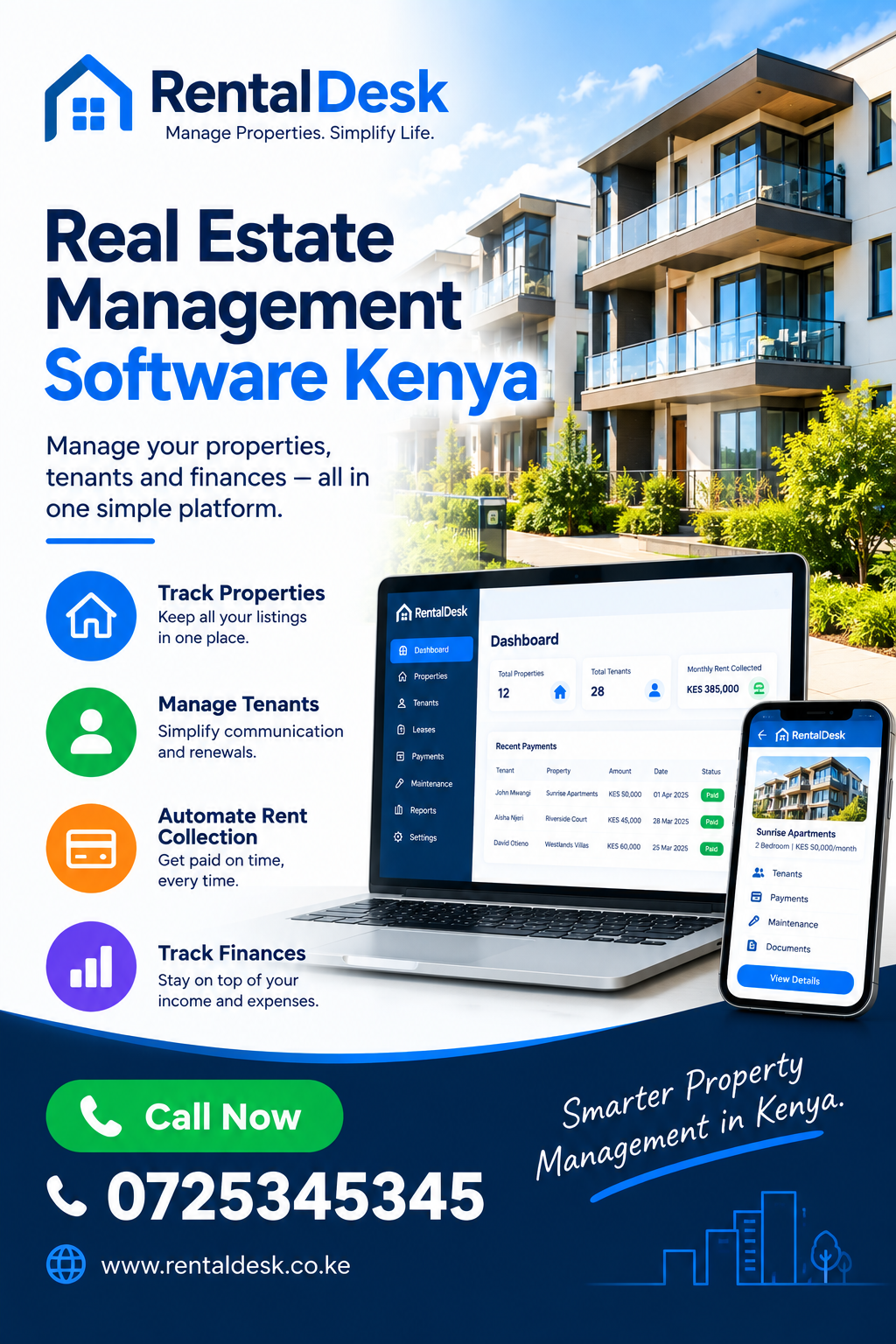
Real Estate Management Software Kenya can be particularly relevant for rental businesses that want to centralize rent collection, tenant information, arrears, property records and reporting. RentalDesk publicly describes its platform as a Kenya-focused rental management solution with features covering property and unit management, tenant management, rent collection, arrears tracking, notifications and financial reporting.
Before committing to any platform, test it using realistic examples from your own property portfolio. Add a sample property, create tenants, record payments, generate reports and test the workflows your team uses most often.
Real Estate Management Software Kenya should ultimately make the business easier to operate, not introduce another layer of unnecessary administration.
For landlords starting with a small portfolio, adopting organized digital records early can create a foundation for growth. For established property managers, the right system can bring scattered operational information into one place.
The best implementation is one that combines appropriate technology with clear procedures, accurate data and trained staff.
Real Estate Management Software Kenya is therefore not simply about replacing a notebook or spreadsheet. It is about creating a repeatable system for managing the financial, operational and tenant-facing responsibilities that come with running real estate professionally.
As portfolios grow, structured information becomes increasingly valuable. A landlord who can quickly see occupancy, rent collection, arrears, expenses, maintenance and lease information has a stronger operational foundation than one who must reconstruct those details manually every month.
Real Estate Management Software Kenya can form part of that foundation when selected and implemented according to the property’s real needs.
Final takeaway
Start by identifying your biggest management problem.
If it is rent collection, prioritize payment tracking and reconciliation.
If it is tenant administration, prioritize centralized tenant records.
If it is reporting, prioritize accurate dashboards and statements.
If it is maintenance, prioritize issue tracking and follow-up.
If it is portfolio growth, prioritize scalability and multi-property management.
Then compare platforms against those requirements rather than choosing based solely on marketing claims.
Real Estate Management Software Kenya can be a useful category of technology for landlords, property managers and real estate businesses seeking greater organization, visibility and automation across their operations.
Real Estate Management Software Kenya becomes even more valuable when the business establishes clear procedures around data entry, payment reconciliation, reporting and staff responsibilities.
Real Estate Management Software Kenya should be evaluated through practical testing, especially for the workflows that directly affect rental income and tenant service.
Real Estate Management Software Kenya can help bring property, tenant and financial information into a more structured environment.
Real Estate Management Software Kenya is relevant to businesses that want to reduce scattered records and establish consistent management processes.
Real Estate Management Software Kenya can support the move toward more organized property administration when the selected platform provides the required functionality.
Real Estate Management Software Kenya should be assessed alongside the business’s actual portfolio size, staff structure and payment processes.
Real Estate Management Software Kenya can help property professionals focus less on repetitive record keeping and more on managing their properties and tenants.
Real Estate Management Software Kenya can support structured operations where centralized information and reporting are important.
Real Estate Management Software Kenya can be considered as part of a broader digital strategy for improving property administration, financial visibility and operational control.