
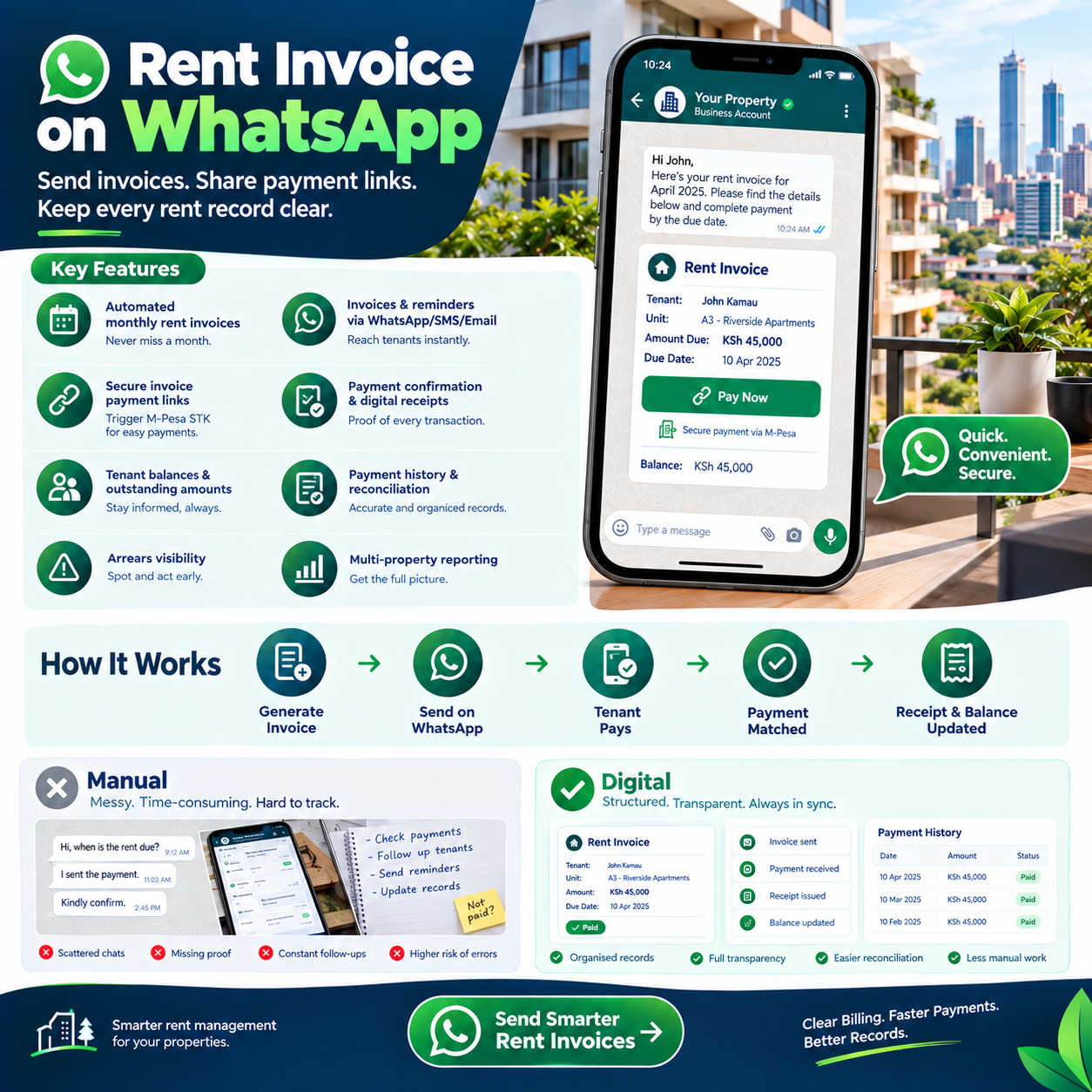
Rent invoice on WhatsApp is quickly becoming the standard way Kenyan landlords bill their tenants — instant, free, and free of paper.
Instead of handwritten receipt books and photocopies, the rent demand now arrives where every tenant already looks twenty times a day.
The result is faster payments, clearer records, and a level of professionalism that costs you nothing.
For decades, rent billing in Kenya has run on carbon books, noticeboards, and memory.
Invoices arrived late, got lost, or never existed at all — and arguments followed.
A rent invoice on WhatsApp ends that era with a message that is dated, detailed, and impossible to lose.
This guide walks you through everything — what to include, how to send it manually, and how automation turns the whole routine into a one-tap monthly habit.
You will learn the etiquette that keeps invoices welcome, the features worth demanding from software, and the mistakes that make tenants mute you.
By the end, you will be able to run a complete rent invoice on WhatsApp system from the phone already in your pocket.
Whether you bill three bedsitters in Rongai or three hundred apartments across the city, the principles are identical.
A clear invoice, sent consistently, on the right channel, gets paid faster than any knock on the door.
And no channel in Kenya beats WhatsApp for reach, familiarity, and goodwill — which is why rent invoice on WhatsApp workflows are spreading through every estate.
The best part is the price.
The manual method costs literally nothing, and the automated layer costs less than one SMS bundle per month.
Few upgrades to your rental business offer a better return than mastering the rent invoice on WhatsApp.
What Is a Rent Invoice on WhatsApp?
A rent invoice on WhatsApp is a digital rent demand delivered to your tenant through WhatsApp instead of paper or a noticeboard.
It states what is owed, for which unit and period, by when, and how to pay.
Think of it as your official bill, delivered into the one inbox every tenant actually reads.
It helps to distinguish the invoice from the receipt, because the two are often confused.
The invoice is the demand — it comes before payment and creates the expectation.
The receipt is the acknowledgment — it comes after payment and proves the money arrived, and a proper rent invoice on WhatsApp routine pairs both.
An invoice can be as simple as a well-written message or as polished as a branded PDF.
What matters is the content: the unit, the amount, the period, the due date, and the payment details.
With those five elements, your rent invoice on WhatsApp carries the same weight as any formal bill.
WhatsApp suits this job remarkably well in Kenya.
It works on every smartphone, needs no new app, and messages there get opened within minutes.
That reach and attention is precisely why rent invoice on WhatsApp delivery outperforms every other billing channel.
Why WhatsApp Works So Well for Rent
First, reach is universal.
WhatsApp is installed on virtually every smartphone in the country, and tenants already use it daily for work, family, and everything else.
Billing on a channel tenants never ignore is the core advantage of rent invoice on WhatsApp delivery.
Second, the evidence comes built in.
Messages carry timestamps, and delivery and read confirmations tell you whether the tenant has received and seen the bill.
Proof of delivery is a quiet legal strength of rent invoice on WhatsApp records.
Third, the channel supports every format you might need.
Text, PDFs, images, voice notes, and payment links all travel through the same thread.
That flexibility is why landlords of every size are standardizing on rent invoice on WhatsApp workflows.
Fourth, and most underrated, is the relationship effect.
Rent communicated on the same channel where you also share maintenance updates feels like communication, not confrontation.
Warmth plus clarity is the signature of a well-run rent invoice on WhatsApp practice.
Why 2026 Is the Breakout Year
Three forces are converging to make 2026 the year WhatsApp billing goes mainstream.
Each removes an old excuse for paper.
Together, they make rent invoice on WhatsApp the obvious default for every landlord.
First, business tools have arrived for everyone.
WhatsApp Business is free, lets you save templates, label chats, and send broadcast lists — features that turn a chat app into a billing office.
The professional layer now available makes rent invoice on WhatsApp feel like a real system rather than improvisation.
Second, payment rails have connected to the chat.
M-Pesa details, Paybill numbers, and payment links can sit inside the invoice itself, shrinking the distance between seeing the bill and paying it.
Every step you remove between invoice and payment is money arriving sooner — the entire economics of rent invoice on WhatsApp billing.
Third, tenants expect it.
A generation that pays school fees, buys groceries, and receives salary slips on their phones now expects rent paperwork to live there too.
Meeting that expectation is the simplest way rent invoice on WhatsApp habits win tenant loyalty.
What a Good Rent Invoice on WhatsApp Contains
Whether typed or templated, every good invoice carries the same core elements.
Miss one, and you invite the exact confusion the message was meant to end.
Here is the checklist behind every professional rent invoice on WhatsApp.
- Tenant name and unit or house number
- The rental period, clearly stated — “Rent for March 2026”
- The exact amount due
- The due date
- Payment instructions — Paybill, till, account, or personal number
- Your name or business name as the landlord
- A courteous closing line
That list is deliberately short.
An invoice cluttered with history, lectures, or multiple demands gets skimmed, and skimmed bills get forgotten.
Focus is a feature of every effective rent invoice on WhatsApp.
Consistency matters as much as content.
When the invoice looks the same every month, tenants learn to recognize it, trust it, and act on it.
Predictable format is the quiet discipline of a mature rent invoice on WhatsApp routine.
One more element deserves mention: the payment details placed at the end, where action naturally follows reading.
The easier you make the next step, the faster the money moves.
Action-oriented design is what separates a real rent invoice on WhatsApp from a mere reminder.
How to Send One Manually: The Free Method
You can run this system today with zero cost and twenty minutes of setup.
Download WhatsApp Business, set up your landlord profile with your name and property details, and save your invoice as a template message.
That one-time setup is the entire technical barrier to a rent invoice on WhatsApp routine.
On the twenty-fifth of each month, copy the template into each tenant’s chat, edit the name, unit, and amount, and send.
Three minutes per tenant covers even a large plot — the manual math that makes rent invoice on WhatsApp workable at small scale.
Keep a simple monthly checklist so nobody gets missed.
Mark each tenant as invoiced, note the date, and tick them off as payments arrive.
That tracking habit is what elevates casual messaging into a genuine rent invoice on WhatsApp system.
Save every sent invoice in the chat thrad itself.
WhatsApp keeps the history automatically, giving you a dated record of what was billed and when.
That built-in archive is a free evidentiary layer no paper book ever offered — a genuine gift of rent invoice on WhatsApp billing.
The Automated Method: Software That Invoices for You
The manual method works, but automation is where the system becomes effortless.
Modern property platforms generate invoices on schedule and deliver them to tenants on WhatsApp automatically.
With automation, your entire rent invoice on WhatsApp routine runs without you opening the app.
Here is how the flow works in practice.
You load your units, tenants, and rent amounts once, and the platform generates each month’s invoices from that data.
On your chosen date, every tenant receives their rent invoice on WhatsApp — personalized, accurate, and timestamped — whether you are asleep, traveling, or busy.
The automation layer also connects billing to payment tracking.
When a tenant pays, the platform matches the payment to the invoice and issues the receipt, closing the loop without manual entry.
That link between rent invoice on WhatsApp delivery and automatic reconciliation is what turns billing into bookkeeping in one motion.
For landlords who bill dozens or hundreds of units, automation stops being a luxury.
Manual messaging at that scale invites omissions, and one missed invoice is one late month.
Consistency at scale is precisely the promise of rent invoice on WhatsApp automation.
For smaller portfolios, the decision is yours.
Manual works beautifully up to around ten units if you are disciplined; beyond that, software pays for itself in saved time alone.
Either way, the discipline of rent invoice on WhatsApp delivery stays the same — only the effort changes.
Must-Have Features to Demand in 2026
If you choose software, evaluate it against a demanding checklist.
The best rent invoice on WhatsApp platforms share a clear set of capabilities.
Use this section as your scorecard.
First, demand scheduled, automatic invoice generation and delivery.
Invoices should create and send themselves on the date you choose, without you touching anything.
Hands-free scheduling is the baseline of serious rent invoice on WhatsApp software.
Second, insist on personalized templates.
The tenant’s name, unit, and amount should merge into each message automatically, because generic blasts feel like spam.
Personalization is what makes rent invoice on WhatsApp feel professional rather than automated.
Third, look for payment integration.
Paybill details or payment links should sit inside the invoice itself, so the tenant can move from reading to paying in one tap.
Click-to-pay is the superpower of rent invoice on WhatsApp automation.
Fourth, expect automatic receipts after payment, sent in the same thread.
Closing the loop within minutes is a hallmark of complete rent invoice on WhatsApp systems.
Fifth, check for reminders on unpaid invoices — courteous follow-ups scheduled automatically until the balance clears.
Follow-up intelligence is the income-protecting layer of rent invoice on WhatsApp software.
Finally, mind the basics.
The platform must work on affordable phones, on weak networks, and without a steep learning curve.
Usability decides whether your rent invoice on WhatsApp system runs all year or dies by March.
From Invoice to Payment to Receipt: Closing the Loop
An invoice is only the first act.
The complete cycle runs invoice, payment, receipt — and the closer those steps sit together, the faster money moves.
Integration across the full cycle is what defines modern rent invoice on WhatsApp systems.
When the invoice carries payment details inside it, the tenant pays without switching apps or asking for numbers.
When the receipt follows within minutes of payment, the tenant feels acknowledged and your records stay current.
That tight loop is the engine of rent invoice on WhatsApp efficiency.
The loop also protects you.
Dated invoices and instant receipts together form evidence of what was billed and what was paid, ending arrears arguments before they start.
Documentation of that quality is the legal spine of rent invoice on WhatsApp practice.
For tenants who fall behind, the same thread becomes your payment-plan record.
Agreed installments can be noted, confirmed, and referenced in one searchable place.
A thread that holds the whole story is the quiet advantage of rent invoice on WhatsApp billing.
The Psychology of Tone and Timing
How and when you send matters as much as what you send.
An invoice that reads like a utility bill — clear, neutral, courteous — gets paid faster than a message that feels like an ambush.
Tone is a design element of every effective rent invoice on WhatsApp.
Timing follows payday.
Sending the invoice a few days before month-end lets tenants plan, while demanding at midnight on the 1st breeds resentment.
Smart scheduling is the human touch inside rent invoice on WhatsApp automation.
Keep the billing thread clean, too.
The chat should stay professional — invoices, receipts, and payment matters — with the friendly banter living elsewhere.
Separation of channels is the etiquette that keeps rent invoice on WhatsApp messages respected.
Finally, end every invoice warmly.
A closing line of thanks costs nothing and changes how the same demand lands.
Consistency of courtesy is the reputation engine behind rent invoice on WhatsApp practice.
Real Benefits for Landlords
The first benefit is faster payment, consistently reported by landlords who switch.
When the bill arrives on time, on the right channel, with payment details attached, payment stops depending on memory.
Speed of collection is the headline return of rent invoice on WhatsApp.
The second benefit is paperwork that files itself.
Every invoice and receipt lives in the thread and in your platform, exportable whenever you need them.
That readiness makes tax season and disputes trivial — the hidden dividend of rent invoice on WhatsApp.
The third benefit is professionalism that compounds.
Tenants talk, and landlords known for clear, courteous billing attract better tenants and keep them longer.
Reputation is the long-term asset built by disciplined rent invoice on WhatsApp.
The fourth benefit is zero marginal cost
Manual invoicing costs nothing, and automation costs less per month than the late payments it prevents.
That value-to-price ratio is why rent invoice on WhatsApp adoption keeps accelerating.
Benefits for Property Managers and Caretakers
Property managers juggle many owners and many buildings, and billing errors damage trust fastest.
Automated invoicing per property keeps every client’s demands accurate and on schedule.
Consistency at that scale is what a shared rent invoice on WhatsApp platform delivers.
Caretakers benefit too.
When the system sends the invoices, the caretaker no longer plays the messenger — or the villain — at the gate.
Removing that burden is why field staff often become the biggest supporters of rent invoice on WhatsApp systems.
Owners receive cleaner reporting as a result.
Invoices issued, payments received, and balances outstanding reconcile in one platform instead of across scattered chats.
That transparency is what retains management clients on rent invoice on WhatsApp arrangements for years.
Why Tenants Actually Prefer It
Tenants are the quiet beneficiaries of invoice discipline.
A clear, early invoice lets them plan, pay without chasing numbers, and hold proof of every transaction.
Dignity and clarity are what a professional rent invoice on WhatsApp gives every renter.
Receipts matter most at tenancy’s end.
A complete invoice-and-receipt history settles deposit conversations in minutes instead of memory contests.
That protection is why smart renters now prefer landlords who run rent invoice on WhatsApp systems.
Manual vs. Automated: Choosing our Setup
The honest answer depends on your size and your discipline.
A useful rule: start manual, automate when it hurts.
The habits you build manually — consistent dates, consistent format, complete records — transfer perfectly into software later, which is why beginning with a rent invoice on WhatsApp routine is never wasted.
Many landlords also run a hybrid.
Software sends the scheduled invoices while the landlord handles personal conversations, disputes, and special arrangements by hand.
That division of labor is the practical sweet spot of rent invoice on WhatsApp adoption.
Common Mistakes to Avoid
Mistake one is invoicing late or inconsistently.
A bill that arrives after payday has already lost its power to guide the tenant’s budget.
Consistency is the entire deal in rent invoice on WhatsApp billing.
Mistake two is harsh or threatening tone.
Demands that read like ultimatums create resentment that costs more than any delay ever did.
Courtesy is the operating standard of rent invoice on WhatsApp.
Mistake three is wrong details.
An incorrect amount, an outdated Paybill, or the wrong tenant’s name breaks trust in the whole system.
Verify before sending, every single month.
Mistake four is over-messaging.
Invoices, reminders, and announcements have their schedules, and flooding the thread trains tenants to ignore you.
Restraint is what keeps the channel powerful.
Privacy, Professionalism, and Boundaries
Billing on a personal channel carries responsibilities.
Keep tenant numbers private, never share screenshots that expose who owes what, and reserve group messages for announcements rather than individual debts.
Respect for data is part of the professionalism a modern landlord projects.
Respect quiet hours too.
Invoices sent at reasonable times of day read as organized, while midnight blasts read as chaotic.
Small courtesies keep the channel welcome for years.
Collect only what billing needs — name, number, unit, and amounts — and store it carefully.
Kenya’s data protection framework rewards restraint, and so do your tenant relationships.
Clean handling today prevents every awkward conversation tomorrow.
Real Scenarios from Real Landlords
Picture a landlord with fourteen bedsitters in Rongai who replaced handwritten notes with a saved template on WhatsApp Business.
Invoices now go out on the 25th like clockwork, and payments routinely arrive before the due date.
His end-of-month phone calls have all but disappeared.
Picture a property manager in Kilimani serving eight landlord clients through an automated platform.
Every unit receives its personalized invoice on schedule, and month-end statements compile themselves from the thread history.
Her client retention has never been higher.
Picture a tenant in Kitengela paying from the invoice itself.
She taps the Paybill details in the message, pays in two minutes, and receives her receipt in the same thread — every month, without a single phone call.
At move-out, her complete history settled the deposit in one short meeting.
These stories repeat across the country because the mechanics are universal.
Clear billing, sent consistently, on the channel tenants already read, produces the same calm everywhere.
Technology simply makes the discipline automatic.
What It Costs in 2026
The price is the best part.
The complete manual method runs on tools you already own, and the automated layer costs less than a night out.
Here is the honest cost picture:
- WhatsApp Business: free
- Manual invoicing: free, plus a few shillings for any data used
- SMS fallback for tenants without WhatsApp: a few shillings per message
- Automation platforms: free tiers available; paid plans roughly KSh 500–3,500 monthly depending on portfolio size
- Annual plans: usually 10–20 percent cheaper than monthly billing
Weigh any of that against one prevented late month or one avoided deposit dispute.
The math favors adoption overwhelmingly, at every portfolio size.
The only real cost is the discipline of sending on schedule — and automation removes even that.
The Road Ahead: 2027 and Beyond
The trajectory points toward the invoice itself becoming interactive.
Invoices that carry one-tap payment inside the message are already emerging, collapsing the journey from bill to bank transfer into seconds.
Every step removed between demand and payment accelerates the entire rental economy.
Intelligence is arriving just behind.
Systems are learning each tenant’s payment rhythm and adjusting reminder timing and tone automatically, so messages arrive exactly when they are most effective.
The landlord of 2027 will send fewer messages and get paid faster than the landlord of 2020 ever did.
The message for today’s owner is simple.
The tool that ends billing chaos is free to start, affordable to automate, and already installed on your tenants’ phones.
There has never been a better moment — in 2026 or beyond — to make it your standard.
Frequently Asked Questions
Is a WhatsApp invoice legally valid in Kenya?
Yes — an invoice is evidence of what was billed regardless of the channel, and WhatsApp actually strengthens the record with timestamps and delivery confirmations.
For any dispute, your thread plus receipts forms a documented history courts and tribunals respect.
Keep the thread intact and never edit what was sent.
What must a rent invoice on WhatsApp contain?
The tenant’s name, the unit, the rental period, the exact amount, the due date, payment instructions, and your name as landlord.
A complete rent invoice on WhatsApp carries all seven, in that order, every month.
Anything less invites the confusion the invoice exists to prevent.
Should I use my personal number or WhatsApp Business?
Use WhatsApp Business — it is free and gives you templates, labels, broadcast lists, and a proper profile with your business details.
It keeps billing organized and separates your landlord identity from your personal chats.
Setup takes about twenty minutes.
What about tenants without WhatsApp?
Send the same content as an SMS, which reaches every phone in the country.
Most automation platforms support both channels from one dashboard, so nobody falls outside the system.
The content matters more than the pipe.
Can tenants pay directly from the invoice?
Yes — Paybill details or payment links embedded in the message let tenants move from reading to paying in one tap.
The shorter that journey, the faster your money arrives.
Ask any provider you evaluate to demonstrate it live.
Does an invoice replace a receipt?
No — the invoice is the demand and the receipt is the proof, and a complete system issues both.
Every payment should trigger a receipt in the same thread, closing the loop automatically.
Together they are what make your records dispute-proof.
How often should I send invoices?
Once a month, on the same date, without exception.
Consistency trains tenants, protects your cash flow, and keeps the channel trusted.
Add reminders only when a payment fails to arrive.
Where can I find verified tenants and landlord tools together?
Start with platforms that combine verified listings with landlord-friendly technology, such as rentaldesk.co.ke.
Pairing the right tenants with disciplined rent invoice on WhatsApp habits takes you from billing headaches to banking every shilling on time, every month.