
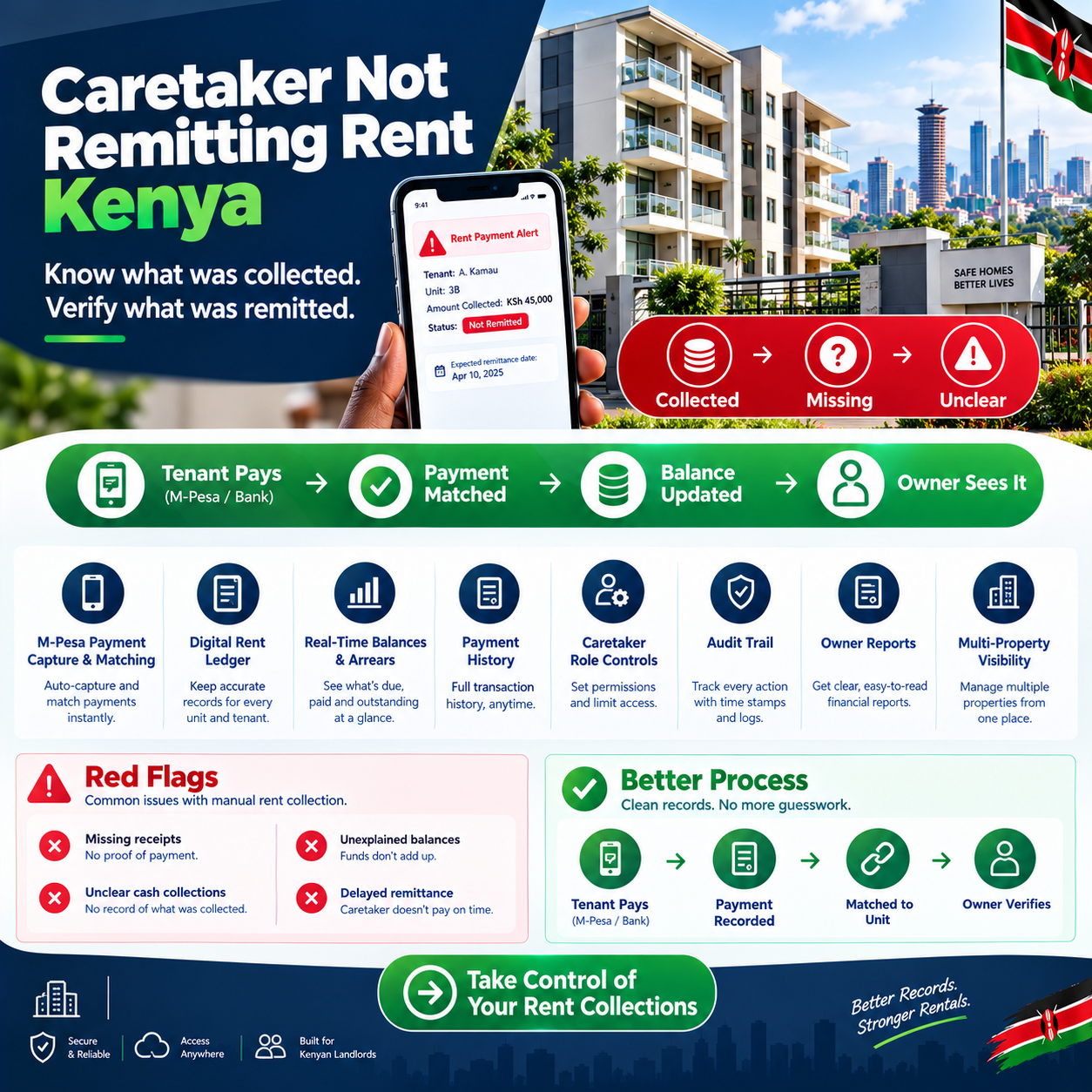
Caretaker not remitting rent Kenya is one of the most painful betrayals in property ownership, and also one of the most common. You trusted someone with your income, they collected it faithfully, and month after month the money quietly never arrived. If that is where you stand today, take heart — this problem is solvable, recoverable, and permanently preventable.
The pattern behind caretaker not remitting rent Kenya is remarkably consistent across the country, from single rooms in Pipeline to apartment blocks in Kilimani. Collections happen on the ground, reports stay smooth, and shortfalls surface only when the numbers are finally checked. The good news is that the pattern has known causes, proven fixes, and a clear prevention path.
This guide walks you through the entire journey — from suspicion to verification, from conversation to recovery, and from repair to prevention. You will learn how to confirm what is really happening before accusing anyone, what your legal options are, and how to restructure so it never repeats. By the end, you will have a complete, calm plan for handling caretaker not remitting rent Kenya from first doubt to final solution.
Why Caretakers Stop Remitting
Understanding why caretaker not remitting rent Kenya happens helps you respond wisely instead of reacting blindly. Not every case begins as theft, and knowing the difference changes the right response. Here are the honest causes, from innocent to criminal.
The first cause is drift. A caretaker with a sick child “borrows” from collections intending to return it, then the debt compounds and silence follows. Many cases of caretaker not remitting rent Kenya begin exactly this way — with a small, desperate loan that snowballed into a habit.
The second cause is poor records on both sides. When nobody tracks payments daily, amounts blur, months blur, and both parties end up holding different versions of the truth. Confusion, not malice, explains a surprising share of caretaker not remitting rent Kenya disputes.
The third cause is a vague mandate. If remittance dates, methods, and proof were never agreed in writing, the caretaker defines the routine — and the routine drifts. Ambiguity is where caretaker not remitting rent Kenya breeds fastest.
The fourth cause is deliberate fraud. Some caretakers systematically skim, report phantom vacancies, or collect from tenants who “do not exist” on your records. This end of the spectrum is criminal in nature, and it demands the firm end of your response to caretaker not remitting rent Kenya.
The Warning Signs
Catching caretaker not remitting rent Kenya early depends on knowing the signals. Individually, each sign has innocent explanations; together, they form a pattern. Watch for these, especially in combination.
Sign one: tenants say they paid while your caretaker reports them unpaid or “away.” When a tenant shows you an M-Pesa message for rent your records say never arrived, the mismatch is the whole case. Direct tenant contact is the single best detector of caretaker not remitting rent Kenya.
Sign two: remittances arrive late, shrink, or arrive attached to stories. “The tenant traveled,” “the house was locked,” “he will pay next week” — once or twice is life, every month is a system. Chronic story-telling is a classic signature of caretaker not remitting rent Kenya.
Sign three: repairs are claimed but never visible. Money requested for a pump, a gate, or paint that never materializes is collections finding another destination. Pair every repair claim with photos, or the pattern of caretaker not remitting rent Kenya will hide inside maintenance.
Sign four: resistance to records. A caretaker who avoids written receipts, dodges daily logs, or discourages you from meeting tenants is avoiding verification itself. Reluctance to be checked is the loudest warning in the entire subject of caretaker not remitting rent Kenya.
Verify Before You Accuse
Before acting on caretaker not remitting rent Kenya, verify — because a false accusation destroys a good caretaker and your information channel with them. Accusations built on assumptions are how good relationships die and how the guilty walk free. Here is the verification sequence.
Step one: talk to tenants directly, respectfully, and without drama. Ask how their rent is going, whether receipts come promptly, and whether anyone collects cash on your behalf. Five honest conversations reveal more about caretaker not remitting rent Kenya than a year of reports.
Step two: ask tenants to show you payment confirmations. M-Pesa messages carry dates, amounts, and the receiving number — the raw truth of who paid and when. Reconcile those messages against what actually reached you, and the gap in caretaker not remitting rent Kenya becomes arithmetic instead of accusation.
Step three: inspect the property or send a neutral third party. Check occupancy against your records: units the caretaker calls vacant may be occupied, and occupied units may be paying someone else. Physical reality is the ultimate referee in caretaker not remitting rent Kenya cases.
Step four: compare everything against a written timeline. List what was collected, what was remitted, and what was claimed, with dates attached. A dated summary turns caretaker not remitting rent Kenya from a feeling into a file — and the file is what protects you in every step that follows.
What NOT to Do
Just as important as acting is refusing to act badly, because the wrong response can turn a winnable case into a disaster. Avoid these six mistakes completely. They cost landlords money, cases, and sometimes their freedom.
Do not accuse before verifying, because a wrong accusation defames an innocent person and destroys your only source of ground truth. Do not take self-help measures — seizing property, locking out tenants, or detaining anyone can expose you to legal liability that outlasts the original loss. Self-help is how victims of [caretaker problems become offenders in their own right.
Do not broadcast your suspicions in estate groups or to neighbors before the facts are firm, because defamation claims are real and reputations — including yours — are at stake. Do not accept vague verbal apologies without a written acknowledgment, because words evaporate exactly when you need them. And do not let it slide for “one more month,” because every month of delay deepens the hole and weakens your evidence.
The Conversation
Once verified, address caretaker not remitting rent Kenya directly, privately, and calmly. Anger feels justified, but a controlled conversation recovers money and preserves evidence better than a public confrontation ever will. Choose a private setting, bring your file, and state the facts.
Present the figures: collected, remitted, and the difference, with dates attached. Give the caretaker a genuine opportunity to explain, because verification can still surprise you. Some cases of caretaker not remitting rent Kenya end here with an honest confession and a repayment plan.
Whatever the outcome, get it in writing. An acknowledgment of the balance, a signed repayment schedule, or a clean resignation — every resolution should exist on paper. The document is what converts caretaker not remitting rent Kenya from a quarrel into an enforceable matter.
Build the File That Wins
Whether your matter ends in a repayment plan, a dismissal, a tribunal, or a courtroom, one artifact decides everything: the file. A complete file is your voice in rooms where you will not be present. Build it deliberately, starting today.
Your file should contain the dated timeline of collections and remittances, copies or screenshots of tenant payment confirmations, and any acknowledgment or agreement the caretaker signed. Add the working agreement or messages that defined the caretaker’s duties, plus photographs, inspection notes, and every relevant message thread. Organize it by date, keep digital and printed copies, and never edit the originals.
The discipline pays off in every direction. A strong file makes repayment plans more likely, dismissals safer, and legal routes faster and cheaper. Landlords who win cases are almost never the angriest — they are the best documented.
Your Legal Options
When conversation fails, the law offers real remedies for caretaker not remitting rent Kenya, and knowing them strengthens your position. Your caretaker acted as your agent or employee, holding money in trust for you. That trust creates obligations on both the civil and criminal sides of Kenyan law.
On the criminal side, collecting money you were entrusted to pass on and keeping it can amount to a criminal offense — commonly charged in such situations as stealing by an agent or servant. A police report is the starting point, and a lawyer will tell you how strong your case is. Treat the criminal route as a serious step for serious amounts involved in caretaker not remitting rent Kenya, guided by professional advice.
On the civil side, you can sue to recover the money. For modest amounts, the Small Claims Court offers a fast, low-cost route — confirm the current monetary limits and process, since they evolve. Small Claims Court has become the practical home of many caretaker not remitting rent Kenya recovery cases because it is quick, affordable, and does not require an advocate.
For larger amounts or complicated facts, engage an advocate. Bring your file — the timeline, the acknowledgments, the tenant confirmations — because evidence wins these cases. Whatever route you take for caretaker not remitting rent Kenya, never let frustration push you into self-help measures, which can turn you from victim into offender.
One honest note: this section is general information, not legal advice. For significant amounts, have an advocate review your file before choosing a route. The small cost of that review protects everything you are trying to recover.
Fix the Structure: Take the Money Out of Their Hands
The deepest fix for caretaker not remitting rent Kenya is structural: remove the caretaker from the money entirely. Kenya’s mobile money rails make this remarkably easy in 2026. One afternoon of setup changes the game permanently.
Open a dedicated M-Pesa line or Paybill in your name, and give tenants the number directly. Rent flows to an account only you control, creating an independent record no one curates for you. This single arrangement eliminates the root condition of caretaker not remitting rent Kenya — the intermediary position itself.
With payments flowing direct, redefine the caretaker’s role as physical, not financial. They show units, report issues, coordinate repairs, and log any unavoidable cash the same day with photos of receipts. That is a fair, honest job — and it removes every temptation that powers caretaker not remitting rent Kenya.
Where cash remains unavoidable, build a tight protocol. Same-day logging, a photo of the written receipt, the tenant’s signature, and immediate entry into your records. Cash under protocol stays clean; cash in silence is where caretaker not remitting rent Kenya lives.
Reconcile daily for the first month after restructuring, then weekly. Compare what tenants say they paid against what your account received, and question every gap within a day. Daily reconciliation is the immune system that keeps caretaker not remitting rent Kenya from ever returning.
Separate the Duties
Even with direct payments, apply the old principle of separation of duties to caretaker not remitting rent Kenya prevention. Whoever collects anything should not be the only one who inspects, reports, or authorizes repairs. Overlapping eyes keep everyone honest — including the honest.
Split the roles across people where your portfolio allows. A caretaker who shows units, a relative who occasionally inspects, and repairs paid directly by you to verified fundis. Redundancy like this is the cheapest insurance ever invented against caretaker not remitting rent Kenya.
Where you cannot split roles — a single caretaker on a single plot — substitute technology for the second pair of eyes. Cameras at the gate, tenant check-ins, and daily dashboards do the work of a second person. Small owners are exactly who modern tools rescued from the worst of this problem.
Let Technology Watch With You
Technology converts oversight from suspicion into routine, and 2026 tools are built for exactly this. The right platform makes caretaker not remitting rent Kenya nearly impossible to hide. Here is the stack that works.
A rent tracking platform is the foundation. Every expected payment, every receipt, and every gap appears on one dashboard you can open from anywhere. When a tenant’s payment and your account disagree, caretaker not remitting rent Kenya surfaces in days instead of months.
Automated reminders add a second layer. The system nudges tenants before due dates, and their responses become visible data rather than private conversations with the caretaker. Payment patterns that once concealed caretaker not remitting rent Kenya now display themselves.
Daily and weekly reports close the loop. A morning summary of collections and outstanding units replaces the caretaker’s monthly story with the account’s daily truth. Owners who receive daily numbers report that attempts at caretaker not remitting rent Kenya simply die for lack of darkness to grow in.
Cameras complete the stack. A Wi-Fi camera at the gate records the arrivals your income depends on, and motion clips review in minutes. Virtual presence at the gate is a proven deterrent, and it is the final layer that makes caretaker not remitting rent Kenya a problem of the past rather than the future.
Hiring a Caretaker Who Won’t Steal
Prevention begins at hiring, because the best fix for caretaker not remitting rent Kenya is never hiring the wrong person. Good caretakers exist in every neighborhood, and they respond beautifully to fair pay and clear systems. Hire slowly, verify thoroughly, and start small.
Check references from other landlords they have served, and call at least two. Ask the previous owners one direct question: would you rehire this person with your money? References freely given are the best screen against caretaker not remitting rent Kenya.
Verify identity and residency documents, and keep copies. Know where your caretaker lives and who knows them locally, because community accountability is powerful. Anonymous hires are the ones most likely to end in caretaker not remitting rent Kenya.
Start with a probation period on one unit or one wing. Watch the records closely for three months before expanding trust, and expand it gradually. Trust that grows in measured steps is what keeps caretaker not remitting rent Kenya out of your future.
The Caretaker Agreement
Put the working relationship in writing, because ambiguity is the accomplice of caretaker not remitting rent Kenya. A simple one-page agreement transforms the relationship from informal favors into defined duties. It protects good caretakers as much as it protects you.
The agreement should state duties, working days, and the boundary that matters most here: the caretaker collects no money except under the cash protocol, and every collection is logged the same day. It should state the remittance rule for any cash — same day, documented, receipted. Clarity on money is the clause that prevents caretaker not remitting rent Kenya before it exists.
Add the reporting standard: daily logs, photo evidence for repairs, and immediate escalation of anything unusual. State the consequences of breach plainly and fairly, and both parties sign. A signed standard is the quiet headstone of caretaker not remitting rent Kenya.
Rebuilding Your Records After the Discovery
After the shock comes the cleanup, and doing it well matters as much as the fix itself. The discovery usually means your books are incomplete, so rebuild them on a foundation both you and your tenants confirm. Here is the sequence that works.
Set a clean start date, and confirm each tenant’s true position in writing before it. A short message per tenant — what you believe they owe as at the date, and an invitation to correct it — produces a baseline everyone accepts. Confirmed balances are the only trustworthy opening point.
Issue proper receipts going forward, and backfill what can be evidenced from M-Pesa messages and old acknowledgments. Where history cannot be proven, note it honestly and move forward clean rather than carrying guesses into the new system. A records restart is the hidden gift inside every painful discovery, because it forces the discipline that prevents recurrence.
Prevention Systems for the Long Term
After fixing the immediate case of caretaker not remitting rent Kenya, build the systems that make a repeat impossible. Prevention is not one action but a small set of habits that run themselves. Here is the permanent kit.
Direct payments in your name are the structural foundation. Daily or weekly reconciliation is the checking habit. Those two alone remove the conditions that produce caretaker not remitting rent Kenya.
Monthly tenant touchpoints keep your own channel to tenants alive — a short message and a receipt that needs no intermediary. Quarterly cross-checks compare caretaker reports against cameras, meters, and direct tenant conversations. These rhythms are how vigilant owners stay ahead of caretaker not remitting rent Kenya forever.
Annual reviews complete the kit. Re-verify the caretaker’s references, review the agreement, adjust pay to market, and refresh the systems. Annual maintenance of trust is the long-term cure for caretaker not remitting rent Kenya.
Keep the Good Ones
An honest word about the caretakers who never steal, because they are the majority. Heavy-handed oversight of loyal people breeds the resentment that eventually creates the very problem you feared. The goal is systems that protect everyone, not suspicion that punishes everyone.
Pay fairly and on time, because underpaid caretakers subsidize themselves in ways you will not choose. Respect the good ones publicly, and let the records speak for their reliability. Recognition is the cheapest retention tool ever devised against caretaker not remitting rent Kenya.
Frame every system as protection for them too. A caretaker whose collections are logged cannot be falsely accused, and one whose reports carry photos cannot be blamed for surprises. Framed that way, honest caretakers become the loudest supporters of the toolkit that ends caretaker not remitting rent Kenya for good.
When to Hire a Property Manager Instead
Sometimes the right answer is not a better caretaker but a different structure entirely. Professional property managers take over tenant placement, rent follow-up, maintenance coordination, and reporting — typically for a percentage of collected rent. For busy, absent, or growing owners, the trade can be excellent.
Apply every principle from this guide to the manager too. Insist that tenant payments flow to your account, demand monthly statements, and verify with occasional direct tenant contact. Delegation changes the job description, never your right to see the numbers.
A good manager costs more than a caretaker and prevents far more than they cost. The transparency standards in this guide are exactly what separates professional firms from the informal agents who give the industry a bad name. Choose partners who welcome verification — it is the surest sign you have found one.
Real Scenarios
Picture an owner in Kisumu with twelve bedsitters whose remittances shrank from full to half to stories over a year. A single afternoon of tenant phone calls revealed seven tenants paying faithfully into a number he had never seen. His case ended with a signed repayment plan and a new direct-payment structure that has held for two years.
Picture a diaspora owner in Manchester whose caretaker reported her Kitengela house vacant for four months. Her tracking platform reconciled tenants’ M-Pesa messages against her Paybill and exposed the gap in one week. Recovery followed, and the restructured setup means the problem structurally cannot recur there.
Picture a young landlord in Embakasi who almost dismissed his caretaker on a neighbor’s rumor. Verification showed the “missing” money was a genuine medical emergency, repaid in full under an agreed schedule. The humane handling kept a loyal employee and became the neighborhood’s favorite story about fair dealing.
These stories repeat across the country because the mechanics are universal. Verification separates the guilty from the struggling, and structure separates the honest from temptation. Every outcome improves when facts come before feelings.
What It Costs
Fixing this costs less than most owners fear. The structural fixes are nearly free: a dedicated M-Pesa line costs nothing to open, and tenant messages cost a few shillings. The paid layer is modest and entirely optional.
- Rent tracking platform: free tiers available; roughly KSh 500–3,500 monthly for paid plans
- Wi-Fi gate camera: from about KSh 3,000–8,000 as a one-time cost
- Legal help: Small Claims Court filing is inexpensive; advocate fees vary, so ask for quotes
- Caretaker pay adjustment: whatever local market fairness requires
Weigh any of these against one recovered month of rent. The math favors action overwhelmingly, every single time. Delay is the only expensive option in the whole matter.
The Road Ahead
The direction of travel favors owners permanently. Payment rails, tracking platforms, and verification tools keep integrating, shrinking the space where intermediaries can hide money. Within a few years, the collect-and-hope model will look as dated as the exercise-book ledger.
Act on the tools that exist today. Every fix in this guide is available, affordable, and proven across thousands of portfolios. The era of hoping is over, and the era of knowing is the permanent answer to caretaker not remitting rent Kenya.
Frequently Asked Questions
Can I fire a caretaker for not remitting rent?
Yes — collecting money in trust and failing to pass it on is gross misconduct that can justify summary dismissal, provided the facts are verified and documented. Put the termination and reasons in writing, settle any lawful dues, and keep the file. Documented facts are what make dismissals safe rather than risky, since employment law protects workers from unfair termination.
What is the single most important step?
Take the money out of the caretaker’s hands with direct payments to your own M-Pesa or Paybill. Everything else in this guide supports that one structural move. It is the permanent vaccine against caretaker not remitting rent Kenya.
Should I involve the police immediately?
Verify first, converse second, and involve the police when the amount is significant, the caretaker vanishes, or they refuse to engage. Criminal process is a serious step best taken with verified figures and, ideally, legal guidance. For modest amounts, Small Claims Court often recovers the money faster.
What if tenants conspire with the caretaker? Cross-check against independent streams — your own account records, gate cameras, meter patterns, and a physical inspection. Conspiracies leave gaps that arithmetic exposes. That is why redundant verification beats any single source.
How do I handle it if the caretaker is a close relative?
Hold family to the same documentation standards as professionals, and separate family generosity from property cash flow. Help relatives from your own pocket if you choose — never through untracked collections at your property. Blurred lines are how most family caretaker cases go wrong.
Can I deduct the shortage from the caretaker’s salary?
Deductions from wages are regulated under employment law, so process and documentation matter — get advice before docking pay. A signed acknowledgment of the debt, or a lawful agreement, puts you on far safer ground than an unilateral deduction. When in doubt, recover through the civil routes instead.
How long do I have to act?
Civil claims for recovery of money generally enjoy generous limitation windows — commonly around six years for contract-based claims — but evidence decays far faster than the law’s patience. M-Pesa records, messages, and memories all fade, so build your file now. Acting early is cheaper, faster, and kinder to everyone, including the innocent.
What if the caretaker claims the money went to expenses I approved?
This is exactly why the file matters — approved expenses should have evidence, and undocumented claims should be weighed against your dated records. Legitimate costs supported by receipts can be acknowledged; unsupported ones remain part of the balance. Verification before accusation protects you here too.
Can I recover money from a caretaker who has already left?
Yes — a written acknowledgment, tenant confirmations, and your timeline support a civil claim, and Small Claims Court is designed for exactly such amounts. The older the case, the more the records matter, so build the file first. Money recovered late is still money recovered.
How do I rebuild trust with tenants after discovering this?
Be honest, apologize for the gap, issue proper receipts going forward, and show them the new direct-payment system. Tenants overwhelmingly respect owners who fix problems transparently. Most will pay you more loyally after a well-handled fix than before the problem existed.
Where can I find verified tenants and landlord tools together?
Start with platforms that combine verified listings with landlord-friendly technology, such as rentaldesk.co.ke. Pairing the right tenants with direct payments and daily records takes you from betrayal to bulletproof.