
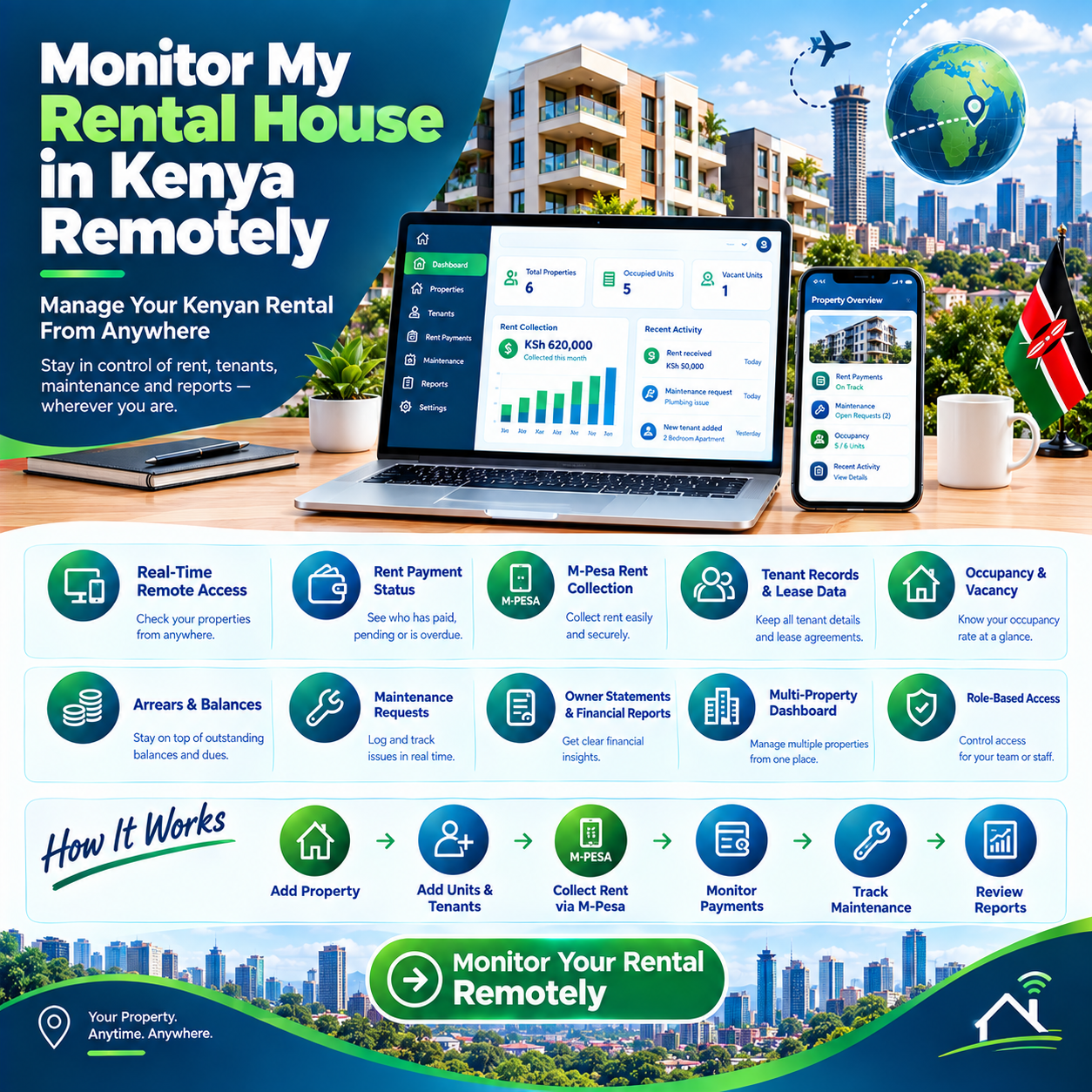
Monitor my rental house in Kenya remotely is the question thousands of owners are asking as work, family, and opportunity pull them away from the properties they worked so hard to build.
The house stands in Kasarani or Kitengela while you sit in Nairobi’s CBD, Mombasa, or another country entirely, and the distance between you and your investment can feel enormous.
The encouraging truth of 2026 is that this distance has become almost entirely closable with tools you can afford and set up yourself.
Modern monitoring combines mobile money records, simple cameras, scheduled video calls, and smart sensors into one clear window onto your property.
Owners who assemble that window report something remarkable: they often know more about their houses than neighbors who live around the corner.
This guide shows you exactly how to monitor my rental house in Kenya remotely from first principles to finished routine.
We cover what to watch — money, security, utilities, people — and the specific tools that watch it for you.
We also cover the routines, the costs, the privacy rules, and the mistakes that catch unprepared owners.
By the end, you will have a complete, practical plan to monitor my rental house in Kenya remotely starting this week.
Whether you live across the city or across an ocean, the same system serves you.
Distance no longer decides how much you know about your own property — your system does.
And building that system costs less than one month of rent, which is the best bargain in property today.
What Remote Monitoring Actually Means
To monitor my rental house in Kenya remotely means keeping verified, continuous awareness of your property’s money, condition, occupancy, and people without being physically present.
It is different from full remote management, which adds tenant placement, repairs, and formalities to the picture.
Monitoring is the eyes; management is the hands.
You can hire out the hands, but the eyes belong to you alone — that division is the soul of the whole discipline.
The owner who learns to monitor my rental house in Kenya remotely properly never has to choose between blind trust and constant anxiety.
Monitoring rests on four pillars, and each one is independently simple.
The first pillar is money visibility — knowing what rent has arrived, from which unit, and when.
The second is physical visibility — seeing the house, the compound, and its condition through cameras and scheduled video.
The third is utility visibility — water, power, and the quiet failures that become expensive when nobody watches.
The fourth is people visibility — knowing your tenant, your caretaker, and any visitors are behaving as agreed.
An owner who has all four pillars in place can genuinely monitor my rental house in Kenya remotely as well as someone standing at the gate.
The beautiful part is that all four now run on the phone already in your pocket.
No special equipment beyond a modest camera budget, no subscriptions beyond a few hundred shillings, and no technical skills beyond WhatsApp.
That accessibility is why this is the golden era of the decision to monitor my rental house in Kenya remotely.
The Visibility Gap: What Goes Unseen
Before building the system, understand honestly what silence costs, because the unseen has a price.
The problems that grow in unmonitored houses are remarkably consistent across the market.
Each one is preventable with the right window onto your property.
The first unseen problem is silent arrears.
A tenant stops paying, the caretaker reports everything as normal, and three months vanish before you discover the truth.
Money monitoring — the first pillar — closes this gap within days, which is why it comes first for anyone setting out to monitor my rental house in Kenya remotely.
The second unseen problem is the quiet leak.
A dripping pipe, a running toilet, or a failing pump can waste thousands of shillings and months of infrastructure life before anyone reports it.
Utility monitoring catches these in their cheap stage rather than their expensive one.
The third unseen problem is unauthorized occupation.
Subletting, moved-in relatives, and even complete stranger-occupants appear in houses whose owners stopped watching.
Occupancy monitoring makes surprise tenants impossible.
The fourth unseen problem is caretaker drift — collections reported late, repairs skipped, small sums borrowed without asking.
Oversight systems keep honest caretakers honest and make drift visible early.
Every one of these problems shares the same root: information flowing only through one interested party.
Break that monopoly and the entire risk category collapses — which is the core promise when you monitor my rental house in Kenya remotely with a real system.
Pillar One: Watching the Money
Money is the most important thing to see and the easiest, because Kenya’s payment rails do most of the work.
The foundation is a dedicated M-Pesa line or Paybill in your name.
Tenant payments land in an account only you control, creating an independent record nobody curates for you.
This single arrangement is the structural heart of every serious plan to monitor my rental house in Kenya remotely.
On top of that account sits a rent tracking platform that records every payment, matches it to the right unit, and flags whatever does not arrive.
Your dashboard becomes the live financial heartbeat of the house.
The owner who monitors my rental house in Kenya remotely through such a platform knows within a day whether rent moved or did not.
Compare that with the traditional arrangement, where you learn about payments through a caretaker’s monthly summary.
One method gives you today’s truth; the other gives you someone’s version of last month.
The difference is the entire gap between hope and knowledge.
Automated reminders add a second layer of sight.
When the system nudges tenants before due dates, you can see from the response pattern who is struggling, who is ignoring, and who simply forgot.
Those patterns are gold, and they flow automatically once you monitor my rental house in Kenya remotely through a platform rather than through messages.
Cash remains the honest exception, and it deserves its own protocol.
If your tenant or caretaker pays in cash, require a photo of the written receipt with timestamp, logged into your records the same day.
A cash culture under monitoring stays clean precisely because every note carries a witness.
Set a simple monthly reconciliation: rent charged, rent received, and rent outstanding must agree.
Five minutes of checking proves your records are complete.
That equation is the proof step that makes everything else about how you monitor my rental house in Kenya remotely trustworthy.
Pillar Two: Cameras and Smart Devices
Physical visibility once meant flying home; now it means a shopping list and an afternoon of setup.
The devices below turn any house into something you can look at from any distance.
Start with the essentials and expand as your comfort grows.
CCTV cameras in shared and exterior areas are the foundation.
Cover the gate, the parking area, the corridor if you own a block, and any shared compound space — never inside tenant living areas, for reasons covered in the privacy section.
Modern Wi-Fi cameras cost from about KSh 3,000, stream to your phone, and store motion-triggered clips in the cloud.
An owner reviewing gate footage twice a week has transformed the ability to monitor my rental house in Kenya remotely more than any other single purchase.
Smart video doorbells add a focused eye on the entrance.
They record every arrival and departure, let you speak to visitors from anywhere, and deter the casual misconduct that thrives on privacy.
Motion-activated lights and door sensors extend your awareness cheaply.
A sensor at the gate or corridor that pings your phone tells you the house is alive — and tells you when movement happens at odd hours.
Smart meters and plug monitors watch consumption, which doubles as both a utility alert and an occupancy signal, as you will see below.
Water tank level sensors deserve special mention for any house that depends on stored water.
Cheap ultrasonic sensors report tank levels to your phone, ending the classic crisis of the dry tank discovered by an angry tenant.
An owner who sees the water before the tenant does has permanently changed what it means to monitor my rental house in Kenya remotely in a water-sensitive city.
Choose devices that work on local power realities: battery-backed cameras for blackouts, and low-data modes for connections that dip.
Test everything before you rely on it, because a camera that fails silently is worse than no camera at all.
Reliability, not sophistication, is the standard for anyone building the system to monitor my rental house in Kenya remotely that actually holds up.
Pillar Three: Watching Water, Power, and Utilities
Utilities are where small failures become big bills, and they respond beautifully to monitoring.
Water comes first in Kenya, always.
Install a tank level sensor if the house depends on storage, and ask your tenant or caretaker to send a photo of the gauge weekly where sensors are not fitted.
Either way, the tank enters your awareness instead of becoming a monthly surprise.
Track the water pattern alongside your rent records.
A tank that empties faster than usual may signal a burst pipe, a new unreported occupant, or a leaking valve — all catchable early.
Pattern-watching like this is the quiet intelligence behind every owner who has learned to monitor my rental house in Kenya remotely over a full year.
Power tells similar stories.
Prepaid meters send low-balance and purchase alerts, and a sudden change in purchase rhythm can flag an empty house, a failing appliance, or meter tampering.
Where you supply shared power — security lights, pumps, common areas — a smart plug or clamp meter puts consumption on your screen in real time.
Internet connectivity deserves monitoring too, especially if you advertise it as an amenity.
A simple weekly speed test arranged with your tenant, or a router you can ping remotely, keeps the service honest.
Amenities that silently die are how good tenants quietly decide not to renew — a loss that visibility prevents for anyone committed to monitor my rental house in Kenya remotely as a long-term practice.
Garbage, service charges, and county bills round out the utility picture.
Put every recurring obligation into a calendar with photo-proof requirements when payments happen through other hands
The goal is simple: nothing about the house runs on memory.
When money, water, and power all report themselves, you have built the sustainable version of the decision to monitor my rental house in Kenya remotely.
Pillar Four: Scheduled Video Inspections
Cameras watch continuously, but nothing replaces a guided walkthrough.
Schedule a video inspection with your tenant or caretaker every month or quarter, walking the house room by room on a call.
Fifteen minutes of live video tells you what no dashboard can.
During the walkthrough, look deliberately: ceilings for stains, corners for mold, taps and flushes for pressure, windows and locks for wear, and the compound for drainage after rain.
Ask the tenant directly how things are working, and let them show you anything they have been tolerating silently.
Tenants routinely reveal maintenance issues on camera that they never bothered to report — a discovery that alone justifies the routine for anyone serious about choosing to monitor my rental house in Kenya remotely.
Record or screenshot key moments, and file them by date in your cloud folder.
Over a year, those files become a visual history of the property that settles any future dispute about condition.
Take the same tour at the same time each visit, because consistency is what makes comparisons meaningful.
Move-in and move-out deserve their own extended video sessions, conducted with the tenant present.
Record the condition, the meter readings, and the inventory together, and both parties keep copies.
Those two recordings bracket every tenancy with evidence, which is the protective frame around everything you do to monitor my rental house in Kenya remotely across the years.
Monitoring Your Caretaker Without Insulting Them
If a caretaker or agent works at the property, they need watching too — and the watching needs framing.
Handled well, oversight elevates honest people and deters the rest.
Handled badly, it breeds resentment that costs more than the fraud ever would.
The framing that works is simple and true: the system protects you both.
A caretaker whose collections are logged with timestamps cannot be falsely accused, and one whose reports carry photos cannot be blamed for surprises.
Explain that openly on day one, and most good field staff become allies of the very systems you use to monitor my rental house in Kenya remotely.
Then apply three structural practices.
First, separate duties: whoever collects money should not be the only one who inspects, and whoever authorizes repairs should not be the only one who executes them.
Second, require evidence with every report: photos before and after any repair, receipts for any purchase, and same-day logging of any cash.
Third, cross-check occasionally: compare caretaker reports against gate camera footage, meter patterns, and direct tenant check-ins twice a quarter.
Discrepancies between those streams are the earliest and most reliable fraud alarms that exist.
An owner who runs this triangle can honestly say they monitor my rental house in Kenya remotely rather than merely hoping from a distance.
And pay your caretaker fairly and on time, because underpaid people subsidize themselves in ways you will not choose.
Generosity plus oversight is the combination that keeps good people good for years.
Monitoring Tenants and Occupancy
Your tenant relationship benefits from the same gentle visibility.
Start with a simple move-in confirmation routine: signed agreement, deposit receipt, condition video, and meter photos, all filed before keys change hands.
That starting snapshot anchors everything you will compare against later.
During the tenancy, keep a monthly touchpoint — a short message checking in, paired with the rent receipt or statement.
The habit costs one minute and tells you volumes about how the house is living.
Tenants who hear from a present, responsive owner treat the property better, which is the quiet return on the effort to monitor my rental house in Kenya remotely through relationship rather than surveillance.
Watch occupancy signals that appear in your existing data.
Water consumption, power purchase patterns, gate traffic on camera, and even the neighbor’s observations all reveal whether the agreed occupants are the actual ones.
Subletting discovered in month two is a conversation; discovered in month twelve, it is a crisis.
Early discovery is only possible for owners who genuinely monitor my rental house in Kenya remotely rather than occasionally glancing.
Respect the boundary that makes this work: monitor the property and the agreement, not the tenant’s private life.
Cameras at the gate, not in the corridor outside their door; utility patterns, not personal profiling.
That restraint keeps your monitoring ethical, legal, and welcome — which paradoxically makes it more effective for anyone committed to monitor my rental house in Kenya remotely for the long haul.
Your Starter Toolkit and What It Costs
Everything above assembles into a modest, concrete shopping list.
Here is the realistic 2026 starter kit for a single house:
- Wi-Fi CCTV camera for the gate or compound: from about KSh 3,000–8,000
- Video doorbell: from about KSh 5,000–12,000
- Water tank level sensor: from about KSh 2,500–6,000
- Smart plug or clamp meter for shared power: from about KSh 1,500–4,000
- Rent tracking platform: free tiers available; paid plans roughly KSh 500–3,500 monthly
- Dedicated M-Pesa line or Paybill: free to set up
- Cloud storage for records and videos: free to a few hundred shillings monthly
- WhatsApp, video calls, and calendar: free
The full hardware kit lands under KSh 30,000 for most houses, and the running costs stay under a month’s rent per year.
Against a single prevented silent-arrears quarter or a single caught water leak, the entire system pays for itself immediately.
That math is why the decision to monitor my rental house in Kenya remotely is one of the highest-return choices an owner can make.
Buy reliability over features.
A slightly older camera from a brand with local support beats a feature-packed gadget that dies in the first blackout.
And test every device for a week before trusting it, because monitoring you cannot verify is not monitoring at all — a rule that separates real systems from toy setups for anyone building the capacity to monitor my rental house in Kenya remotely seriously.
The Weekly and Monthly Rhythm
Tools only work inside a rhythm, so give yours a schedule that fits on one page.
Weekly, take ten minutes: glance at the payment dashboard, review any motion clips from the gate camera, and check the tank sensor trend.
That single sitting keeps your house inside your peripheral vision at all times.
Monthly, take thirty minutes: reconcile rent charged against received, hold the video walkthrough or caretaker check-in, review utility patterns, and archive the month’s records into one dated folder.
Archive discipline is what turns monitoring into history, and history is what turns into evidence when you someday need it.
Quarterly, take an hour: do the deep video inspection, cross-check caretaker reports against cameras and meters, and review every recurring bill against its calendar.
Owners who keep this three-speed rhythm report the same thing: the house stops generating surprises.
Surprise-elimination is the true product of the decision to monitor my rental house in Kenya remotely as a settled habit.
Annually, add the big reviews — insurance, agreements, market rent, and if travel allows, one in-person visit.
The annual visit recalibrates everything the screens have shown you.
Even the most digital owner benefits from one physical grounding per year.
Privacy, Consent, and the Law
Monitoring your own property is legitimate, but it has boundaries that protect you as much as anyone.
Kenya’s Data Protection Act 2019 frames how personal data — including camera footage — should be collected, stored, and used.
Respecting that framework is straightforward with a few rules.
Never place cameras inside tenant living spaces.
Interior surveillance of a tenant’s home crosses legal, ethical, and relational lines that no landlord benefit justifies.
Shared and exterior areas — gates, corridors, compounds, parking — are the legitimate domain of property monitoring.
Tell people they are on camera.
Visible signage or a line in the tenancy agreement stating that common areas are under camera coverage satisfies both the law and basic fairness.
Consent transforms surveillance into shared security, and tenants overwhelmingly prefer disclosed cameras to discovered ones.
Store footage responsibly.
Limit retention to a reasonable window, restrict who can view it, and never use footage for purposes beyond property security and agreement enforcement.
Responsible handling is part of the professionalism that defines the modern owner who chooses to monitor my rental house in Kenya remotely the right way.
Use utility and pattern data for the agreement, not for profiling.
Noticing that consumption suggests subletting is agreement enforcement; building personal dossiers on tenants is something else entirely.
Keep the purpose clean and the practice stays clean.
These boundaries are not obstacles — they are the reason tenants accept and even appreciate monitoring
A system tenants trust produces better information than one they evade, which is the practical wisdom behind ethical monitoring.
Common Mistakes to Avoid
Mistake one is buying cameras and calling it a system.
A camera without a records routine, a payment structure, and a rhythm is a gadget, not oversight.
The full four pillars together are what it actually takes to monitor my rental house in Kenya remotely with confidence.
Mistake two is monitoring in bursts.
Two intense weeks followed by three silent months recreates the exact blindness the system exists to remove.
The rhythm section above is the cure, and it costs less time per month than one episode of a series.
Mistake three is depending on one information stream.
Caretaker reports alone, camera footage alone, or tenant messages alone can each be wrong; the power lives in the cross-checking.
Redundancy is the engineering principle that makes the whole design to monitor my rental house in Kenya remotely trustworthy.
Mistake four is secret monitoring.
Hidden cameras and covert checks, when discovered, destroy the trust that took years to build and may create legal exposure.
Disclose, document, and monitor openly — the transparent system outperforms the secret one on every measure that matters.
Mistake five is ignoring the alerts you paid for.
The sensor that pings, the platform that flags, and the camera that clips only create value when a human responds.
Budget the ten weekly minutes and the system will reward you for the life of the property.
Real Scenarios from Real Owners
Picture a teacher in Nakuru with a three-bedroom house in Rongai rented to a young family.
Her gate camera, tank sensor, and tracking dashboard fit together into one WhatsApp-sized morning routine.
When water purchases stopped matching the tank’s emptying pattern, she caught a burst pipe in week one instead of month three — the exact payoff of her choice to monitor my rental house in Kenya remotely.
Picture a businessman in Kampala with a bedsitter block in Embakasi run by a longtime caretaker.
Payments flow to his Paybill, collections log daily, and his quarterly cross-checks compare reports against gate footage and meter purchases.
The caretaker — honest and fairly paid — describes the system as the thing that finally proved his reliability to the owner.
Picture a nurse in Atlanta with a townhouse in Syokimau and no family nearby to lean on.
Her monthly video walkthrough with the tenant, archived systematically, has replaced every anxious question with a file she can open from her phone at lunch.
She describes the setup in one line: the house texts, and she listens.
These stories repeat because the mechanics are universal.
Direct payments, layered visibility, and a humane rhythm produce the same calm in every neighborhood.
The distance never left; the blindness did.
The Road Ahead: 2027 and Beyond
The trajectory of monitoring technology points toward effortless.
Sensors are merging into single apps, cameras are gaining local AI that alerts only for what matters, and platforms are connecting payments, utilities, and footage into one property view.
Within a few years, the effort required to monitor my rental house in Kenya remotely will shrink again while the clarity grows.
Predictive alerts are arriving fastest.
Systems are learning normal patterns for water, power, and payments, then surfacing only the deviations that deserve attention.
The owner of 2027 will not watch more — they will be interrupted less, and only when it counts.
The message for today’s owner is simple.
Every element of the system described here is available, affordable, and proven, and assembling it takes a weekend.
There has never been a better moment — from any distance — to monitor my rental house in Kenya remotely with total confidence.
Frequently Asked Questions
What is the cheapest way to monitor my rental house in Kenya remotely?
Start with the free layer: a dedicated M-Pesa line, a rent tracking platform with a free tier, and a weekly video call with your tenant or caretaker.
That combination alone delivers most of the financial and occupancy visibility for zero cost.
Add cameras and sensors as budget allows, prioritizing the gate and the water tank.
Can I put cameras inside my tenant’s house?
No — interior surveillance of a tenant’s living space is legally and ethically off-limits, and it would rightly end the tenancy relationship.
Cameras belong in shared and exterior areas like gates, corridors, compounds, and parking, with clear disclosure to tenants.
Disclosure keeps your monitoring lawful, ethical, and effective.
How often should I check on the property?
Ten minutes weekly for dashboards and camera clips, thirty minutes monthly for reconciliation and a video walkthrough, and an hour quarterly for the deep inspection and cross-checks.
That three-speed rhythm catches everything that matters without consuming your life.
Consistency matters far more than intensity.
What do I do if my caretaker resents the monitoring?
Frame it honestly as protection for them as much as for you — logged collections cannot be falsely questioned, and documented reports cannot be blamed for surprises.
Pair the system with fair pay and respect, and good caretakers typically become its strongest supporters.
The ones who resist transparency were usually the reason you needed it.
Which is more important to monitor first: money or the physical house?
Money first, always, because silent arrears are the most expensive and fastest-growing risk.
Direct payments plus a tracking platform close that gap within days.
Physical monitoring follows immediately after, with the gate camera and water sensor as the first hardware purchases.
Do these tools work during blackouts and poor internet?
Choose battery-backed cameras, low-data modes, and platforms that store data offline and sync when connection returns.
Local realities make resilience a core requirement, not a luxury.
Test every device through one blackout and one weak-network day before you rely on it.
How do I monitor a house I inherited or co-own with family?
The same system applies, with one addition: put the monitoring arrangement and duties in writing among the co-owners so everyone sees the same records.
Shared dashboards and a common archive prevent the family disagreements that unmonitored property invites.
The system is often the fairest family member in the room.
Where can I find verified tenants and landlord tools together?
Start with platforms that combine verified listings with landlord-friendly technology, such as rentaldesk.co.ke.
Pairing the right tenants with a disciplined system to monitor my rental house in Kenya remotely takes you from a house you worry about to a house you simply watch — calmly, from anywhere.