
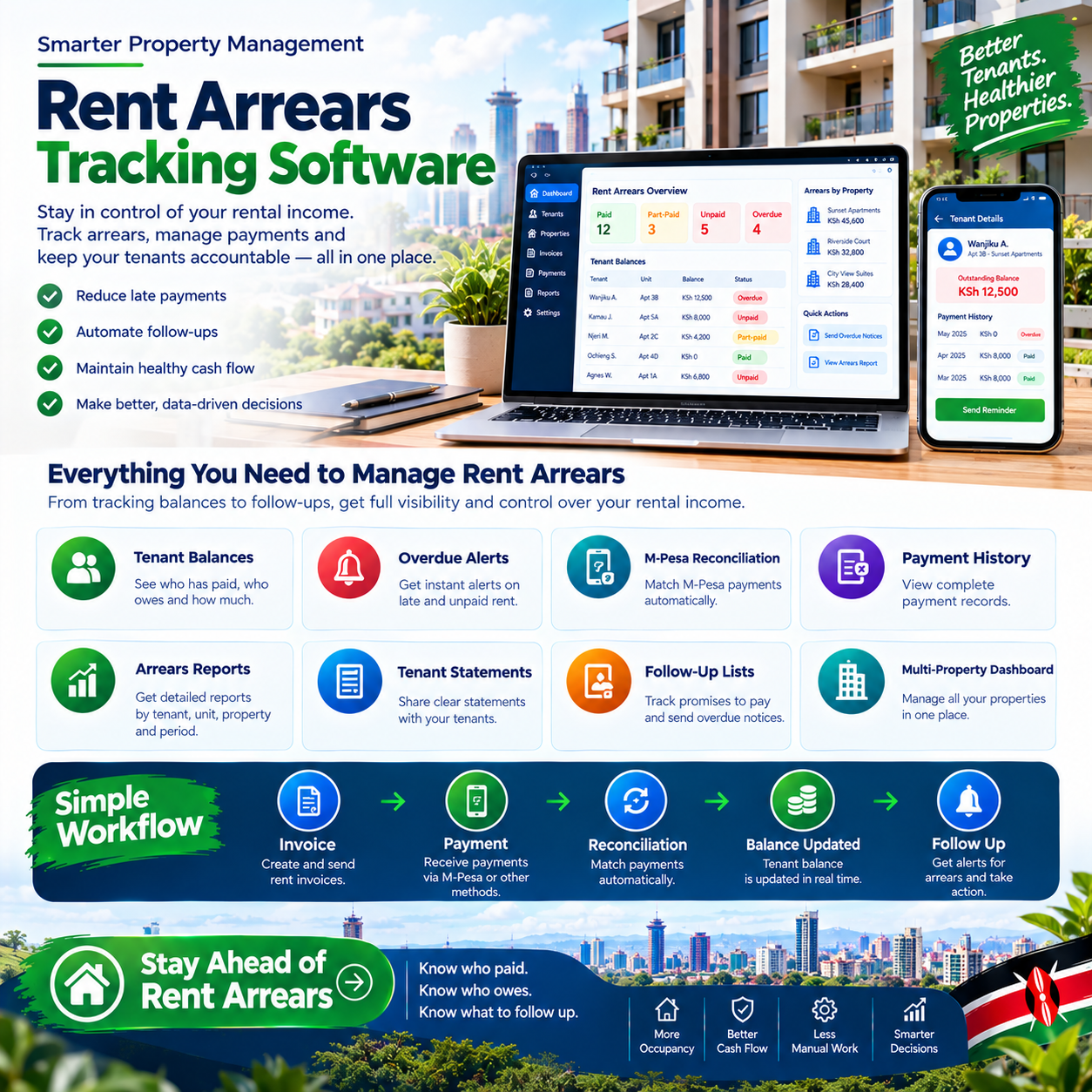
Rent arrears tracking software is the tool quietly rescuing Kenyan landlords from the most expensive problem in property.
Arrears — rent that was due but never arrived — drain income, strain relationships, and steal peace of mind one unpaid month at a time.
In 2026, the owners recovering that income are the ones who stopped chasing by memory and started tracking by system.
The numbers behind the problem are sobering.
Across the market, landlords routinely lose meaningful portions of expected income to balances that drift, vanish, or get forgiven out of awkwardness.
That loss is exactly what rent arrears tracking software was built to end.
This guide walks you through everything the technology does and how to put it to work.
We cover what arrears tracking actually involves, the features worth demanding, realistic costs, and the mistakes that corrupt records.
By the end, you will be ready to choose and run rent arrears tracking software across your portfolio with total confidence.
Whether you collect from five bedsitters or five hundred apartments, the principle never changes.
An arrears balance you can see clearly is a balance you can recover politely — and most of them are recoverable.
That recovery power is the promise at the heart of every good rent arrears tracking software platform.
What Is Rent Arrears Tracking Software?
Rent arrears tracking software is a digital system that monitors unpaid rent across your portfolio and turns every balance into a manageable, dated record.
It knows who owes, how much, since when, and what has been done about it — all from one dashboard.
Think of it as a debt ledger that never forgets, never gets tired, and never feels awkward about the numbers.
The core mechanics are simple.
When rent falls due and no payment arrives, the account automatically moves onto your arrears list with its amount and age attached.
Every payment that comes in reduces the balance, and the rent arrears tracking software updates the record instantly.
It helps to distinguish this category from general rent tracking.
Rent tracking follows all payments; arrears tracking specializes in the money that did not arrive.
That focus on the unpaid is what makes rent arrears tracking software uniquely valuable to income protection.
The category also carries the follow-up workflow inside it.
Reminders, escalation notes, payment plans, and promises made all attach to the account alongside the balance.
That combination of figure and follow-up is what defines true rent arrears tracking software.
Why Arrears Are the Landlord’s Most Expensive Problem
Arrears rarely announce themselves loudly; they accumulate quietly, one missed month at a time.
A tenant pays late once, then partially the next month, and before long the balance has grown while your plans have shrunk.
Without a system, the true size of the problem only surfaces when the damage is done.
The direct cost is obvious: rent charged but never collected.
The indirect costs are just as real — delayed school fees, missed loan installments, and repairs postponed for lack of funds.
Every landlord who has adopted rent arrears tracking software describes the same discovery of how much was leaking.
Memory is the deepest cause of the leak.
Humans cannot reliably track forty balances, their ages, and their promises across a busy life.
A rent arrears tracking software system tracks all of it flawlessly, because consistency is what software does best.
Awkwardness is the second great cause.
Many landlords delay asking for money out of politeness, and delayed asking becomes diluted recovery.
Automated reminders from rent arrears tracking software remove the awkwardness entirely, because the system — not you — starts every conversation.
Why 2026 Is the Breakout Year
Three forces are converging to make 2026 the year arrears discipline goes digital nationwide.
Each one strengthens the case for adopting rent arrears tracking software this year rather than someday.
Together, they mark a turning point for the entire rental sector.
First, M-Pesa has made every payment digital, timestamped, and matchable to an account automatically.
The gap between rent due and rent received is now measurable to the day.
That precision is the raw material rent arrears tracking software runs on.
Second, portfolios have grown across the market, and memory-based chasing collapses somewhere around thirty units.
Landlords who once knew every tenant personally now need systems to stay on top of balances at scale.
Scalability is exactly what rent arrears tracking software was engineered for.
Third, tenant expectations have professionalized.
Clear statements, consistent reminders, and documented agreements are now seen as fairness rather than pressure.
Meeting that standard is the everyday output of rent arrears tracking software in 2026.
How It Works: From Due Date to Recovered Balance
The magic of rent arrears tracking software lies in a loop that runs every month without you.
Here is how the cycle typically unfolds in a well-run portfolio.
Once configured, it repeats reliably whether you are in Nairobi or abroad.
First, rent is charged to every account on its due date.
Second, payments arrive and reconcile automatically, clearing accounts that have paid.
Third, accounts with nothing received move onto the arrears list inside your rent arrears tracking software — flagged with amount and age.
Fourth, the system starts the follow-up.
A courteous reminder goes out on day one or two, long before the balance grows roots.
That early nudge is the single most valuable moment in the entire rent arrears tracking software loop.
Fifth, responses and promises get recorded.
A tenant who promises to pay on Friday gets a note on the account, and Friday becomes checkable.
Sixth, anything unresolved escalates gently through the workflow you define — reminders, statements, then personal conversation.
The escalation ladder is what makes rent arrears tracking software fair as well as firm.
Seventh, partial payments post to the balance without clearing it.
The remainder stays visible, dated, and on the follow-up list rather than vanishing into approximation.
Eighth, the account eventually closes — paid in full, settled by plan, or escalated formally — and the story stays in the record.
That complete history is the long-term asset built silently by rent arrears tracking software.
Must-Have Features to Demand in 2026
The market is growing quickly, and 2026 buyers should evaluate options against a demanding checklist.
The best rent arrears tracking software platforms share a clear set of core capabilities.
Use this section as your scorecard when comparing providers.
First, demand automatic arrears detection.
Balances should appear the day after rent goes unpaid, with no manual flagging required.
Speed of detection is the entire advantage of rent arrears tracking software.
Second, insist on aging views that rank balances by how long they have run.
Oldest and largest first is how recovery lists become action lists.
Third, expect integrated reminders through SMS and WhatsApp, scheduled and logged automatically.
Reminder automation is the workhorse of effective rent arrears tracking software.
Fourth, look for part-payment handling that keeps remainders visible and dated.
Partial payments are exactly where informal records fail, so make this non-negotiable.
Fifth, check for promise and note tracking — the ability to record commitments and hold accounts to them.
Sixth, demand exportable statements and reports your accountant can use at year-end.
Reporting depth separates true rent arrears tracking software from a messaging group with good intentions.
Finally, mind the practical basics.
The platform must work on affordable phones, weak networks, and without a steep learning curve.
Usability decides whether rent arrears tracking software gets used daily or abandoned by March.
The M-Pesa Connection
Kenya’s mobile money rails are the reason arrears tracking works so brilliantly here.
Payments arrive with amounts, references, and timestamps that software matches to accounts instantly.
That instant matching keeps rent arrears tracking software accurate to the minute.
Reconciliation at scale is the real miracle.
An owner collecting from sixty units no longer matches payment messages to names every evening.
Automation completes in seconds what once consumed hours — the core economics of rent arrears tracking software.
Cash still matters in many estates, and good platforms handle it honestly.
Caretakers log cash with amounts and timestamps, and entries post clearly marked for verification.
The Escalation Ladder: Fair, Firm, and Documented
The most successful arrears strategies follow a ladder, and software makes the ladder automatic.
Step one is the friendly reminder — early, courteous, and easy to comply with.
Most balances die at this step, which is why every rent arrears tracking software workflow starts here.
Step two is the statement.
A dated record of what is owed, sent when reminders go unanswered, moves the conversation from opinion to fact.
Step three is the personal conversation — now anchored by documents instead of memory.
Step four is the agreed payment plan, posted to the account with dates and amounts.
Written plans recover far more money than verbal hopes, and rent arrears tracking software holds both parties to the record.
Step five is formal action, taken only when everything gentler has failed.
Your documentation — reminders sent, statements issued, promises logged — becomes the evidence that makes formal steps credible.
That readiness is the quiet power of disciplined rent arrears tracking software.
Real Benefits for Landlords
The first benefit is recovered income, plain and simple.
Landlords who adopt structured arrears tracking routinely recover balances that would otherwise have quietly evaporated.
Over a year, that recovery often exceeds the cost of rent arrears tracking software many times over.
The second benefit is early detection.
A stopped payment shows up in days, when a friendly message still solves it, rather than weeks later when the balance has hardened.
Timing is the compounding advantage of rent arrears tracking software.
The third benefit is dispute-proofing.
Dated charges, payments, and follow-ups turn every disagreement into a document review instead of a shouting match.
Evidence is the invisible armor of rent arrears tracking software users.
The fourth benefit is better relationships, counterintuitive as it sounds.
Consistent, courteous, system-driven follow-up feels fair to tenants because everyone is treated the same way.
Fairness at scale is what rent arrears tracking software automates.
The fifth benefit is growth without fear.
The system that manages ten balances manages a hundred identically.
Scalability makes rent arrears tracking software a long-term partner rather than a stopgap.
Benefits for Property Managers and Caretakers
Property managers juggle multiple owners, and nothing damages client trust faster than unexplained shortfalls.
Shared rent arrears tracking software keeps every client portfolio transparent simultaneously.
Monthly reports build themselves from live records instead of memory.
Caretakers gain just as much.
Their collections post with attribution, protecting them from suspicion when balances move for honest reasons.
Client conversations improve too.
When an owner asks about a shortfall, the answer is a forwarded report rather than a defensive debate.
That professionalism is what retains management clients on rent arrears tracking software for years.
Arrears Tracking vs. the Other Tools
Readers of our earlier guides often ask how this category relates to the wider software family.
Rent tracking follows all payments, balance tracking maintains accounts, and reminder apps send the nudges.
Rent arrears tracking software is the specialist layer focused on the money that did not arrive.
The categories overlap, and most modern platforms bundle several functions.
What matters is choosing based on your actual pain.
If unpaid balances are the leak sinking your income, rent arrears tracking software is the tool to adopt first.
The ideal end state is a connected stack.
Payments, accounts, documents, and follow-ups flowing through systems that talk to each other.
That integrated future is exactly where the rent arrears tracking software market is heading in 2026.
Real Scenarios from Real Portfolios
Picture a landlord with eighteen bedsitters in Kasarani whose arrears once lived in a caretaker’s memory.
Now every unpaid account appears the day after rent falls due, and reminders go out automatically.
His recovery rate doubled within one quarter of starting rent arrears tracking software.
Picture a caretaker in Embakasi managing three buildings for absentee owners.
Every collection he logs posts instantly, and every balance he reports carries the account’s full history.
The owners saw the transparency and expanded his scope — trust built on rent arrears tracking software.
Picture a tenant in Kitengela who fell behind after a job change.
A three-payment plan posted to her account kept her housed and the landlord whole, with every installment tracked to completion.
That humane outcome is the everyday work of rent arrears tracking software done well.
These stories repeat across the country because the mechanics are universal.
Early detection, consistent reminders, and documented plans work identically in Kilimani and Kisumu.
Technology simply makes those virtues automatic every month.
Choosing the Right Platform
A structured selection process prevents regret in this fast-growing market.
Start by listing your realities: unit count, payment mix, who posts cash, and how tenants prefer to communicate.
The right rent arrears tracking software fits your operation, not the loudest advert.
Trial with your real data before paying anything.
Run one building’s actual month through the system, including a part-payment and a cash day.
One honest week of testing reveals more than any rent arrears tracking software brochure ever will.
Test support deliberately.
Send a pre-sale question and judge the speed, warmth, and competence of the reply.
Responsive support is what keeps rent arrears tracking software serving you long after purchase.
Confirm the exit door too.
Your balances and history should export anytime in formats you control.
Data ownership is non-negotiable when adopting any rent arrears tracking software.
What It Costs in 2026
Pricing in this category is friendlier than most owners expect.
Competition among Kenyan providers has kept costs low even as features multiply.
Against recovered arrears, rent arrears tracking software repays itself within the first billing cycle.
Typical pricing structures heading into 2026 look like this:
- Free tiers: ideal for landlords with up to about ten units
- Per-unit plans: commonly KSh 20–80 per unit monthly
- Flat monthly plans: roughly KSh 500–3,500 depending on features
- SMS bundles: often a few shillings per reminder message beyond included volumes
- Annual plans: usually 10–20 percent cheaper than monthly billing
Weigh the price against the full value stack: recovered balances, earlier detection, saved evenings, and audit-ready records.
Viewed that way, the true cost of good rent arrears tracking software approaches zero.
The real question is how long you can afford to let arrears manage you.
Getting Started the Right Way
Adoption succeeds or fails in the first two weeks, so begin deliberately.
Open accounts for one property completely — tenants, rent amounts, due dates, and true existing balances — before expanding.
Accurate opening balances are the foundation of honest rent arrears tracking software usage.
Agree the opening figures with each tenant in writing wherever possible.
A balance confirmed at the start becomes a baseline nobody can dispute later.
From that clean start, rent arrears tracking software maintains the truth automatically.
Then commit to the rhythm.
Review the arrears list twice weekly, act on every flag, and let the first fully recovered month build your momentum.
Habits formed in month one determine whether rent arrears tracking software becomes your income’s guardian.
Common Mistakes to Avoid
The most common mistake is guessing opening balances.
An unverified starting figure quietly poisons every account that follows.
Confirm the books before trusting any rent arrears tracking software output.
The second mistake is harsh escalation.
Threatening messages create resentment that costs more than the arrears ever did.
Keep every rent arrears tracking software reminder courteous and every escalation documented.
The third mistake is ignoring small balances.
Tiny remainders feel uncollectable, but they teach accounts to drift and standards to slip.
Consistency about small figures is the secret strength of rent arrears tracking software.
The fourth mistake is accepting verbal promises without recording them.
An unlogged promise is a hope; a logged one is a date you can check.
Recording commitments is what gives rent arrears tracking software its leverage.
One bonus mistake deserves a warning: running paper books in parallel “just in case.”
Double systems create double work and conflicting truths.
Commit fully once you have tested, and let rent arrears tracking software become the single source of truth.
Security, Privacy, and Trust
Your balances and tenant details deserve bank-grade protection.
Reputable providers encrypt records, back up continuously, and restrict access to authorized users only.
Treat those standards as minimum requirements in any rent arrears tracking software you adopt.
Privacy also means restraint.
Collect only what tracking needs — names, contacts, units, and amounts — and store nothing more.
Responsible handling is part of the professionalism your records project.
Communicate openly with tenants about the system too.
A one-line assurance that records are kept fairly, for everyone’s protection, makes reminders easier to receive.
Trust multiplies the effectiveness of every rent arrears tracking software feature you use.
The Road Ahead: 2027 and Beyond
The trajectory of this technology points somewhere exciting.
Predictive intelligence is arriving, with systems learning each account’s payment pattern and flagging likely late payers before due dates.
Prevention will make the rent arrears tracking software of 2027 smarter than any recovery process.
Self-service is coming just behind it.
Tenants will view balances, query entries, and settle remainders from their own phones, shrinking every step of the recovery journey.
Interactive accounts are the next frontier of rent arrears tracking software.
The message for anyone earning from property is clear and encouraging.
The tool that ends arrears anxiety is affordable, local, and already sitting in your pocket.
There has never been a better moment — in 2026 or beyond — to make rent arrears tracking software part of how you earn.
Frequently Asked Questions
What does rent arrears tracking software actually do?
It monitors unpaid rent across your portfolio, flags balances automatically when they fall due, and manages follow-up until accounts are settled.
Every balance carries its amount, its age, and its full history of reminders and payments.
Think of it as the recovery department of your rental business, working daily.
How is it different from ordinary rent tracking?
Rent tracking follows all payments; arrears tracking specializes in the money that did not arrive.
In practice most modern platforms bundle both, so your payments and balances stay in sync.
Choose based on whether unpaid balances are your biggest leak that dedicated rent arrears tracking software should close.
Can it handle part-payments and payment plans?
Yes — handling part-payments and structured plans correctly is the defining test of the category.
Partial payments reduce the balance without clearing it, and agreed plans post to the account with dated installments.
The record always shows exactly what remains and when it was promised.
Do I need it for a small portfolio?
Even three units benefit, because one unpaid month is proportionally painful for a small income.
Free and low-cost tiers make adoption easy at any size.
Habits built small scale beautifully as you grow.
What if my current arrears records are already messy?
Most landlords begin with a cleanup, reconciling each tenant’s true position before going live.
Agree opening balances in writing and start fresh from a confirmed date.
From there, the system keeps the truth automatically.
Will tenants find the automated reminders hostile?
Almost never, when the tone is courteous and the timing sensible.
Most arrears begin with honest forgetfulness, and a clear, friendly notice helps tenants plan rather than feel attacked.
Hostility comes from ad-hoc confrontations, not from consistent records.
What happens when a tenant simply cannot pay?
The account’s history becomes the foundation for a fair conversation and a documented payment plan.
Structured plans recover far more than eviction-driven standoffs, and they keep records clean either way.
The system supports every outcome with evidence.
How often should I review my arrears list?
Twice weekly is ideal during the first week of the month, when most payments arrive or fail to.
The records never sleep between your visits, so even a weekly review keeps you close.
The point is responding promptly to what the accounts show.
Where can I find rentals and landlord tools together?
Start with platforms that combine verified listings with landlord-friendly technology, such as rentaldesk.co.ke.
Pairing the right tenants with disciplined rent arrears tracking software takes you from filling units to recovering every shilling you are owed.