
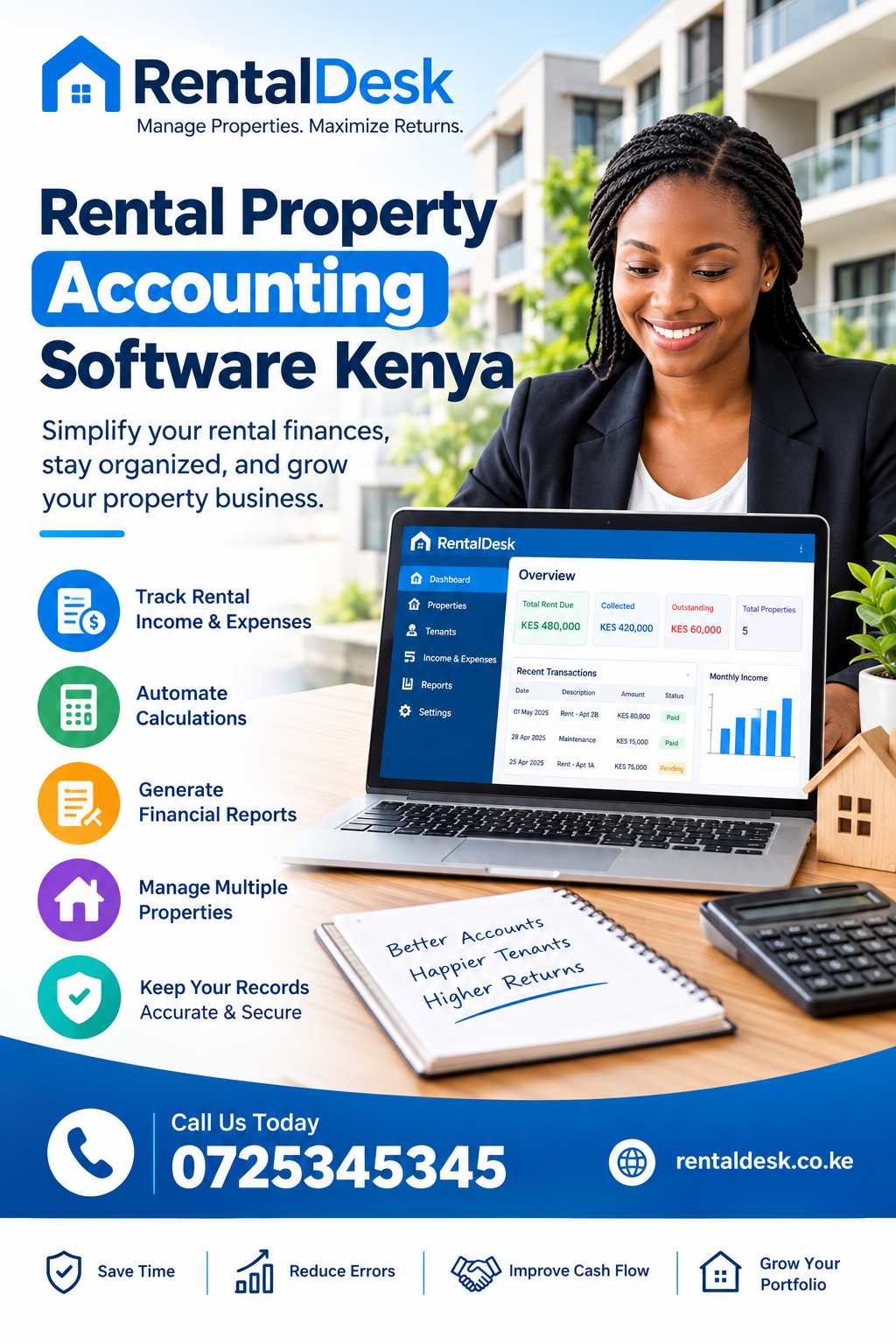
Rental Property Accounting Software Kenya: Complete Guide for Landlords and Property Managers
Managing rental property involves much more than collecting rent at the end of the month. Landlords and property managers need accurate records for income, expenses, deposits, invoices, arrears, maintenance costs and property-level profitability. Rental Property Accounting Software Kenya provides a structured way to organize these financial activities while reducing dependence on spreadsheets, notebooks and scattered payment records. This guide explains how rental accounting software works, the features to look for, the benefits for Kenyan property owners, how M-Pesa and bank transactions can fit into the process, and how to choose a system that supports accurate and efficient property financial management.
What Is Rental Property Accounting Software?
Rental Property Accounting Software Kenya refers to software designed to help landlords, property managers and real estate businesses record, organize and monitor the financial side of rental properties. Instead of keeping rent payments, expenses, invoices and tenant balances in separate files, a centralized system brings the information together.
A rental accounting platform can help answer basic but important questions:
- How much rent was collected this month?
- Which tenants have outstanding balances?
- What expenses were incurred on each property?
- How much was spent on repairs and maintenance?
- Which properties generate the most income?
- How much revenue is outstanding?
- What invoices are unpaid?
- What was the property’s financial performance over a specific period?
For a landlord managing one or two units, manual records may initially seem manageable. As the portfolio grows, however, financial information becomes harder to maintain accurately.
Rental Property Accounting Software Kenya can centralize the records needed to understand rental income and expenditure. This makes it easier to move from basic bookkeeping toward organized property financial management.
The software does not replace sound financial practices. Instead, it provides tools that make those practices easier to follow consistently.
Why Rental Accounting Matters in Kenya
Kenya’s rental market includes individual landlords, residential apartment owners, commercial property owners, estate managers and professional property management companies. Their operations can range from a few units to hundreds of properties.
Regardless of portfolio size, financial records are essential.
Rental Property Accounting Software Kenya helps create a clearer financial trail for transactions associated with rental properties. A landlord can record income and expenses systematically instead of trying to reconstruct the month’s activity from messages, bank statements and handwritten notes.
Consider a landlord with 30 rental units. During a single month, there may be rent payments, water charges, electricity-related expenses, plumbing repairs, security costs, cleaning expenses, caretaker payments and other operational transactions.
Without an organized system, these transactions can become difficult to reconcile.
Rental Property Accounting Software Kenya makes it possible to associate financial transactions with the relevant property, unit or tenant. That structure can make monthly reviews considerably easier.
The Kenyan context also makes payment tracking particularly important. M-Pesa is widely used for everyday transactions, including rent payments. Landlords therefore need a practical method of matching incoming payments to the correct tenant and rental account.
Rental Property Accounting Software Kenya can support this kind of organized financial workflow when the system is configured around the landlord’s actual collection and accounting processes.
Problems Caused by Manual Rental Accounting
Spreadsheets are useful, but they can become difficult to manage when a rental business grows. A spreadsheet may contain hundreds or thousands of rows, with different tabs for properties, tenants, expenses and payments.
Rental Property Accounting Software Kenya reduces the need to maintain disconnected financial records by providing a centralized environment for rental transactions.
Common problems with manual accounting include:
1. Missing transactions
A landlord may receive a payment but forget to record it immediately. Later, the amount may be difficult to match with the tenant.
2. Duplicate entries
When information is entered more than once, the financial report can become inaccurate.
3. Difficulty tracking expenses
Small expenses can easily be overlooked. A plumber’s invoice, transport expense or replacement part may appear insignificant individually but become substantial over several months.
4. Poor visibility of arrears
If rent balances are calculated manually, identifying overdue accounts can take considerable time.
5. Slow reporting
Preparing monthly income and expense summaries manually can require copying information between different spreadsheets.
Rental Property Accounting Software Kenya can address these problems by keeping financial information in a structured system where transactions can be searched, reviewed and reported.
6. Limited property-level visibility
A landlord may know the total amount collected without knowing which property is actually producing the strongest financial performance.
A properly configured accounting platform allows information to be grouped by property, unit or other relevant categories.
Key Features to Look For
Not every accounting application is designed for rental businesses. A general accounting system may record income and expenses, but property operations require additional context.
Rental Property Accounting Software Kenya should ideally provide features that connect accounting information to tenants, units and properties.
Here are the main features to consider.
Rent Income Tracking
The system should make it easy to record expected rent and compare it with actual collections.
Rental Property Accounting Software Kenya can help landlords maintain clearer records of rental income across individual units and properties.
For example, if an apartment building contains 50 units, the owner should be able to see expected monthly income, collected amounts and outstanding balances without manually calculating every unit.
Expense Management
Rental properties generate recurring and unexpected expenses.
These can include:
- Repairs
- Plumbing
- Electrical work
- Cleaning
- Security
- Landscaping
- Garbage collection
- Management fees
- Insurance-related expenses
- Utility costs
- Maintenance materials
Rental Property Accounting Software Kenya allows property expenses to be organized so the landlord can understand where money is being spent.
Tenant Balances
Tenant accounting should connect payments to individual rental accounts.
A useful system should make it possible to see:
- Opening balance
- Current rent
- Payments received
- Other charges
- Credits
- Outstanding amount
- Payment history
Rental Property Accounting Software Kenya can provide a more organized way of maintaining this information.
Invoice Management
Some rental businesses issue invoices for rent, service charges, utilities or other billable items.
Rental Property Accounting Software Kenya can help organize invoices and their payment status, reducing the likelihood of unpaid documents being overlooked.
Financial Reports
Reports are one of the most useful parts of property accounting software.
Rental Property Accounting Software Kenya can help turn transaction records into summaries that are easier for landlords and property managers to interpret.
Useful reports may include:
- Rental income reports
- Expense reports
- Tenant statements
- Arrears reports
- Payment reports
- Property profitability reports
- Outstanding invoice reports
- Cash flow summaries
M-Pesa and Rental Payment Tracking
M-Pesa plays an important role in Kenya’s payment environment. Many tenants prefer digital payments because they are convenient and provide transaction references.
The challenge for property managers is not simply receiving money. The bigger task is accurately recording and reconciling the payment.
Rental Property Accounting Software Kenya can help create a structured process for recording payments and matching them to tenant accounts.
For instance, a tenant may send KSh 25,000 using M-Pesa. The property manager needs to know:
- Who made the payment?
- Which unit does the tenant occupy?
- What rental period does the payment cover?
- Was the full amount paid?
- Does the tenant have an existing balance?
- Should part of the payment cover another charge?
Rental Property Accounting Software Kenya makes these questions easier to manage when payment records and tenant records are connected.
A good workflow should also provide an audit trail. The landlord should be able to review when a payment was recorded and how it affected the tenant’s balance.
Managing Rental Expenses More Effectively
Revenue is only one part of property performance. Expenses can have a significant impact on the amount a landlord actually retains.
Rental Property Accounting Software Kenya gives property owners a way to categorize expenditure and analyze it over time.
Suppose an apartment block generates KSh 1.5 million in rental income in a particular period. If maintenance, security, cleaning, management and other expenses total KSh 500,000, the landlord needs to understand how those expenses were distributed.
A detailed expense record might reveal that maintenance costs have increased substantially over several months.
Rental Property Accounting Software Kenya can help identify such patterns by organizing expenses according to property, category or date.
This information can support better operational decisions without relying on memory.
Recurring Expenses
Some property costs occur regularly.
Examples include:
- Security services
- Cleaning services
- Landscaping
- Internet services
- Property management fees
- Waste collection
- Common-area electricity
Rental Property Accounting Software Kenya can help property managers maintain consistent records for recurring expenses.
One-Time Expenses
Other expenses happen unexpectedly.
A damaged water pipe, broken gate or electrical fault may require immediate spending.
Rental Property Accounting Software Kenya can help record these costs against the relevant property so they are included in financial reports.
Tracking Rental Arrears
Arrears are among the most important financial issues for landlords.
A tenant may pay part of the rent, delay payment, carry forward a previous balance or accumulate other charges. Manual tracking makes these situations harder to monitor.
Rental Property Accounting Software Kenya can organize outstanding balances by tenant and property.
An arrears report can help property managers identify:
- Tenants with overdue rent
- Amounts outstanding
- Length of outstanding balances
- Partial payments
- Previous payment history
- Properties with recurring collection problems
The purpose is not simply to produce a list of debtors. The information can help property managers maintain accurate accounts and follow consistent collection procedures.
Rental Property Accounting Software Kenya can also support clearer tenant statements where the software connects rent charges, payments and outstanding balances.
Property-Level Accounting
A portfolio may contain several buildings with different financial characteristics.
One property could have high maintenance costs, while another may have lower expenses. Some buildings may have commercial tenants while others contain residential units.
Rental Property Accounting Software Kenya can help separate transactions according to the property they belong to.
This is important because portfolio-wide totals do not always provide enough information.
A landlord might see that total rental income increased but still need to know:
- Which property generated the increase?
- Which property incurred the highest expenses?
- Which units have the largest balances?
- Which building has the most maintenance activity?
Property-level reporting provides more useful context.
Tenant Statements and Financial Transparency
A tenant statement provides a history of financial activity associated with a tenant’s account.
It may show:
- Rent charges
- Payments
- Additional charges
- Credits
- Outstanding balances
- Dates of transactions
Rental Property Accounting Software Kenya can help maintain organized statements that are easier to review.
Clear statements can also reduce misunderstandings. When a tenant questions a balance, the property manager can refer to recorded transactions rather than relying on informal conversations.
For property management businesses handling many tenants, this can save considerable administrative time.
Budgeting for Rental Properties
Budgeting helps property owners plan expected income and expenditure.
Rental Property Accounting Software Kenya can provide historical financial information that helps landlords understand previous spending patterns.
For example, if a building consistently incurs significant plumbing costs, the owner can account for this when preparing future maintenance budgets.
A useful rental budget may consider:
| Category | Examples |
|---|---|
| Rental income | Monthly rent, commercial rent |
| Maintenance | Repairs, replacement parts |
| Utilities | Water, electricity, common-area services |
| Operations | Cleaning, security, waste management |
| Administration | Management and administrative costs |
| Capital improvements | Renovations and upgrades |
| Other income | Parking, storage and additional services |
Budgeting should be based on actual records wherever possible.
Cash Flow Management
Cash flow refers to money moving into and out of the rental business.
A property may have strong annual revenue but still experience cash-flow pressure if large expenses occur before rent collections.
Rental Property Accounting Software Kenya can help property managers monitor income and expenses within defined periods.
Cash-flow information can answer questions such as:
- How much cash came in this month?
- What expenses were paid?
- What income remains outstanding?
- Are upcoming expenses likely to require additional planning?
This becomes increasingly useful as the property portfolio grows.
Accounting for Multiple Properties
Managing several properties introduces another layer of complexity.
Rental Property Accounting Software Kenya can help centralize information while keeping individual properties distinguishable.
Imagine a property manager handling:
- Three apartment blocks in Nairobi
- A commercial building
- Several standalone rental houses
Keeping separate spreadsheets for each property may create duplication and make portfolio-level reporting harder.
A centralized platform can provide a common structure for recording transactions while preserving property-specific information.
How Automation Saves Time
Manual accounting requires repeated data entry.
A property manager may need to record a rent payment, update a tenant ledger, change an arrears figure and later include the transaction in a report.
Rental Property Accounting Software Kenya can reduce repeated administrative work when these activities are connected within one system.
Automation may assist with:
- Recording transactions
- Updating balances
- Generating statements
- Producing reports
- Identifying outstanding accounts
- Organizing invoices
- Tracking expenses
Automation should still be monitored. Property managers need processes for reviewing exceptions and correcting incorrect entries.
Why Accuracy Matters in Rental Accounting
Small accounting errors can become significant when repeated across many transactions.
Rental Property Accounting Software Kenya can support more consistent financial recordkeeping by keeping information structured and searchable.
Accuracy matters for several reasons.
Better tenant communication
Tenants can receive clearer explanations of balances and payment histories.
Better management decisions
Owners can make decisions using actual income and expense information.
Easier reporting
Financial summaries can be generated without manually combining multiple spreadsheets.
Better record keeping
Transactions remain organized for future reference.
Security and Access Control
Financial information should be handled carefully.
Rental Property Accounting Software Kenya should be evaluated not only on accounting features but also on how it manages access to financial data.
Consider whether the system supports:
- User accounts
- Permission levels
- Password protection
- Activity records
- Controlled access to financial information
- Data backups
A property manager may need access to tenant accounts, while a caretaker may only need operational information. Different responsibilities can require different access levels.
Reports Every Landlord Should Monitor
Reports transform raw transactions into information that can support property management.
Rental Property Accounting Software Kenya can be useful when reporting tools allow landlords to examine financial performance from different perspectives.
Important reports may include:
Rental income report
Shows rent expected and collected over a selected period.
Expense report
Summarizes spending by category, property or date.
Arrears report
Highlights unpaid balances.
Tenant statement
Provides a transaction history for an individual tenant.
Property performance report
Shows income and expenses associated with a property.
Cash flow report
Summarizes money received and money paid.
Rental Property Accounting Software Kenya can make these reports easier to generate when financial information has been entered consistently.
Choosing Software for a Small Rental Portfolio
A landlord with five or ten units may not need the same configuration as a professional property management company.
Rental Property Accounting Software Kenya should match the scale and complexity of the portfolio.
For a smaller landlord, important requirements may include:
- Rent tracking
- Expense recording
- Tenant balances
- Basic reporting
- Payment records
- Simple invoicing
The interface should be straightforward enough that the owner can use it regularly.
Choosing Software for a Large Property Portfolio
Large portfolios have more demanding requirements.
Rental Property Accounting Software Kenya should be able to accommodate many tenants, properties, transactions and users without making financial administration unnecessarily complicated.
A larger property management company may require:
- Multiple properties
- Multiple users
- Detailed permissions
- Advanced reports
- Tenant statements
- Arrears monitoring
- Expense categorization
- Invoice management
- Payment reconciliation
- Historical records
Scalability should be considered before selecting a platform.
Common Mistakes When Selecting Rental Accounting Software
Buying software simply because it contains the word “accounting” can lead to a poor fit.
Rental Property Accounting Software Kenya should be assessed against the actual workflow of the rental business.
Avoid selecting software without considering these factors:
Ignoring property-specific needs
General accounting tools may not provide the tenant and unit management features needed by landlords.
Focusing only on price
A low subscription cost does not necessarily mean lower total operating costs.
Failing to check reporting
Reports should match the information the owner actually needs.
Ignoring usability
If employees find the system difficult to use, records may not be updated consistently.
Not planning for growth
A system that works for ten units may become difficult to use when the portfolio reaches 100 units.
Implementation Tips for Kenyan Landlords
Moving from spreadsheets to software requires preparation.
Rental Property Accounting Software Kenya can be introduced more smoothly when the landlord first organizes existing records.
Start by preparing:
- Property details
- Unit information
- Tenant records
- Rent amounts
- Existing balances
- Payment history
- Outstanding arrears
- Recurring expenses
- Supplier information
- Relevant invoices
After importing or entering the information, review the opening balances carefully.
Rental Property Accounting Software Kenya works best when the underlying information is accurate.
How to Move From Spreadsheets to Software
Many landlords already have years of information stored in Excel or Google Sheets.
The transition does not have to happen chaotically.
Rental Property Accounting Software Kenya can become the central system after the existing records have been cleaned and verified.
A practical migration process is:
Step 1: Clean the existing records
Remove duplicate tenants and outdated information.
Step 2: Confirm balances
Verify outstanding rent and credits.
Step 3: Organize properties
Create a clear structure for buildings, units and tenants.
Step 4: Enter opening balances
Make sure tenant and property balances agree with the old records.
Step 5: Test transactions
Record sample payments and expenses before going live.
Step 6: Train users
Make sure staff understand the correct process for entering transactions.
Step 7: Review reports
Compare software-generated reports against known figures.
Rental Property Accounting Software Kenya can then become the primary source for ongoing rental financial records.
Rental Accounting and Tax Records
Property owners should maintain appropriate financial records and follow applicable Kenyan tax requirements.
Rental Property Accounting Software Kenya can help organize income and expense information, but software should not be treated as a substitute for professional tax advice.
The specific tax treatment of rental income can depend on the taxpayer’s circumstances and the applicable rules.
For that reason, landlords should consult qualified tax professionals or relevant Kenyan authorities when they need advice about tax obligations.
The value of organized accounting records is that the owner has clearer documentation available when financial information needs to be reviewed.
How Property Managers Can Improve Efficiency
Property managers often serve multiple landlords and properties at the same time.
Rental Property Accounting Software Kenya can support standardized workflows across a portfolio.
For example, a property management company can establish a routine where:
- Rent transactions are recorded consistently.
- Expenses are categorized immediately.
- Tenant balances are reviewed regularly.
- Arrears reports are checked on scheduled dates.
- Property financial reports are generated monthly.
- Management reviews unusual transactions.
Consistency is just as important as technology.
Understanding Total Cost of Ownership
The subscription price is only one part of the cost of using accounting software.
Rental Property Accounting Software Kenya should be evaluated by considering the broader operational impact.
Potential costs include:
- Subscription fees
- Setup
- Data migration
- Staff training
- Support
- Additional users
- Integration requirements
At the same time, potential savings can come from reduced manual work, fewer errors, faster reporting and better visibility.
A landlord should compare the total cost against the needs and size of the portfolio.
Questions to Ask a Software Provider
Before choosing a system, ask practical questions.
Rental Property Accounting Software Kenya should be assessed based on how well it fits your actual rental operation.
Useful questions include:
- Can I manage multiple properties?
- Can I track individual tenants?
- Can I record rent payments?
- Can I monitor arrears?
- Can I categorize expenses?
- Can I generate tenant statements?
- Can I generate property-level reports?
- Does the system support Kenyan payment workflows?
- How are user permissions handled?
- How is data backed up?
- What support is available?
- Can the software grow with my portfolio?
The answers can help determine whether the platform is appropriate for your business.
Practical Example: Managing an Apartment Building
Consider a landlord with a 40-unit apartment building.
Each month, the landlord expects rental income from all occupied units. Some tenants pay in full, some pay late and others may have partial balances.
Rental Property Accounting Software Kenya can organize the financial records associated with each unit.
At the same time, the building has expenses for security, cleaning, repairs, electricity in common areas and plumbing.
Instead of maintaining several disconnected spreadsheets, the landlord can organize transactions under the relevant property and categories.
At the end of the month, the owner can review collected rent, outstanding balances and total expenses.
Rental Property Accounting Software Kenya can support a more structured view of these transactions when the system is configured properly.
The owner can then investigate unusual expenses, follow up on outstanding accounts and prepare a financial summary.
Practical Example: Managing Several Properties
Now consider a property manager handling ten buildings.
Each building has different tenants, rent rates and maintenance requirements.
Rental Property Accounting Software Kenya can provide a centralized framework for managing financial information across the portfolio.
The manager can review individual properties while also preparing broader reports.
For example, management may want to compare:
- Monthly rental collections
- Total expenses
- Outstanding balances
- Maintenance spending
- Property-level cash flow
This is much easier when information follows a consistent structure.
Benefits for Landlords
For landlords, the main benefit of organized rental accounting is visibility.
Rental Property Accounting Software Kenya can help owners understand the financial condition of their properties without depending entirely on manual calculations.
Key benefits include:
- Better organization
- Faster reporting
- Clearer tenant balances
- Improved expense tracking
- Easier arrears monitoring
- Better property-level visibility
- More consistent record keeping
- Reduced administrative work
These benefits become increasingly relevant as the number of units increases.
Benefits for Property Management Companies
Property managers have additional responsibilities because they handle property information on behalf of owners.
Rental Property Accounting Software Kenya can help standardize financial processes across multiple properties.
A management company may use the system to organize:
- Tenant accounts
- Property expenses
- Rental income
- Owner reports
- Invoices
- Arrears
- Payment records
Standardized processes make it easier for different employees to follow the same procedures.
Improving Decision-Making With Better Data
Good accounting records provide more than historical information.
Rental Property Accounting Software Kenya can help property owners identify patterns in revenue and spending.
For example, repeated maintenance costs may indicate that a particular building requires renovation. Persistent arrears may suggest a need to review tenant communication or collection procedures.
The software does not make these decisions automatically. It gives managers clearer information from which to investigate and act.
What Makes Rental Accounting Software Different?
A general accounting platform primarily focuses on financial transactions.
Rental businesses need financial transactions connected to property operations.
Rental Property Accounting Software Kenya combines the accounting perspective with rental information such as tenants, units and properties.
That connection is valuable because the landlord is rarely interested only in the amount of money received. They also need to know where the money came from and which property generated it.
Data Organization Best Practices
Even the best software requires good data management.
Rental Property Accounting Software Kenya should be supported by clear internal procedures.
Use consistent names for:
- Properties
- Units
- Tenants
- Expense categories
- Suppliers
- Payment methods
Avoid creating several different names for the same property or expense category.
Review records regularly and correct errors early.
Frequently Asked Questions
1. What is rental property accounting software used for?
Rental Property Accounting Software Kenya is used to organize rental income, expenses, tenant balances, invoices, payments, arrears and financial reports. It can help landlords and property managers maintain a centralized record of property finances.
2. Can rental accounting software track M-Pesa rent payments?
Rental Property Accounting Software Kenya can support rental payment tracking when the system includes appropriate payment recording or integration capabilities. The exact workflow depends on the software and how the landlord receives payments.
3. Can I manage several rental properties with one system?
Yes. Rental Property Accounting Software Kenya can be useful for landlords and property managers who need to keep multiple properties organized while maintaining separate financial records for each property.
4. Can the software track tenant arrears?
Rental Property Accounting Software Kenya can help monitor outstanding tenant balances when rent charges and payments are properly recorded. Arrears reports can then identify accounts requiring attention.
5. Can rental software track property expenses?
Yes. Rental Property Accounting Software Kenya can help categorize and organize expenses such as maintenance, cleaning, security, utilities and other operating costs.
6. Does rental accounting software replace an accountant?
Rental Property Accounting Software Kenya can automate and organize bookkeeping tasks, but it does not necessarily replace professional accounting or tax advice. Businesses with complex financial or tax requirements should seek qualified professional guidance.
7. Is rental accounting software useful for small landlords?
Yes. Rental Property Accounting Software Kenya can be useful even for smaller landlords if it simplifies rent tracking, expense recording and financial reporting. The appropriate level of software depends on the size and complexity of the portfolio.
8. What reports should rental property software provide?
Rental Property Accounting Software Kenya should ideally provide reports relevant to rental operations, including income, expenses, arrears, tenant statements, payments and property-level financial performance.
9. How do I choose rental accounting software in Kenya?
Start by identifying your number of properties, units, tenants and users. Then evaluate payment tracking, expense management, reporting, security, usability and scalability. Rental Property Accounting Software Kenya should fit the actual workflow of your rental business rather than simply offering a long list of features.
10. Can rental accounting software help reduce manual work?
Yes. Rental Property Accounting Software Kenya can reduce repetitive administrative tasks by connecting transactions, tenant accounts, expenses and reports within one platform.
Final Checklist for Choosing a Rental Accounting System
Before committing to a platform, review the following checklist:
Rental Property Accounting Software Kenya should make it easy to:
- Manage properties and units
- Maintain tenant records
- Record rental charges
- Track payments
- Monitor arrears
- Record expenses
- Manage invoices
- Generate statements
- Review financial reports
- Track property-level performance
- Control user access
- Maintain reliable records
Also consider the software provider’s support, training, implementation process and ability to accommodate future growth.
The Role of Technology in Better Property Financial Management
Rental accounting is ultimately about information.
Rental Property Accounting Software Kenya gives landlords and property managers a structured way to turn individual transactions into useful financial information.
When rent payments, expenses and tenant balances are recorded consistently, managers spend less time searching through disconnected records.
The result is a clearer picture of what is happening financially across the portfolio.
Preparing Your Rental Business for Growth
A property portfolio can become more complex quickly.
Rental Property Accounting Software Kenya can provide a foundation for more organized financial administration as the number of units increases.
A landlord who starts with ten units may eventually manage dozens or hundreds. Establishing consistent accounting processes early can make future growth easier to manage.
The objective should be to build a system that supports the business rather than forcing the business to work around fragmented records.
Conclusion
Accurate rental accounting is essential for landlords and property managers who want a clear understanding of income, expenses, tenant balances and property performance. Rental Property Accounting Software Kenya can bring these activities into a more organized workflow, helping property owners reduce manual administration and maintain clearer financial records.
The right platform should go beyond basic bookkeeping. It should connect financial transactions with properties, units and tenants while providing practical reports for everyday management. M-Pesa payment tracking, rent collection records, expense management, invoicing, arrears monitoring and property-level reporting can all contribute to better financial visibility.
Rental Property Accounting Software Kenya is particularly useful when a portfolio has grown beyond the point where spreadsheets and manual records remain convenient. Before selecting a solution, landlords should assess their number of properties, units, tenants, staff and reporting requirements.
A practical next step is to review your current rental accounting process and identify where the most time is being spent. If payment reconciliation, expense tracking, arrears monitoring or reporting requires repeated manual work, it may be time to consider a centralized system.
Rental Property Accounting Software Kenya can help create a more structured approach to rental financial management when implemented with accurate data and consistent processes.
For landlords and property managers in Kenya, the goal should be simple: maintain accurate records, understand property performance, keep tenant accounts clear and make financial administration easier to manage as the portfolio grows.