
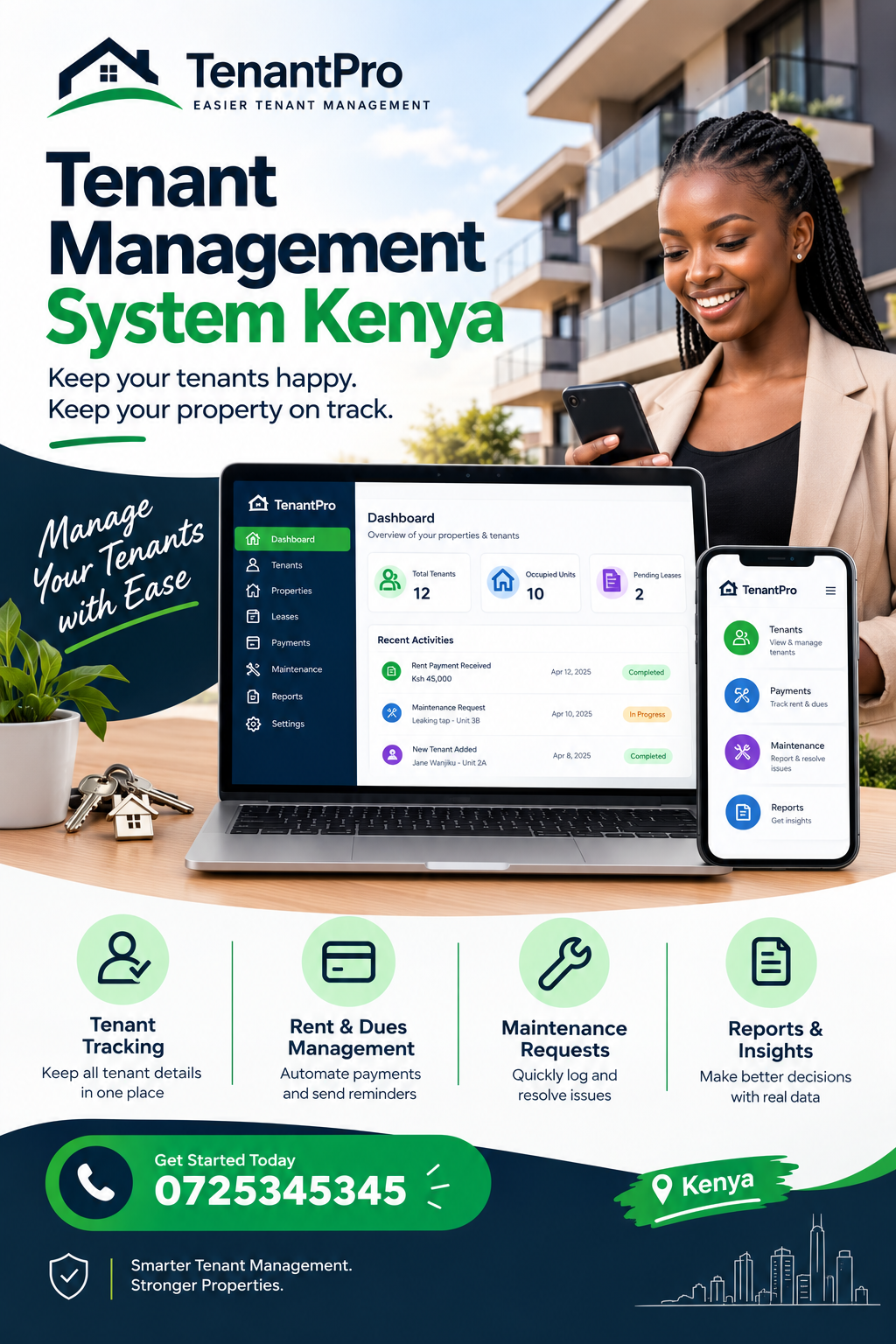
Tenant Management System Kenya: How to Manage Tenants Efficiently
Managing tenants involves much more than collecting rent. Landlords and property managers need to maintain accurate tenant records, monitor leases, follow up on payments, respond to maintenance requests, communicate with occupants, and keep property information organized. A Tenant Management System Kenya solution brings these activities into a structured digital workflow, helping rental businesses manage tenant information efficiently while reducing dependence on scattered spreadsheets, notebooks, and paper files.
For landlords with a few units, manual management may initially seem manageable. However, as the number of tenants, properties, payments, and maintenance requests increases, administrative work can quickly become overwhelming. Property managers handling apartments, estates, commercial buildings, or multiple rental properties need reliable systems that give them access to accurate information when they need it.
This guide explains what tenant management software does, the benefits it can provide, the features to consider, how it supports Kenyan landlords, how it can work alongside rent collection and M-Pesa, and what to consider before choosing a solution.
What Is a Tenant Management System?
A tenant management system is software designed to help landlords and property managers organize information and activities related to tenants.
A typical rental business may need to manage:
- Tenant profiles
- Contact information
- Lease agreements
- Unit assignments
- Rent charges
- Payment records
- Security deposits
- Arrears
- Maintenance requests
- Tenant communication
- Notices
- Documents
- Move-in and move-out information
- Property-related records
A Tenant Management System Kenya platform provides a centralized environment for these records and processes. Instead of keeping tenant information across several spreadsheets, files, messaging applications, and physical folders, property staff can work from a more organized system.
The exact features vary from one software platform to another. Some solutions focus primarily on tenant records, while broader property management platforms combine tenant management with accounting, rent collection, maintenance, lease management, reporting, and other functions.
The main purpose is straightforward: make tenant administration easier to organize, monitor, and maintain.
Why Tenant Management Matters in Kenya
Kenyan rental businesses operate across a wide range of property types. A landlord may own a single residential building, while a professional property management company may oversee hundreds or thousands of units.
Regardless of portfolio size, tenant information needs to be accurate.
A Tenant Management System Kenya solution can help property managers maintain consistent records as the portfolio grows.
Consider a property with 100 units. Each unit may have a tenant with a different lease, rent amount, payment history, contact information, and maintenance history. If those records are stored manually, finding a specific piece of information can take considerable time.
A digital tenant management workflow can bring those records together.
For example, a property manager may be able to search for a tenant and immediately review:
- Tenant name and contact details
- Assigned unit
- Lease information
- Current rent
- Payment history
- Outstanding balance
- Maintenance requests
- Relevant documents
- Communication notes
This centralized approach is especially useful when multiple employees are involved in managing a property portfolio.
The Challenges of Manual Tenant Management
Manual systems can work for very small portfolios, but they often create difficulties as operations become more complex.
Scattered Tenant Information
One tenant’s information may be stored in a lease folder, another record in a spreadsheet, payment information in an accounting file, and maintenance conversations in a phone.
A Tenant Management System Kenya platform can consolidate relevant information into a centralized tenant record.
Difficulty Tracking Rent
Property managers need to know which tenants have paid, which payments are pending, and which accounts have arrears.
When payment records are manually updated, errors can occur through missed entries, duplicate entries, or outdated spreadsheets.
Missed Follow-Ups
A tenant may report a leaking pipe today and call again several days later because nothing has happened.
Without proper tracking, maintenance requests and other tenant issues can be forgotten.
Time-Consuming Reporting
Property owners may ask for a report showing occupancy, rent collection, arrears, or tenant activity.
If staff need to compile information manually from several files, reporting can consume hours.
Poor Record Continuity
When an employee leaves a property management company, important knowledge may leave with them if records were stored mainly in personal notebooks, email accounts, or messaging conversations.
A centralized system provides greater continuity.
Key Features of Tenant Management Software
When evaluating a Tenant Management System Kenya solution, landlords should look beyond the software name and examine the actual functions it provides.
Tenant Profiles
A tenant profile should provide a structured location for important information.
Depending on the software, this may include:
- Full name
- Contact details
- Unit
- Lease dates
- Rent amount
- Deposit
- Payment history
- Documents
- Notes
- Maintenance history
Having this information in one place makes everyday property administration easier.
Unit Assignment
The system should make it clear which tenant occupies which unit.
This is particularly important for properties with many apartments, shops, offices, bedsitters, or other spaces.
Lease Management
Lease information can include:
- Start date
- End date
- Rent amount
- Deposit
- Renewal information
- Notice requirements
- Relevant documents
A Tenant Management System Kenya solution with lease functionality can help property managers monitor important tenancy dates.
Rent Tracking
Rent management is one of the most important areas of property administration.
The system should help staff understand the amount expected, amount received, outstanding balances, and payment status.
Arrears Management
Late payments require timely follow-up.
A Tenant Management System Kenya solution can help identify accounts with outstanding balances and provide a clearer view of arrears.
Property managers can then follow their established collection procedures.
Maintenance Requests
Tenants frequently report maintenance issues.
A useful system can allow managers to record:
- Issue description
- Date reported
- Tenant
- Unit
- Assigned person
- Status
- Completion date
- Related costs
This makes it easier to follow a repair from reporting through completion.
Communication Records
Property managers communicate with tenants about rent, repairs, notices, inspections, access, and other matters.
A Tenant Management System Kenya platform can help keep relevant communication records connected to tenant information where the software supports this functionality.
Managing Tenant Records Digitally
Accurate records are the foundation of effective property management.
A Tenant Management System Kenya solution can help reduce dependence on physical paperwork and disconnected spreadsheets.
A digital tenant profile can provide a historical record of the tenancy.
For example, a property manager could potentially review when the tenant joined the property, the lease terms, payment records, maintenance requests, and other relevant information.
This historical perspective is valuable when investigating recurring issues or preparing reports for property owners.
Keeping Records Updated
Software only works well when records are maintained properly.
Property managers should establish procedures for updating:
- Tenant contact details
- Rent changes
- Lease renewals
- Unit transfers
- Payment information
- Maintenance records
- Documents
- Tenant status
Regular data maintenance is therefore just as important as choosing good software.
Tenant Management and Rent Collection
Tenant management is closely connected to rent collection.
A Tenant Management System Kenya platform can help link tenant records with rental charges and payment information where those features are available.
For each tenant, property staff may need to know:
- Monthly rent
- Billing date
- Payment received
- Outstanding amount
- Arrears
- Previous balances
- Deposit information
Having these details accessible can simplify conversations between tenants, property managers, and landlords.
M-Pesa and Rental Payments
M-Pesa is an important payment method in Kenya, and many rental businesses receive rent through mobile money.
A Tenant Management System Kenya solution may support payment-related workflows depending on its integrations and capabilities.
The important objective is reconciliation.
When payments arrive, property managers need to match them with the correct tenant and rental account. A system that supports payment integration or reconciliation can reduce manual work.
For example:
Tenant pays → Payment received → Transaction identified → Tenant account updated → Balance reconciled
The exact process depends on the software and payment integration being used.
Managing Rental Arrears
Arrears are one of the most important issues property managers need to monitor.
A Tenant Management System Kenya solution can help identify tenants with outstanding balances and organize follow-up activities.
An arrears workflow might include:
- Identify overdue account.
- Confirm payment records.
- Check whether a payment is pending reconciliation.
- Contact the tenant through the established channel.
- Record the follow-up.
- Monitor the account.
- Escalate according to the property’s established procedures.
Digital records can make this process easier to monitor than relying on memory or manually checking multiple spreadsheets.
Tenant Communication
Good communication is an essential part of property management.
A Tenant Management System Kenya platform can help property teams maintain better organization around tenant communication.
Communication may involve:
- Rent reminders
- Payment confirmations
- Maintenance updates
- Inspection notices
- Lease reminders
- General property notices
- Emergency information
- Service announcements
The exact communication capabilities depend on the platform.
The objective is to ensure important tenant interactions are handled consistently and recorded appropriately.
Maintenance Management
Maintenance problems can quickly affect tenant satisfaction and property condition.
A tenant might report:
- Plumbing problems
- Electrical faults
- Broken locks
- Water issues
- Leaking roofs
- Damaged fixtures
- Common-area problems
- Security-related repairs
A Tenant Management System Kenya solution can help connect maintenance requests with the relevant tenant and unit.
Instead of receiving a WhatsApp message and forgetting about it, staff can record the request and monitor its progress.
A Simple Maintenance Workflow
A useful workflow might be:
Request received → Request logged → Technician assigned → Work underway → Repair completed → Request closed
Managers can also use maintenance records to identify recurring problems.
If the same plumbing issue repeatedly affects one building, the property owner may need to investigate the underlying cause rather than treating every incident separately.
Lease Expiry and Renewal Tracking
Lease expiry dates are easy to miss when they are stored only in paper files.
A Tenant Management System Kenya solution can help property managers monitor tenancy dates when lease tracking is included.
Managers can review upcoming expiries and follow their established renewal process.
This can help with:
- Renewal discussions
- Rent reviews
- Documentation
- Vacancy planning
- Property owner communication
- Tenant notices
Early visibility gives property managers more time to plan.
Tenant Onboarding
Tenant management begins before a tenant moves into a unit.
The onboarding process may include:
- Application approval
- Tenant registration
- Lease preparation
- Deposit recording
- Initial rent charge
- Document collection
- Unit assignment
- Move-in inspection
- Key or access handover
- Communication of property rules
A Tenant Management System Kenya platform can help organize these steps and reduce duplicate data entry.
When the tenant’s basic information is already stored digitally, staff may not need to repeatedly enter the same information into different records.
Move-In and Move-Out Management
Tenant records should cover the entire tenancy lifecycle.
At move-in, property staff may document:
- Unit condition
- Meter readings
- Keys issued
- Fixtures
- Existing defects
- Deposit details
At move-out, the property team may record:
- Notice
- Final payment
- Inspection
- Outstanding charges
- Repairs
- Meter readings
- Key return
- Deposit settlement
- Unit status
A Tenant Management System Kenya solution can help organize these records when the platform supports move-in and move-out workflows.
Reporting for Property Owners
Property owners need visibility into how their properties are performing.
A Tenant Management System Kenya system can provide useful reports depending on its capabilities.
Common property management reports include:
| Report | Purpose |
|---|---|
| Tenant list | Shows current occupants |
| Occupancy report | Shows occupied and vacant units |
| Rent report | Tracks expected and received rent |
| Arrears report | Identifies outstanding balances |
| Lease expiry report | Highlights upcoming expiries |
| Maintenance report | Tracks repair activity |
| Payment report | Summarizes transactions |
| Tenant statement | Shows individual account activity |
Good reporting reduces the need for managers to manually assemble information every time an owner requests an update.
Benefits for Landlords
A Tenant Management System Kenya platform can provide practical benefits to individual landlords.
Better Organization
Tenant records are easier to find and manage.
Less Manual Work
Routine administrative activities can be structured within the system.
Faster Access to Information
A landlord can quickly find relevant tenant or unit information instead of searching through paper files.
Improved Visibility
Rent, arrears, leases, and maintenance can be monitored more systematically.
Easier Portfolio Growth
Digital processes can make it easier to manage additional properties without increasing administrative work at the same rate.
Benefits for Property Management Companies
Property management companies have additional operational challenges.
They may manage properties for several owners, employ leasing officers, accountants, maintenance staff, and administrators, and handle a large number of tenant interactions.
A Tenant Management System Kenya solution can help standardize processes across properties.
For example, a management company can establish common procedures for:
- Tenant onboarding
- Rent tracking
- Maintenance
- Lease renewals
- Arrears follow-up
- Tenant communication
- Reporting
Standardization becomes increasingly important as a company grows.
Tenant Management for Multiple Properties
Managing several properties manually can become complicated.
A Tenant Management System Kenya platform can help separate tenants according to buildings, estates, locations, or units when the software supports portfolio management.
This can be useful for a property manager overseeing buildings in Nairobi, Mombasa, Kisumu, Nakuru, Eldoret, or other Kenyan locations.
Instead of maintaining a separate spreadsheet for each property, management can potentially use one centralized environment.
Data Security and Tenant Information
Tenant management involves personal information, so security should be considered before implementing any system.
A Tenant Management System Kenya platform should be assessed for appropriate access controls and security features.
Property businesses should consider:
- Who can access tenant records?
- Who can edit payment information?
- Who can view documents?
- How are accounts protected?
- Are backups available?
- How are former employees’ accounts disabled?
- How is personal information retained?
- How are records shared?
Kenyan businesses handling personal data should also consider their obligations under applicable data protection requirements.
Technology is only one part of data protection. Staff training and internal policies remain important.
User Roles and Permissions
Not every employee needs access to every tenant record.
For example, a maintenance employee may need information about a unit and repair request but may not need access to a tenant’s full financial history.
A Tenant Management System Kenya platform with user permissions can help businesses control access according to responsibilities.
Possible roles may include:
- Property administrator
- Property manager
- Accountant
- Leasing officer
- Maintenance officer
- Senior manager
The actual roles depend on the organization.
Automating Routine Tasks
Automation can reduce repetitive administrative work.
A Tenant Management System Kenya solution may support reminders, notifications, recurring charges, payment updates, or workflow actions depending on the platform.
Examples of potentially automatable activities include:
- Rent invoicing
- Payment notifications
- Lease expiry reminders
- Maintenance status updates
- Tenant notices
- Report generation
Automation should complement good management procedures rather than replace human oversight.
Tenant Statements
Tenants often need clear records of their rental accounts.
A Tenant Management System Kenya platform can help generate tenant statements where statement functionality is available.
A statement may show:
- Opening balance
- Rent charges
- Payments
- Adjustments
- Other charges
- Outstanding balance
Clear statements can reduce misunderstandings because the tenant and property manager can refer to the same transaction history.
Handling Tenant Complaints
Tenant complaints can range from minor issues to serious property concerns.
A Tenant Management System Kenya solution can help property teams record complaints and follow their resolution process.
For example:
Complaint received → Complaint categorized → Responsible employee assigned → Action taken → Tenant updated → Matter closed
Keeping a record helps management identify recurring issues.
If many tenants complain about water interruptions, for example, the property manager can identify a broader property issue instead of treating every complaint as an isolated event.
Tenant Management and Property Maintenance
Tenant administration and maintenance are closely connected.
A tenant’s report often becomes the starting point for a maintenance task.
A Tenant Management System Kenya solution can help connect the tenant, unit, maintenance request, technician, and completion status.
This creates a useful historical record.
When the same unit experiences another issue later, staff can review previous maintenance information rather than starting the investigation from zero.
Choosing a Tenant Management System
Choosing software should begin with the property’s actual needs.
A Tenant Management System Kenya platform should be evaluated based on functionality, ease of use, security, scalability, support, and integration.
Assess Your Portfolio
First determine:
- Number of properties
- Number of units
- Number of tenants
- Number of staff
- Current payment methods
- Current accounting process
- Maintenance workload
- Reporting requirements
A system suitable for a landlord with 15 units may not be suitable for a company managing 1,000 units.
List Current Problems
Write down the problems the software needs to solve.
For example:
- Lost tenant documents
- Difficult arrears tracking
- Manual reports
- Missed lease expiries
- Poor maintenance tracking
- Duplicate data entry
- Slow tenant communication
This list becomes a practical evaluation checklist.
Questions to Ask Software Providers
Before adopting a system, ask detailed questions.
A Tenant Management System Kenya provider should be able to explain how the platform handles important workflows.
Consider asking:
- Can we manage multiple properties?
- Can we create tenant profiles?
- Can we track leases?
- Can we record rent payments?
- Does the system support M-Pesa or payment integrations?
- Can we track arrears?
- Can tenants submit maintenance requests?
- Can we generate tenant statements?
- Can we control user permissions?
- Can we export reports?
- Is training available?
- What customer support is provided?
- Can the system scale as our portfolio grows?
- How is tenant information protected?
Clear answers make comparison easier.
Common Mistakes When Implementing Software
Buying software does not automatically improve property management.
A Tenant Management System Kenya platform can only provide value when the business uses it consistently.
Migrating Poor Data
If existing spreadsheets contain incorrect information, importing everything without cleaning it first can transfer the problem into the new system.
Failing to Train Staff
Employees need to understand how and when to use the software.
Maintaining Parallel Records Forever
If staff continue using old spreadsheets indefinitely, the business may end up with multiple competing versions of the truth.
Overcomplicating the Workflow
The system should simplify administration, not create unnecessary steps.
Ignoring Data Security
Access permissions and responsible data handling should be established from the beginning.
How to Introduce a Tenant Management System
A structured implementation can make adoption easier.
A Tenant Management System Kenya solution can be introduced through the following stages.
Stage 1: Prepare Data
Review tenant records and correct obvious errors.
Stage 2: Define Processes
Decide how tenant onboarding, rent tracking, maintenance, communication, and lease management should work.
Stage 3: Configure the System
Set up properties, units, users, tenant categories, payment information, and other relevant settings.
Stage 4: Train Users
Train employees according to their roles.
Stage 5: Test
Use sample records to verify the workflow.
Stage 6: Go Live
Move the active portfolio into the system.
Stage 7: Review
After implementation, identify areas that need adjustment.
Cost Considerations
The cost of tenant management software varies depending on the platform.
A Tenant Management System Kenya solution may be priced according to the number of units, users, features, integrations, or subscription arrangements.
Businesses should consider total value rather than looking only at the subscription price.
For example, calculate the potential value of:
- Reduced administrative time
- Faster reporting
- Fewer record errors
- Better arrears visibility
- Improved maintenance tracking
- Reduced duplicate data entry
- Easier portfolio management
The right system should fit both the operational requirements and the available budget.
When Should a Landlord Move From Spreadsheets?
There is no fixed number of units at which every landlord must adopt software.
However, certain signs indicate that manual processes may no longer be sufficient.
A Tenant Management System Kenya solution may be worth considering when:
- Tenant numbers are increasing.
- Multiple properties are involved.
- Rent reconciliation takes too long.
- Staff cannot quickly find records.
- Lease dates are frequently missed.
- Maintenance requests are difficult to track.
- Owners frequently request reports.
- Arrears require manual spreadsheet work.
- Tenant communication is becoming difficult to manage.
The decision should be based on operational complexity rather than unit count alone.
Improving Tenant Experience
Technology should also make the tenant’s experience more organized.
A Tenant Management System Kenya platform can support smoother interactions where it provides tenant-facing functions.
Tenants generally want:
- Clear rent information
- Reliable payment confirmation
- Quick responses to maintenance issues
- Clear notices
- Accessible account information
- Professional communication
A well-designed process helps property staff deliver these services consistently.
Supporting Property Owners With Better Information
Property owners often depend on property managers for accurate information.
A Tenant Management System Kenya platform can help management provide structured reports and updates.
Instead of saying, “Most tenants have paid,” a property manager should ideally be able to provide a clear report showing expected rent, collected rent, outstanding balances, and relevant explanations.
Reliable records improve transparency between property managers and owners.
Tenant Management for Commercial Properties
Tenant management is not limited to residential apartments.
Commercial properties may contain:
- Shops
- Offices
- Warehouses
- Restaurants
- Clinics
- Workshops
- Business premises
A Tenant Management System Kenya solution can help manage commercial tenant records where the software supports the relevant lease and billing requirements.
Commercial properties may involve different lease terms, charges, billing arrangements, and maintenance requirements, so businesses should confirm that their selected software supports their specific model.
Student Housing
Student accommodation has its own administrative needs.
A Tenant Management System Kenya system may help property managers organize student tenant records, room allocations, payment information, and maintenance requests where those features are available.
Because student accommodation can experience high turnover, structured onboarding and move-out processes can be especially useful.
Managing Tenant Deposits
Security deposits should be recorded carefully.
A Tenant Management System Kenya platform can help property managers maintain deposit information alongside tenant records.
Depending on the property process, managers may need to record:
- Deposit amount
- Date received
- Related tenant
- Unit
- Adjustments
- Final settlement
Accurate documentation helps reduce confusion when a tenancy ends.
Tenant Transfers
Sometimes a tenant moves from one unit to another within the same property or portfolio.
A Tenant Management System Kenya platform can help update the tenant’s unit assignment while maintaining historical records where supported.
This can be particularly useful in larger apartment communities where internal transfers are common.
The Importance of Accurate Data
Software cannot compensate for inaccurate information.
A Tenant Management System Kenya solution becomes useful when staff maintain accurate records.
Property managers should establish routine checks for:
- Duplicate tenant records
- Incorrect phone numbers
- Wrong rent amounts
- Incorrect unit assignments
- Missing lease dates
- Unreconciled payments
- Outstanding maintenance tasks
Periodic data reviews can improve the reliability of reports.
Measuring Property Management Performance
Property managers can use software-generated information to monitor operational performance.
A Tenant Management System Kenya platform may help track indicators such as:
- Occupancy
- Rent collection
- Arrears
- Maintenance completion
- Lease renewals
- Vacancy periods
- Tenant requests
These indicators can help managers identify where additional attention is needed.
Frequently Asked Questions
What is a tenant management system?
A Tenant Management System Kenya solution is software that helps landlords and property managers organize tenant records, leases, rent information, maintenance requests, communication, documents, and related property administration.
Why do landlords need tenant management software?
Tenant Management System Kenya software can reduce the administrative burden associated with managing tenant records, payments, leases, maintenance, and reporting. It can be especially useful as a property portfolio grows.
Can tenant management software track rent?
Yes. Tenant Management System Kenya platforms may provide rent charging, payment tracking, arrears management, and tenant account information, depending on the software’s functionality.
Can the system work with M-Pesa?
Some platforms support M-Pesa integrations or payment reconciliation. Tenant Management System Kenya should therefore be evaluated based on the specific payment integration offered and whether it fits the landlord’s collection process.
Can property managers handle multiple buildings?
Yes. Tenant Management System Kenya solutions designed for property portfolios can help managers organize multiple properties, units, and tenant records within a centralized environment.
Can tenant management software handle maintenance?
Many property management platforms include maintenance functionality. Tenant Management System Kenya can help connect maintenance requests to specific tenants and units where the relevant functionality is available.
Is tenant information secure in a digital system?
Security depends on the software, configuration, user practices, and organizational controls. Tenant Management System Kenya users should review access controls, authentication, backups, data handling practices, and applicable data protection requirements before implementation.
Can small landlords use tenant management software?
Yes. Tenant Management System Kenya can be useful for small landlords if the features match their requirements. A small portfolio may need only tenant records, rent tracking, lease information, and basic reporting.
What should I look for when choosing tenant management software?
Tenant Management System Kenya should be evaluated for ease of use, tenant records, lease management, rent tracking, maintenance, reporting, security, user permissions, scalability, integrations, and customer support.
Final Checklist for Kenyan Landlords and Property Managers
Before selecting and implementing a tenant management platform, review the following checklist:
- Identify the properties and units you manage.
- Count active tenants.
- Review your current tenant records.
- Identify problems with spreadsheets or paper files.
- Define your rent collection workflow.
- Review M-Pesa and other payment processes.
- Establish a maintenance tracking process.
- Organize lease information.
- Define user roles.
- Review data protection requirements.
- Decide which reports management needs.
- Train employees.
- Clean existing data before migration.
- Test the new workflow.
- Review the system regularly after implementation.
A Tenant Management System Kenya solution should make these activities easier to organize rather than adding unnecessary complexity.
Conclusion
Effective tenant management is about maintaining accurate information and creating reliable processes around the entire tenancy lifecycle. From the first application to move-in, rent collection, maintenance, communication, lease renewal, and eventual move-out, landlords need visibility into what is happening with each tenant and unit.
A Tenant Management System Kenya platform can help bring these activities into one structured environment. Instead of depending on disconnected spreadsheets, paper files, phone notes, and multiple communication channels, property managers can establish centralized digital records.
The benefits can extend beyond convenience. Better organization can help managers respond to tenants more efficiently, monitor arrears, track maintenance, prepare reports, manage leases, and provide property owners with clearer information.
A Tenant Management System Kenya solution should, however, be selected according to the property’s actual requirements. A small landlord may need a straightforward tenant database and rent tracker, while a professional property management company may require multi-property management, accounting, maintenance, reporting, integrations, and detailed user permissions.
The most practical approach is to identify the problems your rental business currently experiences and then evaluate software against those problems.
A Tenant Management System Kenya platform can be particularly useful when tenant numbers are growing and manual processes are becoming difficult to maintain.
For businesses managing multiple properties, Tenant Management System Kenya can support more consistent administration across units and buildings when portfolio functionality is available.
Landlords who are struggling with rent records can use Tenant Management System Kenya as part of a wider process for organizing tenant accounts and payment information.
Property teams dealing with frequent tenant requests can use Tenant Management System Kenya to structure communication and service workflows where those features are supported.
For growing rental operations, Tenant Management System Kenya can contribute to better visibility across tenant records, leases, payments, and property activities.
Businesses should also pay attention to data security. Tenant Management System Kenya software should be assessed alongside internal policies covering access, retention, staff responsibilities, and personal information.
When evaluating software, Tenant Management System Kenya should be considered in relation to ease of use, scalability, reporting, integrations, support, and the needs of the actual rental portfolio.
For properties with frequent repairs, Tenant Management System Kenya can be useful when tenant records and maintenance workflows are connected.
For landlords managing regular onboarding and move-outs, Tenant Management System Kenya can help create a repeatable process for tenant administration.
The financial side of rental management is equally important. Tenant Management System Kenya can support a structured approach to tenant accounts when payment and financial features are included.
As portfolios become larger, Tenant Management System Kenya can help managers obtain a clearer picture of occupancy, rent, arrears, and other operational information.
For organizations looking to centralize records, Tenant Management System Kenya can form part of a broader digital property management strategy.
Property managers can also consider Tenant Management System Kenya when they need standardized processes across several properties.
Businesses looking for broader operational integration may evaluate Tenant Management System Kenya alongside other management and accounting requirements.
For service businesses that also manage recurring customers or members, Tenant Management System Kenya demonstrates the broader value of centralized records and structured workflows.
For landlords and professional property managers, Tenant Management System Kenya can provide a foundation for organizing tenant-related operations within a wider rental management environment.
Property businesses should also consider Tenant Management System Kenya when evaluating how tenant records connect with their wider property administration processes.
Finally, Tenant Management System Kenya can support a digital approach in which tenant information is easier to access, maintain, and use for day-to-day property management.
The next step is to map your current tenant management process, identify where information or time is being lost, and compare software options against those specific needs. The right system should help your team manage tenants more systematically while giving landlords, managers, and occupants a clearer and more reliable rental experience.