
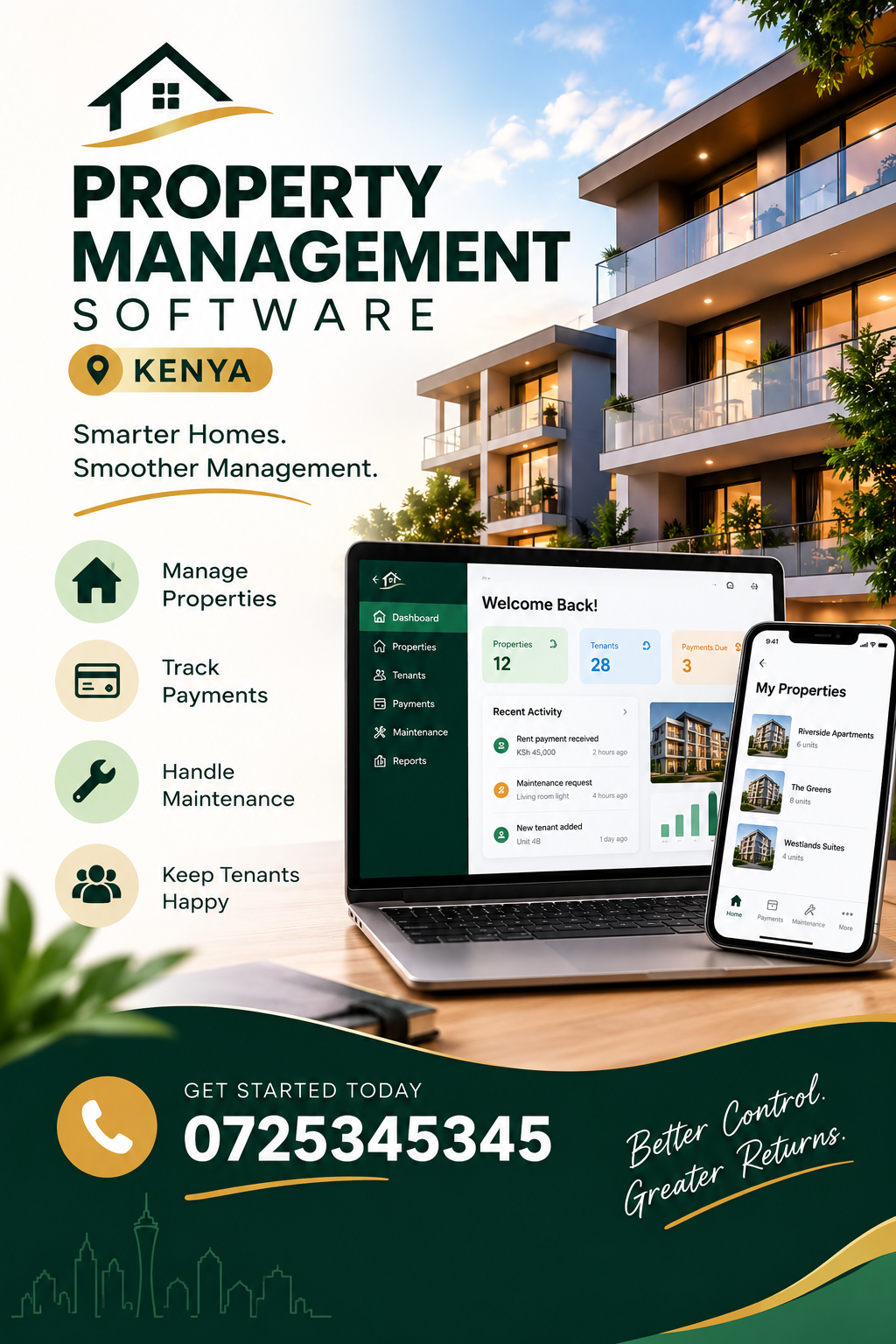
Managing Rental Properties More Efficiently in Kenya
Managing rental property involves much more than collecting rent at the end of the month. Landlords and property managers have to keep track of tenants, vacant units, leases, invoices, payments, arrears, maintenance requests, expenses and financial reports. As a property portfolio grows, handling all these activities through notebooks, Excel spreadsheets, WhatsApp messages and separate M-Pesa records can become difficult. This is where Property Management Software Kenya becomes useful for landlords, property managers, agencies and rental businesses that want a more organised way to manage daily operations.
The Kenyan rental market includes everything from individual landlords with a few houses to property managers responsible for hundreds of apartment units. Although the scale differs, the fundamental challenges are often similar: knowing who has paid, identifying who still owes rent, tracking vacant units, maintaining accurate tenant records and producing reliable reports.
Modern property management systems bring these activities into one digital environment. RentalDesk, for example, provides workflows for properties and units, tenants and leases, rent invoices, M-Pesa collections, reconciliation, arrears tracking, utilities, owner statements, tenant portals, maintenance requests, documents and accounting reports.
What Is Property Management Software?
Property Management Software Kenya refers to a digital platform designed to help landlords and property managers organise and automate rental property operations.
Instead of maintaining several disconnected records, a property manager can maintain information about properties, units, tenants, invoices and payments within one system.
Depending on the provider, the system may include features such as:
- Property and unit management
- Tenant management
- Lease tracking
- Rent invoicing
- Payment recording
- M-Pesa collection
- Arrears tracking
- Maintenance management
- Utility billing
- Expense management
- Owner statements
- Financial reports
- User permissions
- Audit records
- Tenant portals
- Landlord portals
The main advantage is not simply replacing paper with software. The real value comes from connecting related activities.
For example, when a rent invoice is generated for a particular tenant, the payment should be associated with that tenant and unit. If the tenant makes a partial payment, the remaining balance should remain visible. If the payment is unmatched, the property manager should be able to investigate it rather than losing track of the transaction.
Why Kenyan Landlords Need Better Rental Records
Property Management Software Kenya becomes increasingly useful as the number of properties and tenants grows.
A landlord with five units may remember most tenants and payment statuses without much difficulty. A landlord managing 100 units has a different challenge.
If each tenant pays rent every month, there can be 1,200 expected payment events in a year. Add partial payments, late payments, arrears, deposits, utility charges, maintenance expenses and other transactions, and the amount of information increases significantly.
Manual systems can create problems such as:
- Missing payment records
- Duplicate entries
- Incorrect balances
- Forgotten follow-ups
- Difficulty finding old information
- Delayed reports
- Confusion between properties
- Poor visibility into arrears
A centralised system helps property teams work from the same records.
RentalDesk’s current platform specifically focuses on showing paid, part-paid, unpaid and overdue tenants while connecting payments to tenants, units and invoices.
Managing Properties and Units
Property Management Software Kenya should begin with an accurate structure for properties and units.
A property manager may have:
| Property | Units | Type |
|---|---|---|
| Green View Apartments | 60 | Residential |
| Riverside Shops | 15 | Commercial |
| Sunrise Estate | 40 | Residential |
| City Centre Offices | 25 | Commercial |
Each property can then contain individual units.
For example:
Green View Apartments
- A101
- A102
- A103
- A104
This structure makes it easier to identify which tenant occupies which unit and which payment belongs to which property.
RentalDesk describes its property and unit workspace as a way to organise buildings, units, occupancy and unit status within one portfolio structure.
This becomes especially important for property managers handling several landlords.
Without proper property-level organisation, payments and expenses can easily be assigned to the wrong property.
Tenant Management
Property Management Software Kenya can also simplify tenant management.
A tenant record may contain information such as:
- Full name
- Phone number
- Email address
- Unit
- Lease information
- Rent amount
- Deposit
- Payment history
- Outstanding balance
- Communication records
Keeping this information in one place makes it easier for property managers to answer everyday questions.
For example:
“Who occupies Unit B14?”
“When does this lease expire?”
“How much rent does this tenant owe?”
“When was the last payment made?”
“Does this tenant have an outstanding balance?”
Instead of searching through paper files or WhatsApp conversations, the manager can retrieve the information from the tenant record.
Rent Invoicing
One of the most important property-management activities is billing tenants accurately.
Property Management Software Kenya can help automate or organise monthly rent invoicing.
A typical rental invoice may include:
- Rent
- Service charge
- Water
- Electricity
- Parking
- Other approved charges
- Previous balance
- Amount payable
The exact items depend on the property and lease agreement.
Automated invoicing can reduce the need to create individual invoices manually every month.
RentalDesk currently provides monthly billing and invoice workflows, allowing managers to generate rent invoices, review line items and monitor billing status.
This is particularly valuable when managing dozens or hundreds of tenants.
M-Pesa Rent Collection
Property Management Software Kenya is particularly relevant to the Kenyan market because mobile-money payments are widely used for rent.
RentalDesk places M-Pesa at the centre of its rent-collection workflow. Its platform supports Paybill, Till and STK Push workflows, payment matching, tenant ledgers and reconciliation of unmatched or unclear transactions.
A typical process can work like this:
- A tenant receives payment instructions.
- The tenant makes a payment.
- The transaction is captured.
- The payment is matched to the tenant and unit.
- The tenant’s balance is updated.
- The payment is reflected in the payment history.
- The property manager can review the collection status.
This reduces the need to manually check large numbers of M-Pesa messages.
Tracking Paid, Part-Paid and Unpaid Tenants
Property Management Software Kenya can provide better visibility into payment status.
A tenant may:
- Pay the full amount
- Pay part of the rent
- Pay late
- Pay more than the current invoice
- Fail to pay
A good system should distinguish these situations.
For example:
| Tenant | Rent | Paid | Balance | Status |
|---|---|---|---|---|
| Tenant A | KSh 20,000 | KSh 20,000 | KSh 0 | Paid |
| Tenant B | KSh 20,000 | KSh 15,000 | KSh 5,000 | Part-paid |
| Tenant C | KSh 20,000 | KSh 0 | KSh 20,000 | Unpaid |
RentalDesk’s current platform explicitly supports visibility into paid, part-paid, unpaid and overdue tenants.
This allows the property manager to prioritise follow-ups.
Arrears Management
Property Management Software Kenya can help property managers identify arrears earlier.
Arrears are not simply a financial problem. They also create administrative work.
A manager may have to:
- Identify the tenant
- Confirm the amount owed
- Check whether a payment was missed
- Confirm whether a payment was partially made
- Contact the tenant
- Record the follow-up
- Monitor the outstanding balance
When these activities are managed manually, it is easy for follow-ups to be forgotten.
RentalDesk’s current website describes daily follow-up workflows for arrears, unmatched payments, receipts and owner reporting.
A clear arrears dashboard can therefore help managers know what requires attention today.
Tenant Payment History
Property Management Software Kenya should provide a clear history of tenant payments.
A payment history can show:
- Date
- Amount
- Payment method
- Invoice
- Reference
- Remaining balance
This becomes useful when a tenant disputes a balance.
Instead of relying on memory, the manager can review the transaction history.
For example, if a tenant claims that KSh 30,000 was paid, the manager can check the recorded transaction and determine whether it was correctly allocated.
This type of record keeping also helps when a property changes management.
Lease Management
Property Management Software Kenya can help organise lease information.
A property manager may need to know:
- Lease start date
- Lease expiry date
- Monthly rent
- Deposit
- Renewal terms
- Tenant information
- Unit information
Without a structured system, lease dates can be stored in paper files or individual spreadsheets.
This creates the risk of missing important dates.
A centralised tenant and lease record makes it easier to review upcoming expirations.
It can also help managers plan renewals, inspections and communication with tenants.
Managing Vacant Units
Property Management Software Kenya can help managers keep track of occupancy.
A property portfolio can contain several unit statuses:
- Occupied
- Vacant
- Reserved
- Under maintenance
- Unavailable
Knowing the status of each unit is important for rental businesses.
A vacant unit represents potential income that is not currently being collected.
If the property manager does not have a reliable vacancy record, marketing and allocation can become inefficient.
RentalDesk’s current property and unit workspace includes occupancy and unit-status organisation.
Maintenance Management
Property Management Software Kenya should not focus only on rent collection.
Property management also involves maintaining buildings and responding to tenant complaints.
Common maintenance requests include:
- Plumbing problems
- Electrical faults
- Broken doors
- Water issues
- Leaking roofs
- Damaged fixtures
- Security concerns
- Cleaning issues
A maintenance system can allow the manager to record the request, assign responsibility and track progress.
RentalDesk currently lists maintenance requests and ticket workflows among its platform features.
This is better than relying entirely on WhatsApp messages that may become difficult to track.
Utility Billing
Property Management Software Kenya can also help with utility-related charges.
Some properties charge tenants separately for:
- Water
- Electricity
- Garbage collection
- Internet
- Service charges
- Other shared services
If these charges are calculated manually, errors can occur.
A digital system can help maintain clearer records of what was billed and what was paid.
RentalDesk lists utility billing among its available rental-management workflows.
The exact billing structure should still follow the property’s agreements and applicable rules.
Service Charge Management
Property Management Software Kenya can be useful for buildings that collect service charges in addition to rent.
Service charges may cover costs such as:
- Security
- Cleaning
- Common-area maintenance
- Waste management
- Landscaping
- Shared utilities
Property managers need to keep these charges separate from ordinary rent where required by their agreements and accounting procedures.
Clear categorisation makes it easier to prepare financial reports and explain charges to owners or tenants.
Owner Statements
Property Management Software Kenya can also support landlords who rely on property managers.
A property owner may want to know:
- Rent collected
- Outstanding rent
- Expenses
- Management fees
- Net amount
- Property performance
RentalDesk currently provides owner-reporting workflows and states that owner statements can include collections, arrears, expenses, fees and payouts.
This creates greater visibility for owners who are not involved in daily property operations.
Financial Reporting
Property Management Software Kenya can bring financial reporting closer to the daily rental workflow.
Useful reports may include:
- Rent collection report
- Arrears report
- Tenant statement
- Property income report
- Expense report
- Occupancy report
- Payment history
- Owner statement
- Outstanding balances
Reports help property managers move from individual transactions to an overall understanding of the portfolio.
For example, the manager can compare rent expected against rent collected and identify properties with unusual arrears.
Multi-Property Management
Property Management Software Kenya becomes even more important when a company manages several properties.
A property management company may manage:
Property A: 50 units
Property B: 80 units
Property C: 120 units
Property D: 40 units
Managing these properties through separate spreadsheets can create unnecessary complexity.
A multi-property dashboard can provide a broader view while maintaining property-level records.
RentalDesk’s Estate Manager plan is currently positioned for estate managers, agencies and companies managing multiple landlords and many units, with features including a multi-property dashboard and role-based permissions.
Role-Based Access
Property Management Software Kenya should provide appropriate access controls for property teams.
A property company may have:
- Property managers
- Accountants
- Caretakers
- Administrators
- Directors
- External accountants
They do not necessarily need the same level of access.
For example, a caretaker may need to see maintenance requests but should not necessarily have permission to modify financial records.
RentalDesk states that its system supports role-based access so caretakers, managers, accountants and administrators can work with the records relevant to their responsibilities.
This creates better separation of responsibilities.
Reconciliation of Rental Payments
Property Management Software Kenya should support a process for checking payments against tenant records.
Payment reconciliation involves determining whether money received belongs to the correct tenant, unit and invoice.
This matters because payment records can sometimes be:
- Unmatched
- Duplicated
- Incorrectly referenced
- Partially paid
- Overpaid
RentalDesk currently provides a reconciliation workflow for unmatched, unclear and duplicate payments.
A reconciliation process helps prevent incorrect balances from remaining unnoticed.
Managing Partial Payments
Property Management Software Kenya should account for tenants who do not always pay the entire amount at once.
Suppose rent is KSh 25,000.
The tenant pays KSh 15,000.
The remaining balance is KSh 10,000.
The system should not simply mark the tenant as unpaid.
Instead, it should show that the tenant is part-paid and display the outstanding balance.
RentalDesk’s current platform supports part-paid tenants and updates the remaining balance so managers can distinguish full payments from outstanding amounts.
This provides more accurate information for follow-up.
Managing Overpayments
Property Management Software Kenya should also make unusual transactions visible.
A tenant might accidentally pay more than the amount currently due.
For example:
Rent due: KSh 20,000
Payment received: KSh 25,000
The extra KSh 5,000 should not simply disappear into the records.
The property manager needs to review how the overpayment should be treated.
RentalDesk’s current M-Pesa workflow makes overpayments visible for review rather than silently ignoring them.
This improves the accuracy of tenant balances.
Mobile Access for Property Managers
Property Management Software Kenya is especially useful when managers need access while away from the office.
Property managers may spend much of their day:
- Visiting properties
- Inspecting units
- Meeting tenants
- Following up maintenance
- Checking vacant units
- Reviewing payment issues
A cloud-based platform can allow authorised users to work with records without depending on a single office computer.
RentalDesk describes itself as a cloud-based platform and provides mobile-access functionality among its features.
Replacing Spreadsheets
Property Management Software Kenya can reduce dependence on large spreadsheets.
Excel remains useful for many businesses, but rental operations can become complicated when spreadsheets are responsible for:
- Tenant records
- Rent calculations
- Arrears
- Payment tracking
- Expenses
- Property information
- Reports
A spreadsheet can also become difficult to control when several people need to update it.
RentalDesk positions its platform as a replacement for notebook and spreadsheet workflows covering rent collection, arrears, tenant records, utilities, maintenance, reports and owner statements.
Improving Daily Follow-Ups
Property Management Software Kenya can help managers prioritise daily tasks.
Instead of starting every morning by checking multiple WhatsApp conversations and spreadsheets, the manager can review outstanding actions.
For example:
Today
- 8 tenants overdue
- 3 unmatched payments
- 4 maintenance requests
- 2 leases approaching expiry
- 5 vacant units requiring follow-up
This turns property management into a task-driven workflow.
The objective is not to automate every decision. It is to make important exceptions easier to identify.
Data Security
Property Management Software Kenya should be evaluated for security as well as convenience.
Rental systems can contain:
- Tenant names
- Phone numbers
- Lease information
- Payment records
- Property information
- Owner details
- Financial data
Access should therefore be controlled.
RentalDesk currently states that its platform includes role-based permissions, audit visibility and security resources.
Property managers should also use strong passwords and ensure that former employees no longer have unnecessary access.
Property Management for Real Estate Agencies
Property Management Software Kenya can be particularly useful for agencies managing properties on behalf of multiple owners.
An agency needs to keep owner records separate while maintaining a central operational workflow.
For example:
Landlord A
- 20 units
- 18 occupied
- KSh 360,000 expected rent
Landlord B
- 50 units
- 46 occupied
- KSh 920,000 expected rent
The agency needs to know both the individual property position and the overall portfolio position.
A multi-property system can help provide both views.
Supporting Property Owners With Small Portfolios
Property Management Software Kenya is not only for large agencies.
A landlord with ten or twenty units can also benefit from structured records.
At this size, manual management may still seem manageable, but the landlord may already be spending considerable time on:
- Rent reminders
- Payment confirmation
- Arrears calculations
- Maintenance
- Tenant communication
- Expense tracking
Digitising these processes early can help establish better habits before the portfolio becomes much larger.
Supporting Large Estates
Property Management Software Kenya becomes particularly useful for larger estates where the number of tenants, units and transactions creates significant administrative work.
A large estate may have:
- Hundreds of tenants
- Multiple blocks
- Different rent amounts
- Service charges
- Utility billing
- Parking
- Maintenance teams
- Security personnel
- Multiple administrators
A central platform helps different teams work from the same property records.
Rental Property Accounting
Property Management Software Kenya can help connect operational activity with financial reporting.
Property accounting involves more than knowing the total amount collected.
Managers may need to distinguish:
- Rent income
- Service charges
- Utility charges
- Maintenance expenses
- Management fees
- Other expenses
- Owner payouts
Clear categorisation makes reports easier to understand.
Tracking Property Expenses
Property Management Software Kenya should provide a way to record property-related expenses.
Common examples include:
- Plumbing
- Electrical repairs
- Security
- Cleaning
- Landscaping
- Garbage collection
- Maintenance materials
- Staff expenses
Recording expenses against the correct property is important.
Otherwise, an owner may receive a report showing income but no clear explanation of the costs associated with managing the property.
Tenant Communication
Property Management Software Kenya can also support better communication workflows.
Property managers regularly need to communicate about:
- Rent reminders
- Payment confirmations
- Maintenance
- Inspections
- Lease matters
- Notices
RentalDesk’s current platform includes SMS rent reminders in its Starter plan and tenant portal workflows that can allow tenants to view balances, invoices, receipts and payment instructions.
This can reduce repetitive manual communication.
Tenant Portals
Property Management Software Kenya can provide a better tenant experience when tenant portals are available.
Instead of calling the property manager for every basic question, tenants may be able to view:
- Rent balance
- Invoice
- Receipt
- Payment instructions
- Statement
- Maintenance requests
This does not eliminate communication between tenants and managers.
It simply makes routine information easier to access.
Landlord Portals
Property Management Software Kenya can also improve communication between property managers and owners.
Landlords who live outside Nairobi or outside Kenya may not visit their properties regularly.
A landlord portal or owner-reporting workflow can give them better visibility into:
- Collections
- Arrears
- Expenses
- Property performance
- Tenant balances
- Statements
RentalDesk currently provides landlord and owner-reporting workflows as part of its broader platform.
Choosing the Right Software
Property Management Software Kenya should be selected based on actual business requirements rather than simply the number of features advertised.
Before choosing a platform, consider:
| Requirement | Question |
|---|---|
| Units | How many units can it manage? |
| Tenants | Can tenant records be organised properly? |
| M-Pesa | Does it support the required payment workflow? |
| Invoicing | Can recurring rent invoices be created? |
| Arrears | Can outstanding balances be identified? |
| Maintenance | Can requests be tracked? |
| Reports | Are owner and financial reports available? |
| Users | Can different permissions be assigned? |
| Support | Is help available when needed? |
| Data | Can records be exported? |
The right choice depends on the property portfolio and operating model.
Testing Software Before Paying
Property Management Software Kenya should be tested using realistic rental scenarios.
Do not simply open the dashboard and look at the interface.
Create sample properties.
Add units.
Create tenants.
Generate invoices.
Record payments.
Test partial payments.
Create arrears.
Record an expense.
Generate an owner statement.
Create a maintenance request.
Then ask whether the workflow makes sense.
RentalDesk currently offers a free Lite option for one property and up to five units, while its Starter plan is listed at KSh 5,000 per month for up to 99 units and its Estate Manager plan at KSh 9,500 per month for larger multi-landlord operations.
Pricing and features should always be confirmed directly with the provider before making a purchase.
Cost Versus Value
Property Management Software Kenya should not be judged on subscription price alone.
Consider how much time the system can save.
If a property manager spends several hours every month reconciling payments manually, the cost is not only the software subscription. It also includes staff time.
Other potential benefits include:
- Faster payment reconciliation
- Better arrears follow-up
- Clearer owner reports
- Fewer duplicate records
- Easier tenant communication
- Better visibility into vacancies
- More organised maintenance
RentalDesk itself highlights faster reconciliation, clearer balances and owner reporting, and reduced spreadsheet work as benefits associated with its Starter plan.
Moving From Excel to a Property Management System
Property Management Software Kenya can make the transition from spreadsheets more structured.
Before moving data, review the existing records.
Check for:
- Duplicate tenants
- Old tenants
- Incorrect phone numbers
- Wrong rent amounts
- Incorrect balances
- Missing units
- Duplicate properties
- Outstanding arrears
Cleaning the data first is important.
A new system should not simply become a new place for old mistakes.
A practical migration process is:
- Review existing data.
- Remove duplicates.
- Confirm active tenants.
- Confirm units.
- Verify rent amounts.
- Confirm outstanding balances.
- Import or enter verified records.
- Test transactions.
- Compare reports.
- Begin normal operations.
Training Property Staff
Property Management Software Kenya works best when staff understand how to use it.
Training does not need to be complicated.
A property team should understand:
- How to add tenants
- How to update tenant information
- How invoices work
- How payments are recorded
- How arrears are reviewed
- How maintenance requests are handled
- How reports are generated
- What each user is allowed to access
A short internal procedure document can also help new staff learn the system.
Property Management KPIs
Property Management Software Kenya can help property managers monitor important performance indicators.
Useful KPIs include:
Occupancy rate
The percentage of units currently occupied.
Collection rate
The proportion of expected rent actually collected.
Arrears
The amount of outstanding rent.
Vacancy
The number of units not currently occupied.
Maintenance response
How quickly maintenance issues are addressed.
Expense levels
How much is being spent on property operations.
Tracking these indicators gives property owners more useful information than simply looking at the bank balance.
A Monthly Property Management Routine
Property Management Software Kenya can support a repeatable monthly workflow.
A property manager could follow this process:
Week 1
Generate invoices and review payment status.
Week 2
Follow up overdue accounts.
Week 3
Review maintenance and expenses.
Week 4
Prepare owner and financial reports.
At the end of the month, the manager can review:
- Rent expected
- Rent collected
- Outstanding balances
- Vacancies
- Expenses
- Maintenance
- Owner payouts
This creates consistency across the portfolio.
Handling Unmatched Payments
Property Management Software Kenya should make exceptions visible rather than hiding them.
Suppose a payment is received but the reference does not clearly identify the tenant.
The system should place it somewhere the property manager can investigate.
RentalDesk’s current reconciliation workflow specifically provides a queue for unmatched, unclear and duplicate payments.
This is important because automatically assigning an uncertain payment to the wrong tenant can create a false balance.
Property-Level Reporting
Property Management Software Kenya should allow managers to analyse properties individually.
For example:
Apartment A
- Expected rent: KSh 1,000,000
- Collected: KSh 950,000
- Arrears: KSh 50,000
- Occupancy: 95%
Apartment B
- Expected rent: KSh 800,000
- Collected: KSh 700,000
- Arrears: KSh 100,000
- Occupancy: 85%
This information allows managers to identify which property requires more attention.
Portfolio-Level Reporting
Property Management Software Kenya can also provide an overall view.
A property management company may want to know:
- Total units
- Total occupied units
- Total vacancies
- Total rent billed
- Total rent collected
- Total arrears
- Total expenses
The portfolio view helps management understand the entire business.
The property-level view helps identify where the problems are.
Both are useful.
Maintenance Follow-Up
Property Management Software Kenya should help ensure maintenance requests do not disappear after the initial complaint.
A simple maintenance workflow can be:
Tenant reports problem
↓
Request recorded
↓
Issue assigned
↓
Work completed
↓
Cost recorded
↓
Request closed
This provides a history of what happened.
It also helps managers identify recurring problems.
For example, if the same plumbing issue appears repeatedly in one building, the property owner may need a more permanent solution.
Managing Documents
Property Management Software Kenya can also help organise documents related to properties and tenants where document-management functionality is provided.
Relevant documents may include:
- Lease agreements
- Tenant records
- Inspection records
- Maintenance documents
- Property documents
- Receipts
- Other operational records
Centralised documents can make it easier to retrieve information when required.
Supporting Property Managers With Multiple Owners
Property Management Software Kenya is particularly valuable for professional property managers who manage properties for different clients.
The manager must be able to answer:
“Which property generated this income?”
“Which landlord owns this property?”
“What expenses belong to this property?”
“How much should this owner receive?”
“Which tenants are in arrears?”
Without proper property-level records, these questions can become difficult.
A multi-property system can establish a clearer relationship between landlords, properties, units, tenants and transactions.
What Makes Software Suitable for Kenya?
Property Management Software Kenya should account for local rental workflows.
Important considerations include:
- M-Pesa payments
- Kenyan Shilling
- Local payment references
- Tenant communication
- Rent collection
- Arrears
- Local property structures
- Local business practices
RentalDesk positions itself specifically for Kenyan landlords, agencies and property teams, with M-Pesa workflows and local rent-collection requirements at the centre of its platform.
A localised workflow can be more practical than trying to adapt software designed around completely different rental-payment systems.
Common Property Management Mistakes
Property Management Software Kenya can help reduce administrative mistakes, but the software does not replace good procedures.
Common mistakes include:
Keeping separate tenant lists
Different spreadsheets can result in conflicting tenant information.
Delaying payment entry
Late recording can make balances unreliable.
Ignoring partial payments
Part-payments should remain visible.
Failing to reconcile
Unmatched transactions can create incorrect tenant balances.
Giving everyone full access
User permissions should match responsibilities.
Forgetting vacant units
Vacancy affects expected income and should be monitored.
Recording expenses without property allocation
Owners need to know where expenses occurred.
How to Implement a New System
Property Management Software Kenya can be implemented gradually.
A practical approach is:
Stage 1: Document the current process
Write down how rent, tenants, maintenance and reports are currently handled.
Stage 2: Identify problems
Find the activities that consume the most time or create the most errors.
Stage 3: Clean the data
Verify properties, units, tenants and balances.
Stage 4: Configure the system
Set up properties, units, rent amounts and users.
Stage 5: Test payments
Run sample transactions and check balances.
Stage 6: Train users
Ensure staff understand their responsibilities.
Stage 7: Go live
Begin using the system for normal operations.
Stage 8: Review
After the first month, identify what needs improvement.
Who Can Use Property Management Software?
Property Management Software Kenya can be useful for several types of property businesses.
Individual landlords
Suitable for owners managing their own rental units.
Property managers
Useful for professionals managing properties on behalf of owners.
Real estate agencies
Useful when rental management is one of the agency’s services.
Apartment managers
Helpful for large residential developments.
Commercial property managers
Useful for offices, shops and other commercial spaces.
Estate managers
Useful for larger developments with multiple units and shared services.
Hostel operators
Useful for managing student or residential accommodation.
The exact features required will vary depending on the property type.
Frequently Asked Questions
What is property management software?
Property Management Software Kenya is software that helps landlords and property managers organise rental activities such as properties, units, tenants, rent invoices, payments, arrears, maintenance and reporting.
Can property management software track M-Pesa rent?
Yes, some systems support M-Pesa rent-collection workflows.
Property Management Software Kenya can be especially relevant in Kenya when the platform supports payment matching, tenant ledgers and reconciliation.
RentalDesk currently supports M-Pesa collection workflows involving Paybill, Till and STK Push processes.
Can tenants make partial payments?
Yes, a suitable system can record partial payments and maintain the remaining balance.
Property Management Software Kenya should therefore be evaluated for how it handles part-paid tenants rather than only full payments.
Can the software track rent arrears?
Yes.
Property Management Software Kenya can help managers identify tenants with outstanding balances and organise follow-up activities when arrears-tracking functionality is available.
Can landlords manage multiple properties?
Yes. Multi-property management is one of the most useful features for landlords and agencies with larger portfolios.
Property Management Software Kenya should be evaluated based on the number of properties, units and users the organisation expects to manage.
Can property managers manage several landlords?
Yes, some systems are designed specifically for agencies and professional property managers.
Property Management Software Kenya can be useful where the system supports separate landlords, properties and owner reports.
Can the software generate invoices?
Yes, many modern rental-management platforms support recurring rent invoices.
Property Management Software Kenya can help automate monthly billing where invoicing functionality is included.
Can the system manage maintenance?
Yes.
Property Management Software Kenya can include maintenance-request workflows that allow managers to record, assign and monitor property issues.
Can property owners receive statements?
Yes. Some platforms provide owner statements showing collections, expenses, fees and payouts.
Property Management Software Kenya can therefore be useful for professional managers who need to provide landlords with regular financial information.
Is property management software suitable for small landlords?
Yes.
A small landlord may not need advanced multi-property functionality, but centralised tenant, invoice and payment records can still be useful.
Property Management Software Kenya can help reduce the administrative burden associated with managing rental units.
Can property management software replace Excel?
It can replace many spreadsheet-based rental workflows.
Property Management Software Kenya is especially useful when a property manager wants tenant records, invoices, payments, arrears and reports connected within one system.
How much does property management software cost in Kenya?
Pricing varies according to the number of units, users and features.
RentalDesk currently lists a free Lite plan for one property and up to five units, a Starter plan at KSh 5,000 per month for up to 99 units, and an Estate Manager plan at KSh 9,500 per month for larger multi-landlord operations.
Property Management Software Kenya should therefore be evaluated based on the actual size and needs of the property portfolio.
Does property management software require technical skills?
Not necessarily.
Property Management Software Kenya should be simple enough for everyday property staff to use without advanced technical knowledge.
Training and onboarding can also make adoption easier.
Can tenants view their balances online?
Some platforms provide tenant portals.
Property Management Software Kenya can support tenant self-service where this functionality is available.
RentalDesk’s current tenant portal workflow can allow tenants to view balances, invoices, receipts, statements, payment instructions and request updates.
What should I look for before choosing software?
Property Management Software Kenya should be evaluated based on:
- Tenant management
- Rent invoicing
- M-Pesa collection
- Payment reconciliation
- Arrears tracking
- Maintenance
- Reporting
- User permissions
- Multi-property support
- Data export
- Customer support
Is cloud-based property management better than spreadsheets?
It can be more practical for teams that need shared access and centralised records.
Property Management Software Kenya can give authorised users access to the same rental information instead of keeping separate spreadsheet versions.
The right choice still depends on the size and requirements of the property business.
Property Management Software Checklist
Before selecting a platform, landlords and property managers can use this checklist:
- Property records
- Unit management
- Tenant records
- Lease tracking
- Automated invoicing
- M-Pesa collection
- Payment matching
- Partial payments
- Arrears tracking
- Expense management
- Maintenance tracking
- Utility billing
- Owner statements
- Tenant portal
- Landlord portal
- Financial reports
- Role-based permissions
- Audit history
- Mobile access
- Data export
Property Management Software Kenya should be compared against this checklist before a property business commits to a particular platform.
A Practical Example for a 100-Unit Apartment
Consider a property with 100 units.
Monthly rent averages KSh 15,000.
Expected monthly rent is therefore KSh 1.5 million.
The manager has to monitor:
- 100 tenants
- 100 monthly invoices
- M-Pesa payments
- Partial payments
- Arrears
- Maintenance
- Utilities
- Expenses
- Owner reports
Property Management Software Kenya can centralise these activities within one property-management workflow.
At the beginning of the month, invoices can be generated.
As tenants pay, transactions can be recorded and matched.
The manager can then identify unpaid and part-paid tenants.
Maintenance requests can be tracked separately.
At the end of the month, the manager can prepare financial and owner reports.
This is considerably easier to manage when the information is connected rather than distributed across several spreadsheets.
Preparing for Property Portfolio Growth
Property Management Software Kenya should not only solve today’s problems.
A landlord with 20 units today may have 100 units in the future.
A property agency managing five buildings may eventually manage twenty.
When selecting software, consider:
- Maximum units
- Number of users
- Number of properties
- Multiple landlords
- Reporting requirements
- Payment volume
- Data export
- Support
RentalDesk’s current plans illustrate this type of scaling, with Starter supporting up to 99 units and the Estate Manager plan designed for larger multi-landlord operations.
The Importance of Accurate Property Data
Property Management Software Kenya is only as useful as the information entered into it.
Property managers should verify:
- Unit numbers
- Tenant names
- Rent amounts
- Lease dates
- Deposits
- Payment balances
- Property ownership
- Expense records
Incorrect information can lead to incorrect reports.
For example, if a tenant’s rent is recorded as KSh 15,000 instead of KSh 18,000, the system will generate incorrect invoices unless the mistake is corrected.
Digital systems improve organisation, but data accuracy remains a management responsibility.
Building a Better Rental Management Workflow
Property Management Software Kenya can bring the complete rental workflow together.
A simplified process can look like this:
Property
↓
Unit
↓
Tenant
↓
Lease
↓
Invoice
↓
Payment
↓
Reconciliation
↓
Balance
↓
Arrears follow-up
↓
Report
This structure makes it easier to understand where each transaction belongs.
It also helps different members of the property team work from the same information.
What Property Managers Should Review Daily
Property Management Software Kenya can support a daily dashboard approach.
A manager can start the day by checking:
Collections
What payments came in?
Arrears
Who has outstanding rent?
Exceptions
Are there unmatched payments?
Maintenance
Which requests remain open?
Vacancies
Which units are empty?
Follow-ups
Which tenants or owners need communication?
This approach changes property management from reactive administration to structured daily monitoring.
What Property Managers Should Review Monthly
Property Management Software Kenya can support a broader monthly review.
At the end of each month, managers can review:
- Rent billed
- Rent collected
- Collection rate
- Arrears
- Vacancies
- Expenses
- Maintenance
- Utility billing
- Owner payouts
- Outstanding tenant balances
The information can then be used to identify problems before they become larger.
Making Property Management More Accountable
Property Management Software Kenya can support accountability by making records more visible and structured.
For example, if a payment is entered manually, the team should be able to identify the relevant transaction.
If an expense is recorded, it should be associated with the correct property.
If a tenant has arrears, the balance should be visible.
If a maintenance request is opened, the team should know whether it has been resolved.
This creates an operational history that can be reviewed when questions arise.
When Should a Landlord Adopt Software?
Property Management Software Kenya becomes particularly valuable when manual administration begins taking too much time.
Some warning signs include:
- You have multiple properties.
- You manage many tenants.
- Rent reconciliation takes hours.
- You frequently check WhatsApp for payment confirmations.
- Tenants dispute balances.
- You struggle to track arrears.
- Owner reports take too long.
- Maintenance requests get lost.
- Several people need access to the records.
- You have multiple spreadsheets.
These problems indicate that a more structured system may be worthwhile.
Final Practical Considerations
Property Management Software Kenya should be viewed as an operational tool rather than simply an accounting application.
The strongest systems connect property records, tenants, invoices, payments, arrears, maintenance and reporting.
For Kenyan landlords, M-Pesa workflows are especially important.
For professional property managers, multi-property management and owner reporting may be more important.
For larger estates, user permissions, service charges, utility billing and maintenance workflows may become essential.
For smaller landlords, simple tenant and payment tracking may be enough.
The right system therefore depends on the portfolio.
Before choosing a platform, define the current workflow, identify the biggest problems, clean existing records and test the system using realistic transactions.
Property Management Software Kenya can then be assessed according to whether it actually makes those processes easier, clearer and more manageable.
A modern rental operation should make it easy to answer a few basic questions every day:
Who has paid?
Who has not paid?
Who has paid partially?
Which payments need reconciliation?
Which units are vacant?
Which maintenance issues are open?
How much rent has been collected?
How much remains outstanding?
What does each property owe or earn?
What information does each landlord need?
When those answers are available from organised records, landlords and property managers can spend less time searching through spreadsheets and messages and more time managing the properties themselves.