
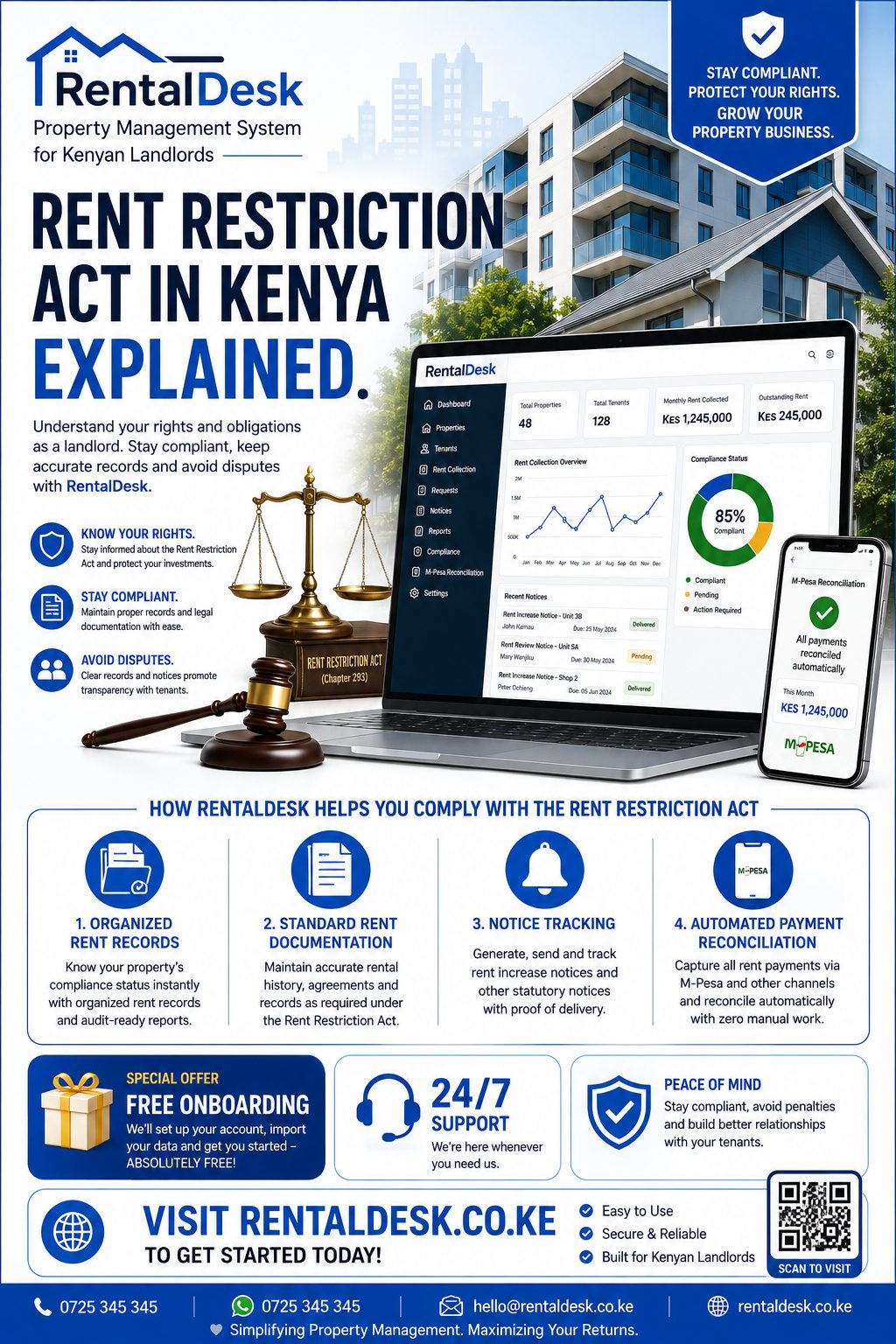
Rent Restriction Act in Kenya explained begins with understanding one of the oldest and most misunderstood pieces of legislation governing residential tenancies in the country. Enacted in 1959 under Cap 296, the Rent Restriction Act was designed to protect low-income tenants from exploitative rent increases and unlawful evictions. However, decades later, the Act’s coverage has been significantly overtaken by economic realities, leaving many landlords and tenants confused about when the law actually applies. RentalDesk helps landlords maintain accurate rent records, track payments, and ensure compliance with applicable rental laws, including proper documentation of standard rents and tenancy terms.
What Is the Rent Restriction Act in Kenya?
The Rent Restriction Act in Kenya explained starts with its purpose: to make provision for restricting the increase of rent, the right to possession, and the exaction of premiums, and for fixing standard rents in relation to dwelling-houses. The Act applies to residential properties only—commercial premises fall under separate legislation (Cap 301 for shops, hotels, and catering establishments).
A critical limitation of the Rent Restriction Act in Kenya explained is that it only applies to dwelling-houses with a standard rent not exceeding KShs. 2,500 per month. This threshold was set based on the rent levels prevailing on January 1, 1981, and has never been updated. In today’s rental market, where even modest bedsitters in Nairobi cost far more than KShs. 2,500, the Act’s coverage has become extremely limited.
Key Definitions Under the Rent Restriction Act in Kenya
Understanding the Rent Restriction Act in Kenya explained requires familiarity with several key terms:
Standard Rent
Standard rent is the rent at which a dwelling-house was let on January 1, 1981. If the property was not let or was not yet erected at that time, the standard rent is assessed by the Rent Restriction Tribunal. The Act restricts landlords from charging rent above the standard rent, subject to reassessment by the Tribunal.
Protected/Controlled Tenancies
A protected or controlled tenancy under the Rent Restriction Act in Kenya explained is a residential tenancy where the monthly rent is KShs. 2,500 or below. These tenancies receive special protection against rent increases and eviction under the Act.
Exemptions from the Act
Section 2(1) of the Rent Restriction Act in Kenya explained excludes the following from coverage:
-
Dwelling-houses with standard rent exceeding KShs. 2,500 per month
-
Exempted dwelling-houses
-
Dwelling-houses let on service tenancies
The Rent Restriction Tribunal
The Rent Restriction Act in Kenya explained establishes the Rent Restriction Tribunal (RRT) under Section 4. This quasi-judicial body handles disputes involving residential properties that qualify under the Act.
Tribunal Jurisdiction
The Rent Restriction Act in Kenya explained gives the Tribunal power to determine:
-
Questions concerning determination of rent
-
Mesne profits and service charges
-
Repairs of rented premises
-
Recovery of possession of premises
-
Levy of distress for rent
-
Apportionment of service charges among tenants
Tribunal Powers
Under Sections 5 and 6 of the Rent Restriction Act in Kenya explained, the Tribunal has extensive powers:
Rent Assessment Powers:
-
Assess the standard rent of any premises, either on application or of its own motion
-
Fix the date from which standard rent is payable
-
Fix service charges (water, light, conservancy, security) in addition to standard rent
-
Apportion charges among tenants sharing common services
Repair Orders:
-
Order landlords to carry out necessary repairs within a specified time
-
If the landlord fails, authorize the tenant to execute repairs and deduct the cost from rent
Possession and Recovery Powers:
-
Make orders for recovery of possession of premises
-
Order recovery of arrears of rent, mesne profits, and service charges
-
Permit levy of distress for rent
Reduction Powers:
-
Reduce standard or recoverable rent where the landlord has failed to carry out required repairs or maintenance
Refund Powers:
-
Order refund of irrecoverable rent paid by a tenant (application must be made within two years of the amount becoming due)
Important Jurisdictional Limitation
A crucial aspect of the Rent Restriction Act in Kenya explained is the Tribunal’s limited jurisdiction. The Tribunal cannot determine disputes where the monthly rent exceeds KShs. 2,500. Recent court decisions have reinforced this position, with the Environment and Land Court confirming that the Tribunal lacks jurisdiction for properties above this threshold.
In one case, an appellant who had filed a complaint before the Rent Restriction Tribunal was informed that the Tribunal lacked jurisdiction because the monthly rent under the lease agreement exceeded the pecuniary jurisdictional limit as per Section 2(1) of the Act. The court noted that “the Tribunal being a statutory creature under Cap 296 could not expand its powers”.
Penalties for Non-Compliance
Section 7 of the Rent Restriction Act in Kenya explained imposes penalties for failing to comply with a lawful order or decision of the Tribunal: a fine not exceeding KShs. 2,000 or imprisonment for a term not exceeding six months, or both.
Appeals
Section 8 of the Rent Restriction Act in Kenya explained allows appeals from certain Tribunal decisions to the High Court. However, no appeal lies from an order or decision made by consent of parties.
Rent Restrictions Under the Act
Restriction on Increasing Rent
Section 9 of the Rent Restriction Act in Kenya explained prohibits landlords from recovering rent in excess of the standard rent, regardless of any tenancy agreement executed between the landlord and tenant. Landlords may only increase rent when the rates payable by the landlord to the government over the dwelling premises increase during the letting period.
The Rent Restriction Act in Kenya explained also includes a notice requirement—no rent increase is due or recoverable until the landlord has served a valid written notice of intention to increase the rent. This requirement applies whether the increase is by agreement with the tenant or by reassessment of standard rent by the Tribunal.
Penalty for Accepting Excess Rent
Section 10 of the Rent Restriction Act in Kenya explained makes it an offence for a landlord, agent, or employee to demand or accept rent exceeding the standard rent. This provision aims to prevent exploitation of tenants.
Eviction Protections
Under the Rent Restriction Act in Kenya explained, landlords must provide a valid reason for eviction—such as non-payment of rent or property damage—and follow due process, which may involve obtaining a Tribunal order. The Tribunal may stay or suspend execution of any possession order on terms it considers fit, particularly with regard to payment of arrears.
Distress for Rent
The Rent Restriction Act in Kenya explained prohibits levying distress for rent over protected dwelling-houses without leave of the Rent Restriction Tribunal. This protects tenants from having their goods seized arbitrarily.
Exemptions from the Rent Restriction Act
The Rent Restriction Act in Kenya explained includes several statutory exemptions:
1. Exempted Dwelling-Houses
Properties specifically exempted by the Minister by notice in the Gazette are not covered.
2. Service Tenancies
Dwelling-houses let on service tenancies fall outside the Act’s scope. A service tenancy is typically one where the tenant occupies the property as an employee or as part of employment conditions.
3. Properties Above KShs. 2,500 Standard Rent
The most significant exemption—any dwelling-house with a standard rent exceeding KShs. 2,500 per month is not covered by the Act.
The KShs. 2,500 Challenge
The Rent Restriction Act in Kenya explained cannot be understood without addressing the KShs. 2,500 threshold. This figure, set based on 1981 rent levels, has been rendered almost irrelevant by inflation and market forces.
A 2022 review noted that “the restriction of rent for only rental houses whose monthly rent is KShs. 2,500 and below is however low in modern day and has since been overtaken by events”. The Act now protects only tenants in the lowest-income segment, leaving the vast majority of Kenyan tenants without its protections.
There have been calls for the law to be updated and revised. The proposed Landlord and Tenant Bill 2021 aimed to address these gaps, but it was not passed before the term of Parliament expired. Until new legislation is enacted, the KShs. 2,500 threshold remains the key determinant of whether a tenancy is protected.
Interaction with Business Premises Rent Tribunal
The Rent Restriction Act in Kenya explained deals exclusively with residential properties. Commercial properties fall under the Landlord and Tenant (Shops, Hotels and Catering Establishments) Act (Cap 301), which establishes the Business Premises Rent Tribunal (BPRT). Landlords and tenants with commercial premises should consult the BPRT rather than the RRT for dispute resolution.
Historical Application of the Rent Restriction Act
The Rent Restriction Act in Kenya explained has been the subject of significant litigation. One landmark case addressed whether the Act applies to dwelling houses erected after January 1, 1965. The court held that the Act applies to premises erected after that date, and that the determining factor is the quantum of rent, not construction date. This means a property built in 1972 is still subject to the Act if the rent is at or below the statutory threshold.
Another notable case established that a rent tribunal may raise a standard rent to any figure, and when that rent is raised above the limits set in the Act (then KShs. 800), the premises are no longer subject to it. This demonstrates the importance of the pecuniary threshold.
Common Misconceptions About the Rent Restriction Act
The Rent Restriction Act in Kenya explained dispels several common myths:
1. “The Act Applies to All Rental Properties”
False. The Act applies only to residential properties with standard rent at or below KShs. 2,500 per month. Most modern tenancies, even modest ones, exceed this threshold and are not protected.
2. “The Tribunal Handles Security Deposit Refunds”
Generally false. The Rent Restriction Tribunal has consistently declined to handle refund claims for security deposits, and many claims exceed the Tribunal’s pecuniary jurisdiction. Tenants seeking deposit refunds typically need to pursue other legal avenues.
3. “The Act Has Been Updated”
False. The KShs. 2,500 threshold has not been reviewed or changed for over four decades. This means the Act’s protections cover a shrinking percentage of the rental market.
4. “All Tenants Can Approach the Rent Restriction Tribunal”
False. Only tenants in protected tenancies (rent at or below KShs. 2,500) can approach the RRT. Tenants in properties with higher rent have no access to the Tribunal under Cap 296.
How RentalDesk Simplifies Compliance with Rental Laws
RentalDesk helps landlords navigate the complexities of the Rent Restriction Act in Kenya explained by providing:
Organized Property Records
A landlord needs accurate rent records to determine whether a tenancy is covered by the Act. RentalDesk provides property and unit records, tenant details, rent invoices, payment tracking, arrears, receipts, and reports—all from one dashboard.
Standard Rent Documentation
For properties potentially covered by the Act, RentalDesk helps landlords document standard rent calculations and maintain records of rental history. This is essential if the Tribunal ever needs to assess standard rent.
Compliance with Notice Requirements
Section 14(2) of the Rent Restriction Act in Kenya explained requires landlords to serve written notice before increasing rent. RentalDesk helps landlords generate and track formal notices, maintaining a complete audit trail.
Automated Rent Tracking
RentalDesk captures every rent transaction through M-Pesa integration, providing accurate monthly rent summaries. This ensures landlords can prove compliance or demonstrate that tenancies exceed the statutory threshold.
Communication History
The platform maintains records of all communications with tenants, including notices, reminders, and responses. This is valuable if a dispute reaches the Tribunal.