Property Management Software Kenya: Complete Guide for Landlords & Property Managers
Managing rental properties in Kenya can become complicated very quickly.
A landlord managing a few units may initially rely on Excel spreadsheets, notebooks, WhatsApp messages and M-Pesa confirmation messages. But as the number of properties and tenants increases, tracking rent, arrears, leases, expenses and tenant balances manually becomes increasingly difficult.
This is where property management software Kenya becomes valuable.
Modern property management software helps landlords, property managers and real estate agencies bring their rental operations into one centralized system.
Instead of asking Who has paid? Who still owes rent? Which M-Pesa payment belongs to which tenant?, a property manager can maintain organized records of properties, units, tenants, invoices, payments and outstanding balances.
RentalDesk is designed around these everyday rental-management workflows in Kenya.
What Is Property Management Software Kenya?
Property management software Kenya is a digital platform used by landlords, property managers and real estate agencies to organize and automate rental property operations.
Depending on the platform, the software may help manage:
- Properties and rental units
- Tenants
- Leases
- Rent invoices
- M-Pesa payments
- Rent reconciliation
- Tenant balances
- Rent arrears
- Receipts
- Maintenance
- Utilities
- Expenses
- Owner statements
- Financial and operational reports
Instead of maintaining different spreadsheets and records for each building, information can be managed from one centralized platform.
Why Kenyan Landlords Need Property Management Software
Managing property is not simply about receiving rent.
Every month, a landlord or property manager needs to know how much rent was expected, how much was collected, which tenants paid, which tenants partially paid and which accounts remain overdue.
When these records are managed manually, mistakes can easily occur.
For example, imagine managing 100 rental units.
During a single month, you may need to handle:
- 100 rent invoices
- Dozens of M-Pesa transactions
- Partial payments
- Previous arrears
- Deposits
- Utility bills
- Tenant changes
- Maintenance requests
- Vacancies
- Owner reports
Over several months, this creates thousands of individual records.
A property management software Kenya solution creates a structured system for managing this information.
Common Problems with Manual Property Management
Difficulty Tracking M-Pesa Payments
M-Pesa makes paying rent convenient, but receiving a payment does not automatically organize your rental accounts.
Someone still needs to determine:
Who paid?
Which unit does the payment belong to?
Which invoice should be cleared?
Was the payment complete or partial?
Does the tenant have previous arrears?
Property management software can make this reconciliation process significantly easier.
Rent Arrears
Late and unpaid rent can affect property cash flow.
Without organized records, property managers may discover outstanding balances much later than they should.
A centralized system makes it easier to identify paid, partially paid, unpaid and overdue accounts.
Spreadsheet Errors
Excel can work for small portfolios, but larger portfolios involve frequent manual updates.
Incorrect formulas, duplicate records and missed payments can affect the accuracy of reports.
Disorganized Tenant Records
Tenant information may be distributed across notebooks, WhatsApp conversations, files and spreadsheets.
Property software creates a central location for maintaining tenant and rental information.
Difficult Owner Reporting
Property management companies managing properties for other owners need to provide clear reports.
Owners normally want straightforward answers:
- How much rent was expected?
- How much was collected?
- Who has not paid?
- What expenses were incurred?
- What balance is outstanding?
- How is my property performing?
Good property management software makes this information easier to prepare and review.
Essential Features of Property Management Software Kenya
Not every property management platform is the same.
When evaluating property management software Kenya, consider whether it supports the workflows your property team performs every day.
1. Property and Unit Management
Your system should allow you to organize properties and their individual units.
For example:
Green Apartments
- Unit A1
- Unit A2
- Unit A3
Westlands Commercial Centre
- Shop 01
- Shop 02
- Office 101
This creates a clear structure for your portfolio.
2. Tenant Management
Each tenant should be connected to the correct property and unit.
Useful tenant information may include:
- Tenant details
- Property and unit
- Rent amount
- Deposit
- Lease dates
- Payment history
- Outstanding balance
This provides a more organized tenant record than maintaining separate spreadsheets.
3. M-Pesa Rent Collection
M-Pesa is particularly important for Kenyan rental operations.
A modern property management software Kenya should therefore support structured M-Pesa rent workflows.
A typical process may look like:
Tenant → M-Pesa Payment → Transaction Captured → Tenant Matched → Balance Updated → Receipt/Record → Report
This reduces the amount of manual reconciliation required.
4. Rent Invoicing
A good system should help property managers create and track rent invoices.
Instead of manually preparing every monthly record, invoices can be connected to individual tenant accounts.
This makes it easier to compare expected rent against actual collections.
5. Rent Arrears Tracking
Property managers should be able to quickly distinguish between tenants who are:
Paid
Partially Paid
Unpaid
Overdue
This makes rent follow-up more focused.
Instead of contacting every tenant, your team can concentrate on accounts requiring attention.
6. Payment Reconciliation
One of the most important features of Kenyan property management software is payment reconciliation.
Consider receiving an M-Pesa payment without a clear reference.
The transaction should not simply disappear into an Excel spreadsheet.
Your property team needs a process for reviewing the transaction and allocating it to the correct tenant, property and invoice.
Good reconciliation helps reduce incorrect tenant balances.
7. Tenant Ledgers
A tenant ledger creates a history of invoices, payments and balances.
For example:
Monthly Rent: KSh 25,000
Amount Paid: KSh 20,000
Outstanding: KSh 5,000
If another KSh 3,000 is paid, the ledger should reflect the new remaining balance.
This is particularly useful for managing partial payments.
8. Maintenance Management
Rent collection is only one part of managing property.
Tenants may report:
- Plumbing problems
- Electrical faults
- Damaged fixtures
- Water problems
- General repairs
A property management system can help keep maintenance requests connected to the relevant property or unit.
9. Utility Management
Properties may also require tracking of water, electricity or other utility charges.
Keeping these records connected with tenant accounts can reduce confusion and improve billing.
10. Owner Statements and Reports
Property owners need visibility.
A property management company should be able to provide reports showing relevant collections, expenses, balances and property performance.
This is particularly important when managing properties for several different landlords.
How M-Pesa Property Management Software Works
Suppose a tenant called Mary lives in Unit A12 and pays KSh 20,000 monthly.
A structured workflow could operate as follows.
Step 1: Rent Is Billed
Mary’s monthly rent obligation is recorded against her tenant account.
Step 2: Payment Instructions Are Provided
The tenant receives the appropriate M-Pesa payment information and reference.
Step 3: Tenant Pays
Mary completes the M-Pesa transaction.
Step 4: Payment Is Captured
The payment enters the rent collection workflow.
Step 5: Transaction Is Matched
The payment is connected with Mary’s tenant record and Unit A12.
Step 6: Balance Is Updated
If Mary pays the complete amount, her rent account reflects the payment.
If she makes a partial payment, the outstanding amount remains visible.
Step 7: Records Are Available
The landlord or property manager can review the payment history without relying only on M-Pesa confirmation messages.
This is one reason M-Pesa integration should be an important consideration when choosing property management software Kenya.
Property Management Software for Multiple Properties
Software becomes particularly valuable when managing several buildings.
Suppose your company manages:
Property A: 40 units
Property B: 60 units
Property C: 35 units
Property D: 80 units
You are now responsible for 215 units.
Maintaining separate spreadsheets for each property makes consolidated reporting difficult.
A centralized property management platform can organize these properties while still maintaining individual unit and tenant records.
Property managers can then review performance at the individual property or portfolio level.
Property Management Software for Real Estate Agencies
Real estate and property management companies have different needs from landlords managing their own houses.
An agency may manage properties belonging to several landlords.
The system therefore needs to distinguish between:
Property → Owner → Unit → Tenant → Invoice → Payment
This structure makes owner reporting and portfolio management easier.
A suitable property management platform should also support user roles so team members can access the information required for their work.
Property Management Software for Diaspora Landlords
Many Kenyan property owners live outside the town or county where their properties are located, while others live outside Kenya.
Remote landlords need visibility into their properties without depending entirely on telephone updates.
Digital property management can help owners review information such as:
- Rent collections
- Outstanding balances
- Tenant payment histories
- Occupied units
- Vacancies
- Property expenses
- Rent arrears
A centralized platform can therefore make managing Kenyan rental properties remotely more organized.
Excel vs Property Management Software
Excel is useful and flexible, particularly for a landlord with only a few tenants.
The challenge begins as the portfolio expands.
Excel-Based Management
A property manager may need to:
- Check M-Pesa messages.
- Identify the tenant.
- Open the spreadsheet.
- Locate the tenant.
- Enter the transaction.
- Calculate the remaining balance.
- Update arrears.
- Prepare a receipt.
- Update the monthly report.
Repeat this process for hundreds of transactions and the administrative workload grows significantly.
Property Management Software
A structured platform can connect:
Properties → Units → Tenants → Invoices → Payments → Balances → Reports
This reduces dependence on disconnected records.
How RentalDesk Helps Kenyan Property Managers
RentalDesk is built around rental workflows used by Kenyan landlords and property management teams.
Rather than concentrating on one isolated task, RentalDesk brings important rental operations into one environment.
M-Pesa-Ready Rent Collection
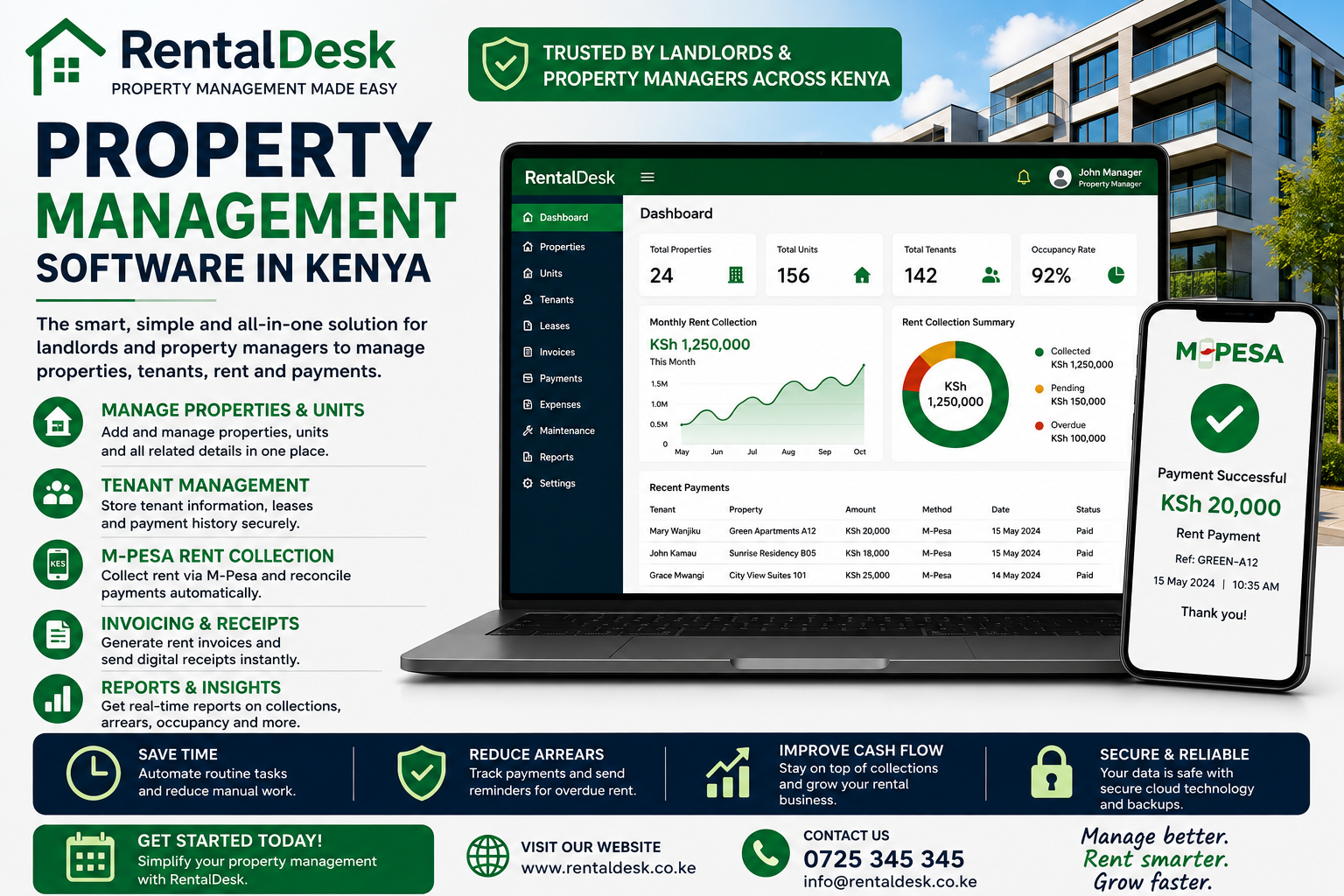
RentalDesk supports workflows around M-Pesa rent payments so collections can be connected to the correct tenant and unit.
This makes it easier to maintain accurate rent records.
Tenant and Lease Records
Property managers can maintain tenant information together with lease and unit details.
Rent Invoices
Rental invoices and due dates can be tracked so managers understand expected collections.
Tenant Balances
Payment records remain connected to tenant accounts, providing clearer visibility into outstanding amounts.
Arrears Tracking
Managers can identify tenants who have paid, partially paid or remain overdue.
Reconciliation
Unmatched or unclear transactions can be reviewed instead of being incorrectly assigned.
Multi-Property Management
Agencies and landlords can organize multiple buildings from a centralized platform.
Owner Reporting
Property managers can maintain clearer records for reporting collections and property activity to owners.
Who Should Use Property Management Software Kenya?
A property management system can be useful for:
- Individual landlords
- Property managers
- Real estate agencies
- Estate managers
- Apartment owners
- Commercial property managers
- Student accommodation managers
- Property management companies
- Diaspora property owners
- SACCOs managing rental property
- Organizations managing staff housing
- Owners managing multiple rental buildings
The greater the number of tenants and properties, the more valuable automation and centralized records become.
How to Choose the Best Property Management Software Kenya
Before selecting software, consider your actual operational requirements.
Does It Support M-Pesa?
For Kenyan rental businesses, this should be an important consideration.
Ask how payments are captured, matched and reconciled.
Can It Handle Partial Payments?
Tenants do not always pay their entire balance at once.
The platform should maintain an accurate outstanding balance after each payment.
Can It Manage Multiple Properties?
If your portfolio is expanding, choose software capable of supporting multiple buildings and units.
Does It Track Arrears?
Outstanding rent should be easy to identify.
Can It Generate Useful Reports?
Software should provide information that helps property managers make decisions, not simply store data.
Is It Easy for Your Team to Use?
Complex software that staff avoid using will not solve operational problems.
Choose a system that fits your team’s daily workflow.
Can It Scale?
Consider where your rental portfolio will be in two or three years, not only its current size.
Benefits of Property Management Software Kenya
Moving from manual rental management to a centralized system can provide several benefits.
Better Rent Visibility
Know which tenants have paid and which accounts require follow-up.
Faster Reconciliation
Structured payment records reduce time spent searching through M-Pesa messages.
Better Tenant Records
Keep rental information organized around the correct tenants and units.
Improved Arrears Management
Identify outstanding balances earlier.
Better Owner Reporting
Give property owners clearer information about their properties.
Easier Multi-Property Management
Manage multiple buildings without creating independent spreadsheets for every property.
More Organized Operations
Keep payments, tenants, properties and reporting connected.
Property Management Software in Nairobi
Nairobi has a large and diverse rental market covering apartments, commercial properties, student housing, estates and mixed-use developments.
Property managers operating across areas such as Westlands, Kilimani, Kileleshwa, South B, South C, Kasarani, Embakasi, Ruaka and surrounding areas can benefit from centralized rental management.
Instead of maintaining separate records for every building, property management software can create one portfolio view.
The same principle applies to property managers operating in Mombasa, Nakuru, Kisumu, Eldoret, Kiambu and other parts of Kenya.
Frequently Asked Questions About Property Management Software Kenya
What is property management software?
Property management software is a digital system that helps landlords and property managers organize properties, tenants, rent payments, invoices, balances, maintenance and reporting.
What is the best property management software in Kenya?
The best solution depends on the size and requirements of your portfolio. Kenyan landlords should particularly consider M-Pesa workflows, tenant management, rent invoicing, arrears tracking, reconciliation, reporting and multi-property support.
RentalDesk is designed specifically around these Kenyan rental-management workflows.
Can property management software collect rent through M-Pesa?
Property management platforms can integrate or support M-Pesa-based rent collection workflows, allowing digital payments to be connected with tenant records.
Can I manage multiple properties using RentalDesk?
Yes. RentalDesk is designed for landlords and property managers who need to organize multiple properties, units and tenants centrally.
Can property management software track rent arrears?
Yes. Rent-management software can maintain tenant balances and help property managers identify unpaid, partially paid and overdue accounts.
Is property management software suitable for small landlords?
Yes. Small landlords can benefit from organized tenant and payment records, particularly when manual administration starts taking too much time.
Can property management software manage commercial properties?
Property-management systems can be used for different rental portfolios, including residential and commercial properties, depending on the functionality offered by the platform.
Is M-Pesa important when choosing property management software in Kenya?
For landlords collecting rent through M-Pesa, payment capture and reconciliation are important considerations. A system should make it easy to connect incoming payments with the correct tenant and unit.
Move From Spreadsheets to Smarter Property Management
The rental business becomes increasingly difficult to manage when properties, tenants, payments and reports are scattered across Excel sheets, notebooks, WhatsApp conversations and M-Pesa messages.
The purpose of property management software Kenya is to bring these activities together.
With RentalDesk, Kenyan landlords and property managers can organize properties, units, tenants, rent invoices, M-Pesa payments, balances, arrears, reconciliation and reporting from a centralized rental management platform.
Whether you manage a few rental units or a growing portfolio of properties, the goal remains the same:
Know who paid. Know who owes. Know what requires attention.
Start Managing Your Properties with RentalDesk
Stop spending unnecessary time manually matching M-Pesa transactions and updating disconnected spreadsheets.
Use RentalDesk to build a more organized rental operation with centralized tenant records, rent tracking, M-Pesa workflows, arrears management and property reporting.
Get started with RentalDesk today and manage your rental properties with greater clarity and control.