Table of Contents
ToggleBest Landlord Software Thika Road: The Ultimate Guide for Modern Property Owners in 2026
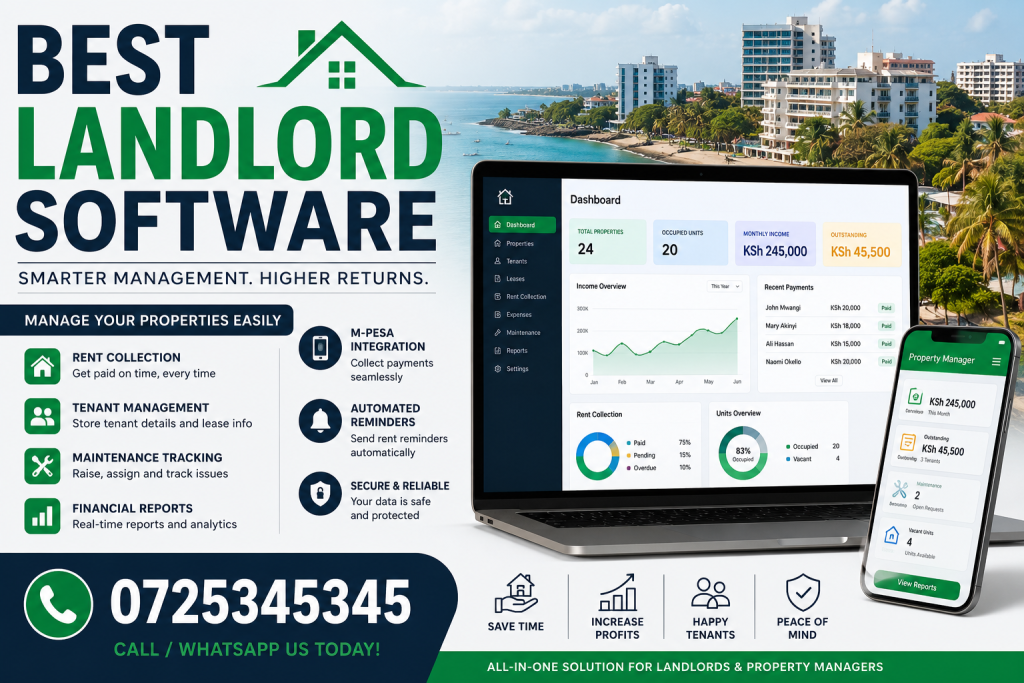
Table of Contents
- Introduction
- Why Property Management Is Changing Along Thika Road
- Key Features of Modern Landlord Software
- Benefits for Landlords and Property Managers
- How to Choose the Right Platform
- Common Challenges in Property Management
- The Future of Property Management in Kenya
- Conclusion
1. Introduction
Property ownership along Thika Road has grown rapidly over the past decade, driven by urban expansion, student housing demand, and commercial investments. Managing these properties manually, however, has become increasingly difficult. This is where Best Landlord Software Thika Road comes in as a game-changer for modern landlords.
Many landlords are now shifting from traditional spreadsheets and paperwork to digital systems that automate rent collection, tenant management, and maintenance tracking. Best Landlord Software Thika Road is at the center of this transformation, offering a streamlined solution for landlords who want efficiency and accuracy.
In today’s fast-paced real estate environment, Best Landlord Software Thika Road is not just a convenience—it is becoming a necessity. Whether you own a single apartment or multiple rental units, Best Landlord Software Thika Road helps simplify operations and reduce human error.
The rise of smart property tools means landlords can now manage their investments from anywhere. With Best Landlord Software Thika Road, property owners gain control, transparency, and improved tenant relationships.
2. Why Property Management Is Changing Along Thika Road
The real estate corridor along Thika Road is one of the fastest-growing residential and commercial zones in Kenya. With increasing demand for rental housing, landlords face more responsibilities than ever before.
Traditional methods of management often lead to missed rent payments, poor communication, and maintenance delays. Best Landlord Software Thika Road solves these challenges by digitizing every aspect of property management.
One major reason landlords are adopting Best Landlord Software Thika Road is the need for automation. Manual tracking is time-consuming and prone to errors. By using Best Landlord Software Thika Road, landlords can automate reminders, receipts, and reporting.
Another factor driving adoption is tenant expectations. Modern tenants expect digital communication and instant responses. Best Landlord Software Thika Road bridges this gap effectively, ensuring smooth interaction between landlords and tenants.
As competition increases along Thika Road, landlords using Best Landlord Software Thika Road are gaining a competitive advantage over those still relying on outdated systems.
3. Key Features of Modern Landlord Software
One of the reasons Best Landlord Software Thika Road is gaining popularity is its wide range of features designed specifically for property owners.
Automated Rent Collection
With Best Landlord Software Thika Road, landlords can automate rent reminders and receive payments digitally. This reduces delays and improves cash flow.
Tenant Management
Best Landlord Software Thika Road allows landlords to store tenant information, lease agreements, and payment history in one centralized system.
Maintenance Tracking
Maintenance requests can be logged and tracked efficiently using Best Landlord Software Thika Road, ensuring quick resolution of issues.
Financial Reporting
Landlords using Best Landlord Software Thika Road can generate instant financial reports to understand income and expenses.
Communication Tools
Built-in messaging systems in Best Landlord Software Thika Road make it easy to communicate with tenants in real time.
These features make Best Landlord Software Thika Road a complete solution for modern property management.
4. Benefits for Landlords and Property Managers
Property ownership is becoming increasingly complex, especially in fast-growing urban zones like Thika Road. With rising tenant expectations, increased competition, and tighter financial tracking requirements, landlords and property managers need smarter tools to stay efficient and profitable. This is where modern property management systems—often referred to as Best Landlord Software Thika Road solutions—deliver major advantages.
Below is a detailed breakdown of the key benefits landlords and property managers gain when they adopt digital property management systems.
1. Improved Rent Collection Efficiency
One of the biggest challenges landlords face is delayed or missed rent payments. Traditional methods rely on manual reminders, physical receipts, or cash handling, all of which are prone to delays and errors.
With digital systems, rent collection becomes automated. Tenants receive reminders before due dates, and payments can be made through mobile money or bank integrations. This creates a smoother cash flow cycle and reduces follow-ups.
For landlords managing multiple units along Thika Road, this efficiency is a game-changer.
2. Better Financial Tracking and Transparency
Keeping accurate financial records is essential for any property business. Manual bookkeeping often leads to inconsistencies or missing data.
Modern property systems automatically record every transaction, including rent payments, deposits, penalties, and maintenance costs. This allows landlords to generate real-time financial reports showing:
- Monthly income
- Outstanding balances
- Expense breakdowns
- Profit and loss summaries
This level of transparency helps landlords make informed investment decisions and plan future expansions.
3. Reduced Administrative Workload
Property management involves a lot of repetitive tasks such as issuing receipts, sending reminders, updating tenant records, and tracking leases.
Digital systems significantly reduce this workload by automating routine processes. This allows landlords and property managers to focus on higher-value tasks such as property improvement, tenant acquisition, and portfolio growth.
Instead of spending hours on paperwork, everything can be managed from a single dashboard.
4. Improved Tenant Communication
Poor communication between landlords and tenants often leads to misunderstandings, disputes, and delayed issue resolution.
Modern property platforms provide integrated communication tools such as messaging systems, automated notifications, and email alerts. This ensures tenants are always informed about:
- Rent due dates
- Maintenance updates
- Lease renewals
- Policy changes
Clear communication builds trust and improves tenant retention rates.
5. Faster Maintenance and Issue Resolution
Maintenance requests are a common part of property management. Without a proper system, these requests can easily be forgotten or delayed.
Digital platforms allow tenants to submit maintenance issues directly through an app or portal. Landlords or property managers can then assign tasks to technicians and track progress in real time.
This ensures faster response times, improved property conditions, and higher tenant satisfaction.
6. Enhanced Record Keeping and Organization
Keeping physical files for each tenant or property can become overwhelming, especially as portfolios grow.
Digital systems store all important documents in one centralized location, including:
- Lease agreements
- Payment histories
- Identification documents
- Inspection reports
This makes it easy to retrieve information instantly when needed, reducing stress and improving efficiency.
7. Increased Scalability for Property Portfolios
As landlords acquire more properties, manual management becomes unsustainable. Systems designed for property management allow seamless scaling without increasing workload proportionally.
Whether managing 5 units or 500, the system structure remains efficient and organized. This makes expansion easier and less risky.
8. Better Legal Compliance and Documentation
Landlords must comply with various rental regulations, tax requirements, and tenancy agreements. Missing documentation can lead to legal disputes or penalties.
Digital systems help ensure compliance by maintaining proper records and generating legally valid reports. This reduces risk and improves accountability.
9. Improved Tenant Retention
Happy tenants are more likely to renew leases, reducing vacancy rates and marketing costs.
By offering faster responses, transparent billing, and reliable communication, landlords create a positive tenant experience. This leads to higher retention and stable long-term income.
10. Real-Time Insights and Decision Making
Data-driven decision-making is one of the biggest advantages of modern property systems.
Landlords can instantly view occupancy rates, revenue trends, and maintenance costs. These insights help in:
- Setting competitive rental prices
- Identifying underperforming properties
- Planning renovations or upgrades
- Forecasting income trends
11. Reduced Risk of Fraud and Errors
Manual systems are vulnerable to human error and even fraud, especially when cash payments and handwritten records are involved.
Digital platforms reduce these risks by automating calculations and maintaining secure audit trails of every transaction.
12. Convenience and Remote Access
One of the most powerful benefits is the ability to manage properties from anywhere.
Whether a landlord is in Nairobi, traveling, or managing overseas investments, all property data is accessible via mobile or desktop. This flexibility is especially valuable for modern investors.
Property management is evolving rapidly, and landlords who embrace digital tools gain a clear advantage. From improved rent collection and better communication to enhanced financial tracking and scalability, the benefits are significant.
In growing real estate corridors like Thika Road, adopting modern systems is no longer optional—it is essential for long-term success and sustainable property growth.
5. How to Choose the Right Platform
Selecting the right system is crucial for success. Not all software solutions are the same, so landlords must evaluate carefully before choosing Best Landlord Software Thika Road.
Key factors to consider include ease of use, affordability, customer support, and scalability. The ideal Best Landlord Software Thika Road solution should be user-friendly and accessible on mobile devices.
Security is also important. Landlords should ensure that Best Landlord Software Thika Road protects tenant and financial data with strong encryption.
Integration with payment systems is another key factor. A reliable Best Landlord Software Thika Road should support mobile money and bank transfers commonly used in Kenya.
By evaluating these features, landlords can confidently choose Best Landlord Software Thika Road that fits their needs.
6. Common Challenges in Property Management
Despite its benefits, property management still faces several challenges. However, Best Landlord Software Thika Road helps address many of these issues.
Late rent payments are a common problem, but Best Landlord Software Thika Road reduces this through automated reminders.
Another challenge is poor record keeping. With Best Landlord Software Thika Road, all records are stored digitally and can be accessed anytime.
Maintenance delays are also common in traditional systems. Best Landlord Software Thika Road ensures that maintenance requests are tracked and resolved quickly.
Communication gaps between landlords and tenants are minimized when using Best Landlord Software Thika Road.
These improvements make Best Landlord Software Thika Road essential for efficient property management.
7. The Future of Property Management in Kenya
The Future of Property Management in Kenya
The property market in Kenya is entering a new era shaped by rapid urbanization, technology adoption, and changing tenant expectations. In high-growth corridors such as Thika Road, the traditional way of managing rentals is steadily giving way to smarter, data-driven, and more automated systems. The future of property management is no longer about paperwork and manual tracking—it is about efficiency, intelligence, and accessibility.
1. Full Digital Transformation of Rentals
One of the biggest shifts happening in Kenya’s real estate sector is full digitalization. Landlords are increasingly moving away from notebooks, Excel sheets, and manual receipts to integrated property management platforms.
In the near future, nearly all rental operations—from tenant onboarding to rent collection—will be handled digitally. This shift is being accelerated by the growing adoption of solutions like Best Landlord Software Thika Road, which demonstrate how automation simplifies complex property operations.
Digital transformation means landlords will be able to manage entire property portfolios from a single dashboard, reducing human error and improving efficiency.
2. Growth of Mobile Money and Cashless Payments
Kenya is already a global leader in mobile money adoption, and this will continue to shape property management.
Tenants increasingly prefer convenient payment options such as mobile money transfers rather than cash payments. In the future, rent payments will be fully integrated with automated systems that confirm payments instantly, update records in real time, and send receipts automatically.
This eliminates disputes, delays, and reconciliation issues that are common in manual systems.
3. Rise of Artificial Intelligence in Property Management
Artificial intelligence (AI) is expected to play a major role in the future of Kenyan real estate management. AI-powered systems will help landlords:
- Predict rental income trends
- Identify tenants likely to default
- Recommend optimal rental pricing
- Forecast maintenance needs
Instead of reacting to problems, landlords will be able to prevent them before they occur. This predictive capability will make property investment far more stable and profitable.
4. Smart Maintenance and IoT Integration
The future will also introduce smart property maintenance systems powered by the Internet of Things (IoT). Sensors in buildings will be able to detect issues such as water leaks, electricity faults, or security breaches in real time.
Maintenance requests will no longer depend solely on tenant reporting. Instead, systems will automatically detect and log issues, allowing faster resolution and reduced property damage.
This will significantly increase property value and tenant satisfaction.
5. Increased Transparency and Data-Driven Decisions
As competition increases, landlords will rely more heavily on data analytics. Property management systems will provide insights into occupancy rates, payment behavior, maintenance costs, and tenant turnover.
This data will help landlords make smarter decisions such as:
- When to increase rent
- Which properties to upgrade
- How to reduce vacancies
- Where to invest next
Data-driven decision-making will become the standard approach for serious investors.
6. Improved Tenant Experience as a Priority
In the future, tenant satisfaction will become a key differentiator in the rental market. Tenants will expect:
- Instant communication with landlords
- Online rent payment systems
- Fast maintenance response
- Transparent billing and contracts
Landlords who fail to meet these expectations risk high tenant turnover. Systems like Best Landlord Software Thika Road already demonstrate how improved communication and automation lead to better tenant relationships.
7. Expansion of Property Technology (PropTech) in Kenya
Kenya’s PropTech sector is expected to grow significantly in the coming years. Startups and software providers are developing tools tailored specifically to local challenges such as mobile payments, informal rental markets, and multi-unit housing.
This growth will make property management tools more affordable, accessible, and localized for Kenyan landlords, even in smaller towns outside major cities.
8. Regulatory Digitization and Compliance
Government agencies are also expected to digitize rental regulations and tax compliance systems. This means landlords will increasingly be required to maintain proper digital records of tenants, income, and property transactions.
Digital property systems will help landlords stay compliant automatically, reducing legal risks and simplifying tax reporting.
9. Remote Property Management Becomes the Norm
One of the most significant changes will be the ability to manage properties from anywhere in the world. Whether a landlord is in Nairobi, Mombasa, or abroad, they will be able to control their entire portfolio remotely.
This is especially important for investors who own multiple properties in different locations. Remote access ensures continuous oversight without physical presence.
10. The Shift Toward Professional Property Management
As the industry matures, more landlords will transition from informal management to professional property management structures. This includes using standardized systems, formal contracts, and automated workflows.
This professionalization will improve trust in the rental market and attract more institutional investors into Kenya’s real estate sector.
The future of property management in Kenya is clearly digital, automated, and data-driven. Traditional methods are gradually becoming obsolete as landlords embrace smarter tools that improve efficiency, transparency, and profitability.
In fast-growing regions like Thika Road, adopting systems such as Best Landlord Software Thika Road is not just an upgrade—it is a strategic move toward future-proofing rental businesses.
Landlords who embrace these changes early will enjoy smoother operations, higher returns, and stronger tenant relationships, while those who delay risk falling behind in an increasingly competitive market.
8. Conclusion
Property management is undergoing a major shift, especially in high-growth urban areas like Thika Road where rental demand, tenant expectations, and property investment activity continue to rise. In this environment, relying on manual methods—paper records, spreadsheets, or informal communication—is no longer efficient or sustainable for landlords and property managers who want to remain competitive.
The core takeaway is that modern property management systems are no longer just “nice-to-have” tools; they have become essential infrastructure for running a profitable and organized rental business. By adopting digital solutions such as Best Landlord Software Thika Road, landlords move from reactive management to proactive control of their properties.
One of the most important outcomes of this shift is financial stability. Automated rent collection, accurate record keeping, and real-time reporting reduce inconsistencies that often lead to cash flow problems. Instead of guessing who has paid or manually reconciling accounts at the end of the month, landlords gain clear visibility into their income and expenses at any moment. This clarity directly improves decision-making and long-term planning.
Another major impact is operational efficiency. Property owners often underestimate how much time is lost on repetitive administrative tasks—sending reminders, issuing receipts, tracking maintenance requests, and updating tenant information. When these processes are automated, landlords free up significant time and mental energy, allowing them to focus on expanding their portfolios or improving property value.
Tenant relationships also improve significantly. In competitive rental markets, tenants are no longer just looking for shelter—they expect responsiveness, transparency, and convenience. Digital systems enable faster communication, structured complaint handling, and clear billing, which collectively build trust. Over time, this leads to higher tenant satisfaction and reduced turnover, which is critical for maintaining consistent rental income.
Scalability is another key advantage that shapes the future of property investment. As landlords acquire more units, manual systems become increasingly difficult to manage. Digital platforms remove this limitation by centralizing operations into a single dashboard, making it possible to manage multiple properties with the same ease as managing one. This opens the door for landlords to grow their portfolios without proportionally increasing workload or operational stress.
Risk reduction is equally important. Errors in rent tracking, missing documents, or poor record keeping can lead to disputes, financial losses, or even legal complications. A structured digital system minimizes these risks by maintaining accurate, time-stamped records of all transactions and interactions. This creates accountability and protects both landlords and tenants.
Ultimately, the transition toward digital property management reflects a broader change in the real estate industry: one driven by efficiency, data, and automation. Landlords who adopt these systems early position themselves ahead of the curve, benefiting from smoother operations, stronger tenant relationships, and improved profitability.
In conclusion, the future of rental property management is undeniably digital. For landlords operating in fast-developing corridors like Thika Road, embracing tools such as Best Landlord Software Thika Road is not just about convenience—it is about building a sustainable, scalable, and future-ready property business that can thrive in an increasingly competitive market.